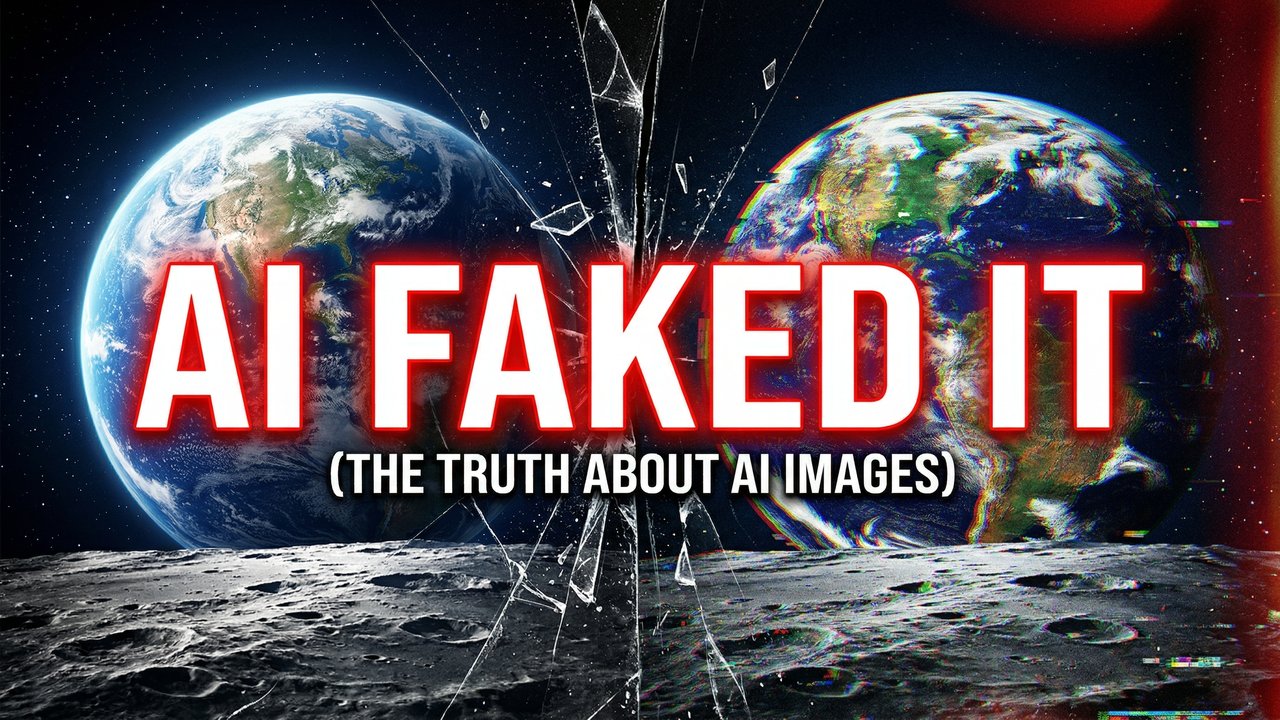
Four astronauts just flew around the Moon. For real. With Nikon cameras, an iPhone 17, and a twelve-year-old GoPro strapped to the outside of the capsule. And within 72 hours, the most shared photo of the entire mission was completely fabricated.
Not by conspiracy theorists in a basement. By Google's own AI.
This is the story of how artificial intelligence simultaneously threatened and defended one of humanity's greatest achievements - and what it means for every image you'll ever see again.
What Actually Happened
On April 1st, 2026, Commander Reid Wiseman, Pilot Victor Glover, Mission Specialist Christina Koch, and Mission Specialist Jeremy Hansen launched from Kennedy Space Center aboard the Orion spacecraft. Their mission: Artemis II, the first crewed lunar flyby in over fifty years. The last time humans traveled this far from Earth was December 1972, when Apollo 17 closed out an era.
Nine days later, on April 10th, 2026, all four astronauts splashed down safely in the Pacific Ocean near San Diego at 8:07 PM Eastern. The crew had swung around the far side of the Moon on April 6th, exited the lunar sphere of influence on the 7th, and made it home in one piece. Nine days, one hour, and thirty-two minutes of history.
NASA documented every moment. The crew shot photos and video with a Nikon D5 DSLR, a Nikon Z9 mirrorless camera, an iPhone 17 Pro Max, and a GoPro that was nearly twelve years old. Every image carried full EXIF metadata - camera model, timestamp, lens data. Every file traceable. Every photo verifiable.
That's the real story. But it's not the story most people saw.
The Flood
While the crew was still in deep space - before they'd even made it home - a different kind of content started flooding social media. AI-generated images of the Moon. AI-generated videos of astronauts floating on wires. AI-generated footage of crew members sitting in harnesses in front of green screens.
And here's the one that really stung: the most widely shared "Artemis II" photo in the 72 hours after the flyby was a stunning Earthrise through the spacecraft window. It was beautiful. It was cinematic. It was everything you'd want from a once-in-a-generation space photo.
It was also completely fake.
The image was generated by AI, and it was modeled on one of the most famous photographs in human history: the 1968 Apollo 8 Earthrise captured by astronaut William Anders on Christmas Eve. The AI version replicated the composition, the framing through the spacecraft window, and even matched the cloud patterns from the original. It was good enough to stop your scroll. Good enough to make you feel something. And good enough to make you share it without a second thought.
Millions of people did exactly that. Most of them had no idea the image they were sharing wasn't real.
The Recursive Loop
Here's where the story gets genuinely wild. And I want you to stay with me on this because the irony is almost too perfect.
Conspiracy theorists began sharing photos that showed the Artemis II astronauts wearing harness systems in front of a green screen. The message was clear: the mission was faked. NASA was lying. The footage was staged. And here was the "proof."
So the BBC's Verify team did what good journalists do. They ran those green screen photos through Google's SynthID detection tool - a system specifically designed to read embedded watermarks on AI-generated content created by Google's own models.
The watermark lit up instantly. Made by Gemini. Confirmed in seconds.
Think about what just happened there. Someone used Google's Gemini AI to generate photos of astronauts in a studio. Then they shared those AI-fabricated images as evidence that a real space mission was staged. And then Google's own detection tool caught Google's own AI as the source of the fabrication.
The weapon and the shield came from the same forge.
This isn't a metaphor. This literally happened. AI created fake evidence to discredit a real achievement. And AI caught it. We're living in a world where the same technology that threatens truth is also the only thing fast enough to defend it.
The False Positive Problem
But the conspiracy circus didn't stop with obviously fake photos. Something more subtle - and in some ways more dangerous - happened during a live CNN interview with the astronauts.
Eagle-eyed viewers noticed unusual text artifacts overlaid on a floating gravity toy named "Rise" that the crew had brought aboard. The artifacts looked wrong. They looked digital. They looked like the kind of glitch you'd expect from a poorly rendered AI video.
Social media exploded. People pointed to those artifacts as definitive proof that the CNN interview was AI-generated. Case closed. Smoking gun.
Except it wasn't.
The BBC's Verify team investigated this claim too. Their conclusion: the unusual text artifacts were not a green screen error or a sign of AI fabrication. They were a standard broadcast graphics glitch from the tool used to place text overlays on the live footage. A mundane technical error that had nothing to do with artificial intelligence.
This is the flip side of the deepfake crisis that nobody talks about enough. It's not just that AI can create convincing fakes. It's that the awareness of AI fakes is making people distrust real content. Legitimate broadcast errors get flagged as fabrication. Real footage gets accused of being synthetic. The paranoia itself becomes a weapon.
When every image might be fake, every image is suspect. Including the ones that are real.
The Numbers Behind the Crisis
Let's look at the data, because the scope of this problem is staggering.
A survey of nearly 4,000 U.S. adults found that 82% say their confidence in media has decreased as a direct result of AI-generated content. That's not a small number. That's a supermajority of the public telling you they fundamentally trust visual media less than they did two years ago.
And this didn't start with Artemis II. Twelve percent of Americans already believed NASA didn't land on the moon in 1969. Another 17% were "unsure." Combined, nearly thirty percent of Americans doubted or were uncertain about the original moon landing before AI-generated images even existed.
Now imagine that pre-existing doubt supercharged by technology that can produce photorealistic evidence in seconds.
Before AI, conspiracy theories had a natural throttle. You needed some skill to fake a convincing photograph. You needed time and resources. The barrier to entry was high enough that most fake "evidence" was obviously flawed - blurry, poorly composited, easy for experts to debunk.
That throttle is gone. Today, anyone with a keyboard can type a prompt and generate an image that would fool most casual viewers. The playing field between truth-tellers and fabricators hasn't just shifted. It's been obliterated.
The Engagement Economy
There's a dimension to this that goes beyond ideology and conspiracy theories. It's about economics.
"AI slop farmers" - a term that's emerged to describe content creators who manufacture fake AI content purely for engagement - are deliberately exploiting historic events like Artemis II. They don't necessarily believe the mission was faked. They don't care. What they care about is that a major news event generates attention, and attention generates clicks, and clicks generate revenue.
So they spin up AI-generated "moon footage" - some of it claiming the mission is fake, some of it just producing spectacular but synthetic space imagery - and push it across TikTok, Instagram, X, YouTube, and Facebook. The content is designed to stop your scroll, trigger an emotional reaction, and compel you to share.
And it works. A single BBC Instagram reel about Artemis II conspiracy theories received 32,000 likes and nearly 2,000 comments. The engagement was massive. And that's just one post on one platform from one outlet covering the story. The fake content itself generated orders of magnitude more interaction.
This is the uncomfortable economics of misinformation in the AI era. Truth is slow and expensive. Fabrication is fast and free. And the platforms' engagement algorithms don't distinguish between the two.
The Case Against Panic
Now, I want to be fair here. Because there's a reasonable counterargument to everything I've described, and it deserves real consideration.
Conspiracy theories are not new. Moon landing hoax claims have persisted for fifty-seven years since Apollo 11. The flat earth movement predates the internet. Skepticism of official narratives is woven into human nature. People have always questioned what they're told, and that instinct isn't inherently bad. In fact, healthy skepticism is essential to a functioning democracy.
The argument goes: we've survived conspiracy theories before. We survived them without AI detection tools. We survived them because most people, given enough time and information, eventually land on what's real. The system is self-correcting, even if it's messy.
And there's truth in that. The vast majority of people who saw fake Artemis II footage likely didn't permanently conclude the mission was staged. Most scrolled past. Some shared without thinking, then forgot about it. The hard-core conspiracy believers were going to believe regardless of whether the fake images existed.
There's also the argument that AI detection tools are improving faster than AI generation tools. SynthID caught the Gemini fakes instantly. Detection worked. The system held.
These are valid points. But I think they miss something critical.
Why This Time Is Different
The difference between 1969 and 2026 isn't that people are more gullible. It's that the cost of manufacturing convincing evidence has dropped to effectively zero.
In 1969, if you wanted to fake a photograph convincing enough to support a moon landing conspiracy, you needed access to photography equipment, darkroom skills, an understanding of lighting and perspective, and the time to execute it. The handful of people who tried produced images that experts could debunk relatively easily.
In 2026, you type a sentence. Thirty seconds later, you have a photorealistic image that most people - including many who consider themselves media-literate - can't distinguish from a real photograph.
That's not an incremental change. That's a category shift.
And the speed dynamic matters enormously. Fake content spreads at the speed of social media algorithms. Fact-checking happens at the speed of journalism. By the time a verification team publishes a debunk, the fake has already been shared millions of times. The correction never catches up to the original claim.
This asymmetry - fast fabrication, slow verification - is the defining challenge of the AI misinformation era.
What's Actually Working
But there's good news here, and it's worth spending time on it because the doom narrative isn't the whole picture.
Verification IS working. It's just working differently than it used to.
The BBC's Verify team demonstrated a new model of real-time digital forensics during Artemis II. They didn't just report on the conspiracy theories after the fact. They actively ran suspected fakes through AI detection tools in near-real-time, publishing results within hours rather than days. They also - and this is equally important - debunked false positives. When viewers accused the CNN interview of being AI, the Verify team proved it was a mundane graphics glitch. That kind of balanced analysis builds credibility on both sides of the trust equation.
NASA's approach was equally instructive. They published every photo with full camera metadata - make, model, timestamp, lens settings. This "radical transparency" strategy gave anyone with technical knowledge the ability to independently verify that a photo came from a real camera on a real spacecraft. It's a defense-in-depth approach: you can't fake EXIF data at scale and have it be internally consistent across thousands of images from multiple cameras.
And fact-checking organizations globally mobilized faster than they ever have before. Within days, multiple independent organizations had systematically dismantled the most viral fakes. The infrastructure for verification exists. It's getting faster. It's getting better.
The question isn't whether we can catch fakes. We can. The question is whether we can catch them fast enough to prevent damage.
The SynthID Paradox
There's a deeper philosophical question embedded in the Artemis II story that I think most coverage has missed.
Google's SynthID tool caught Google's Gemini AI generating fake evidence. The same company built both the weapon and the shield. On one hand, this is reassuring - it proves that AI-generated content can be detected and traced. On the other hand, it raises uncomfortable questions about what happens when the generator and the detector aren't made by the same company.
SynthID works because it reads embedded watermarks that Google deliberately places on Gemini-generated content. It's a closed ecosystem. If someone uses an open-source image generator that doesn't embed watermarks, SynthID won't catch it. If someone uses a model from a company that doesn't participate in watermarking standards, the detection chain breaks.
This means the current detection model works best against the most responsible actors - the companies that voluntarily watermark their outputs - and fails against the least responsible ones. That's backwards. The people most likely to generate harmful content are the least likely to use tools that make detection easy.
The long-term solution probably isn't watermarking alone. It's a combination of watermarking, statistical detection methods, metadata verification, and - most importantly - widespread media literacy education. We need all of these layers working together, because no single approach is sufficient.
What History Teaches Us About Truth and Photography
It's worth zooming out for a moment. Photography has always had a complicated relationship with truth.
The first doctored photographs appeared within a decade of photography's invention. During the Civil War, photographers routinely rearranged battlefield scenes for dramatic effect. Stalin's regime infamously airbrushed political enemies out of official photographs. The tools were crude by modern standards, but the intent was the same: manipulate visual evidence to shape perception.
What changed over the past 150 years wasn't the desire to fake photos. It was the skill barrier. Each generation of manipulation tools made faking easier. Photoshop democratized photo editing in the 1990s. Smartphone apps made it casual in the 2010s. And generative AI made it effortless in the 2020s.
But here's what's genuinely new about the AI era. Previous generations of photo manipulation required starting with a real image. You had to take or find a photo, then alter it. With generative AI, there's no source image at all. The entire visual is synthesized from a text prompt. There's nothing to trace back to. No original to compare against. No camera, no lens, no film grain, no EXIF data.
That's the qualitative leap that makes this moment different from every previous crisis of photographic trust. We've moved from "altered reality" to "manufactured reality." And our collective instincts for evaluating images - instincts developed over decades of living with photography - haven't caught up.
The Platform Responsibility Question
There's one more dimension that doesn't get enough attention: what role should the platforms themselves play?
Right now, TikTok, Instagram, X, YouTube, and Facebook all serve as distribution channels for AI-generated content. Their algorithms don't meaningfully distinguish between verified footage and synthetic media. An AI-generated Earthrise and a real NASA photograph compete on equal terms in the feed. The algorithm optimizes for engagement, and fake content is often more engaging than real content because it's designed to be.
Some platforms have introduced AI content labels. But they're inconsistent, easy to circumvent, and rarely applied to content that crosses platform boundaries. A video generated on one service and uploaded to another loses whatever labeling the original platform applied.
The harder question is whether platforms should be responsible for detection at all. The scale of the problem is staggering - billions of images are uploaded daily. Automated detection at that volume is imperfect and expensive. False positives would flag legitimate content. False negatives would let harmful fakes through.
There's no clean answer here. But the current model - where platforms profit from engagement driven by fabricated content while offloading verification costs to under-funded journalism organizations - isn't sustainable. Something's going to give. The Artemis II episode might be the catalyst that forces that conversation into the open.
What You Can Actually Do
This isn't just a problem for journalists and fact-checkers. Every person with a social media account is a node in the information network. Every share, every repost, every reaction amplifies content - real or fake. Here's what actually helps.
Pause before you share. This is the single highest-impact action you can take. When a breathtaking image crosses your feed - a moonrise, a breaking news photo, anything that makes you stop scrolling - don't immediately share it. Take ten seconds to ask: where did this come from?
Check the source. Is the image from an official channel? A verified account? An organization with a track record? Or is it from a random account with a generic name that was created last month? Official channels like NASA publish images with verifiable metadata. Random engagement-farming accounts don't.
Be suspicious of perfection. Real photographs from space are stunning, but they're also imperfect. They have lens artifacts, slightly off framing, uneven lighting. AI-generated images tend to be almost too perfect - too cinematic, too dramatic, too exactly what you'd expect. Counterintuitively, if an image looks like it belongs in a movie, that's a reason to verify it, not share it.
Understand false positives. Not every visual glitch means AI. Broadcast errors happen. Compression artifacts happen. Unusual lighting conditions happen. Being skeptical doesn't mean assuming everything is fake. It means withholding judgment until you've checked.
Support verification journalism. Fact-checking teams are doing critical work on shoestring budgets. When you see a well-researched debunk or verification, share that. Amplify the correction, not just the original claim.
The Mirror in Orbit
Here's the thing I keep coming back to. Four astronauts flew around the Moon. They looked back at Earth from a quarter million miles away. They took real photos with real cameras and brought real data back to real scientists.
And the biggest challenge to their achievement wasn't the physics. It wasn't the engineering. It wasn't the 54-year gap since the last time humans left low Earth orbit.
It was us. Our feeds. Our algorithms. Our willingness to share without verifying.
The astronauts didn't just orbit the Moon. They gave us a mirror. And that mirror is showing us exactly how we process information in 2026 - how easily we're swayed by a compelling image, how quickly we share before thinking, and how urgently we need to upgrade our relationship with visual media.
We went to the Moon. AI said we didn't. And the truth won.
But it only won because people did the work. Journalists ran the detection tools. NASA published the metadata. Fact-checkers dismantled the fakes one by one.
The next time you see something that stops your scroll, remember: the most powerful verification tool on the planet isn't an algorithm. It's you, choosing to pause for ten seconds before you hit share.
Be one of those people. The truth is counting on it.