Fatih Birol, the agency's chief, said it was more serious than the crises of 1973, 1979, and 2022 combined.
And here is the part nobody in Western energy policy wants to say out loud: this crisis is doing more for clean energy adoption than three decades of climate summits ever did. Renewables already accounted for 85.6% of all new energy capacity installed worldwide in 2025, according to IRENA. The Hormuz blockade just turned that trend into a stampede.
But stampedes have winners. And the winner here is not Europe. It is not the United States. It is China. Beijing has spent over a decade becoming the world's largest installer of solar and wind capacity. Chinese companies dominate the supply chains for panels, turbines, batteries, and electric vehicles. When the world suddenly needs to buy energy independence, China is, as Forbes put it, "by far the cheapest producer and most accessible trade partner."
I think this conflict will be remembered less for its military outcomes and more for the energy map it redraws. Here is the framework for understanding why.
The Chokepoint Inversion
Call it the Chokepoint Inversion. For 50 years, the global energy system concentrated risk in a handful of maritime corridors. The Strait of Hormuz. The Suez Canal. The Malacca Strait. Fossil fuels required moving molecules through militarized water. Every barrel of oil was a geopolitical liability dressed up as an economic asset.
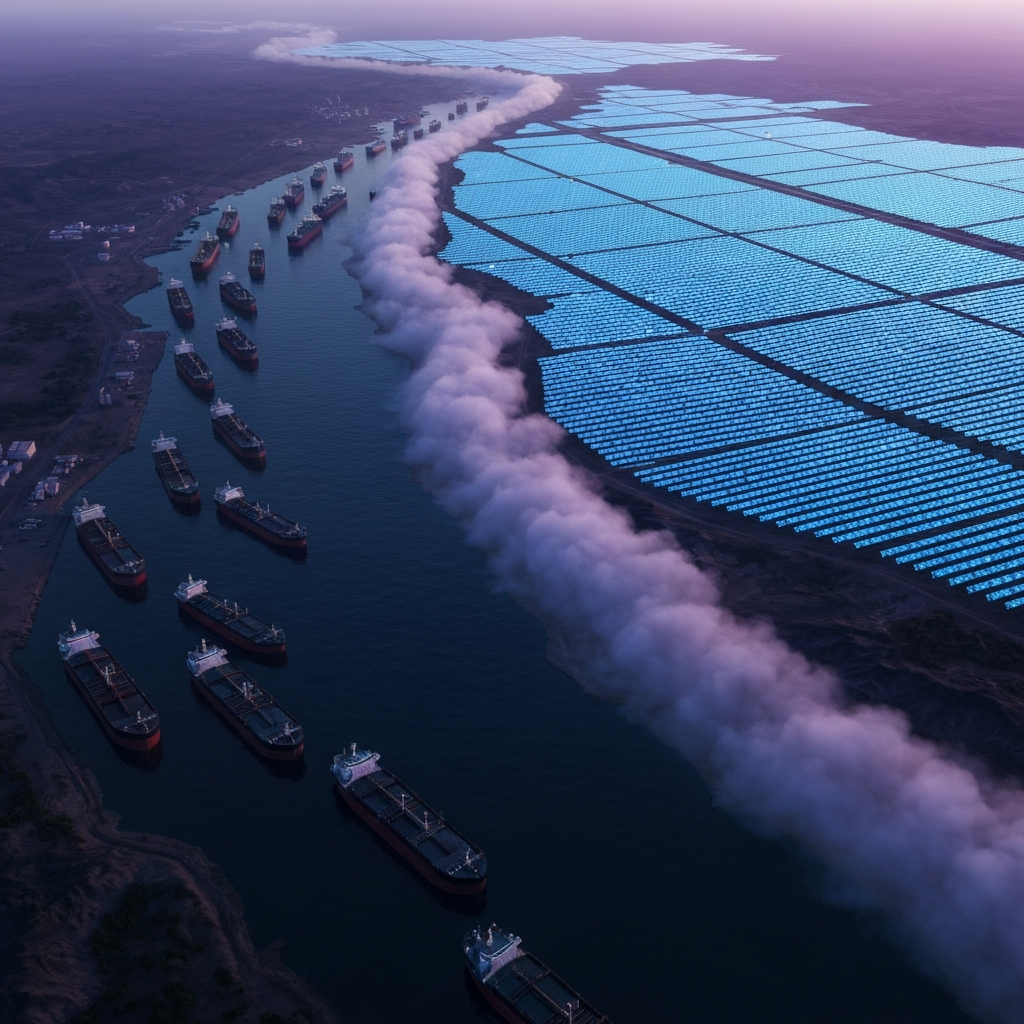
The Chokepoint Inversion is what happens when the cost of that liability finally exceeds the cost of switching. Solar panels do not need to transit a strait. Wind turbines do not require naval escorts. Batteries manufactured in Guangdong can ship from any port. The energy itself, once installed, is domestic. It is local. It is sovereign.
The inversion works like this: every dollar of war premium on oil becomes a dollar of subsidy for renewables. It is a price signal screaming at every finance ministry on earth to buy solar, buy wind, buy storage. Over 90% of new renewable projects are already cheaper than fossil fuel alternatives, according to UN analysis from early 2026. The war premium widens that gap into a canyon.
The old chokepoints concentrated power in producers. The new chokepoints, if they exist at all, concentrate power in manufacturers. And that is where China sits.
The Asymmetric Advantage Beijing Built in Plain Sight
This is not a story about opportunism. It is a story about compounding. China did not wake up on March 4 and decide to dominate clean energy. Beijing has been the world's largest installer of solar and wind capacity for over a decade. The structural advantage was built slowly, deliberately, and in plain sight. The Hormuz blockade simply made the advantage impossible to ignore.
Consider what is happening on the ground. Iraq sits on massive oil reserves. But Iraq depends on imported natural gas to run its power plants. When the Strait closed, that dependency became an existential vulnerability. Al-Khazali's $2,000 purchase is one household. Multiply it by millions across South Asia, Southeast Asia, the Middle East, and Africa.
Pakistan offers a preview. Distributed solar installations there grew so substantially that analysts estimate the solar boom avoided $12 billion in oil and gas imports even before the Iran war began. Almost 90% of LNG transiting the Strait of Hormuz in 2025 was destined for Asian countries. Those countries are now the most motivated buyers of Chinese clean energy hardware on earth.
The compounding works across three layers. First, manufacturing scale. China produces solar panels and batteries at costs no other country can match. Second, supply chain depth. Raw materials, components, and finished products flow through an integrated Chinese industrial ecosystem. Third, financing. Beijing offers credit terms and infrastructure partnerships that Western competitors cannot replicate at speed.
It is unclear whether Western Hemisphere producers, particularly the United States and Latin America, can ramp fossil fuel exports fast enough to fill the Hormuz gap. But even if they can, they are filling a gap in a system the world is now actively trying to leave. Selling more oil into a market that just learned oil is a strategic vulnerability is not a long-term position. It is a rearguard action.
The contrarian case deserves attention. China itself is a major oil and gas importer. The crisis damages Chinese markets too. War-driven cost hikes on raw materials could inflate clean energy prices. And some countries, notably South Korea, are responding by restarting nuclear and coal plants rather than accelerating renewables. History shows that energy crises sometimes trigger fossil fuel restarts, not green transitions.
My read on this: the short-term pain is real, but the structural math favors China. Every crisis-driven nuclear restart takes 10 to 15 years to deliver electrons. Every coal plant restart locks in fuel import dependency. Solar and wind deploy in months. The IEA's own analysis suggests solar growth in 2025 alone could displace gas-fired electricity equivalent to all LNG exported through the Strait of Hormuz that year. The timeline asymmetry is enormous.
There is a secondary crisis worth naming. QatarEnergy declared force majeure on all exports after the Strait closure. Qatar is a major urea producer. The shutdown triggered a 35% spike in fertilizer costs right as Asia's 2026 Kharif sowing season began. Natural gas shortages via Hormuz restrict roughly 30% of global fertilizer trade. In African economies where food consumes 50% of household income, this is not an energy story. It is a hunger story. And hunger stories create political instability that further accelerates the search for energy sovereignty.
The phrase I keep returning to: only cash is real, the rest is accounting. China is collecting real cash for real hardware that generates real electrons. The petrodollar system, by contrast, is collecting a war premium on a commodity the world now associates with strategic fragility.
2031. Five years from now, the Hormuz blockade will look like the moment the global energy order split in two.
One path leads through molecules. Oil, gas, LNG. These fuels require extraction, refining, shipping, and military protection of transit routes. The countries on this path remain vulnerable to the next Hormuz, the next Suez closure, the next sanctions regime. Their energy costs are structurally volatile.
The other path leads through electrons. Solar, wind, batteries, grid storage. These technologies require manufacturing, installation, and grid integration. The countries on this path face different risks: mineral supply dependencies, grid modernization costs, intermittency challenges. But their energy, once installed, is domestic. No navy required.
By 2031, I expect the global EV fleet will have displaced oil consumption equivalent to several multiples of Iran's total exports. The fleet already avoids consumption equal to 70% of Iran's exports as of early 2026, according to IEA data. That number compounds.
The India-Middle East-Europe Economic Corridor, known as IMEC, will likely be fast-tracked as a bypass for Persian Gulf chokepoints. Small Modular Reactors will attract serious capital from countries that want baseload power without fuel import dependency. Green hydrogen pilot projects will move from PowerPoint to pipeline.
But the biggest shift will be psychological. The Hormuz blockade ended the "just-in-time" energy era. For decades, the global economy treated energy like a logistics problem: get the cheapest molecules from the cheapest source and ship them where needed. That model assumed stable sea lanes and cooperative geopolitics. Both assumptions died in March 2026.
The ceasefire reached on April 2 between the U.S. and Iran may reopen the Strait. But vessel transit volumes are expected to remain far lower than before the war. The structural damage is done. Finance ministries, sovereign wealth funds, and corporate boards now price maritime energy risk differently. That repricing does not reverse when the shooting stops.
China's flywheel keeps spinning. Every panel sold funds the next factory. Every battery exported builds the next supply chain node. Every financing deal creates the next political relationship. The compounding is quiet, steady, and largely invisible to Western media focused on the military conflict.
It is unclear whether the United States will respond with an industrial policy ambitious enough to compete. The 2022 Inflation Reduction Act was a start. But competing with China's clean energy manufacturing base requires a level of sustained investment and political will that American politics has not demonstrated in decades.
The asymmetric bet is this: countries that treat the Hormuz crisis as a temporary disruption and wait for oil markets to normalize will fall behind. Countries that treat it as a permanent signal and invest in domestic clean energy will compound their advantage for a generation. Impermanence is the only constant. The question is whether policymakers have the shoshin, the beginner's mind, to see the old energy order clearly enough to let it go.
What to Build This Weekend
You do not need to be a geopolitical analyst to act on this. The energy transition creates information asymmetries, and information asymmetries create opportunities. Here is what you can do this week.
First, build a market monitoring dashboard. Use Basquio to pull spreadsheet data on energy commodity prices, renewable capacity additions, and Chinese export volumes. Basquio turns raw data into finished analysis decks automatically. Feed it IEA monthly reports and IRENA capacity data. You will have a clearer picture of the transition's pace than most equity analysts.
Second, set up an alert system for supply chain shifts. Use Carly AI as an email-based agent to monitor news feeds and route relevant updates to your inbox. Configure it to flag announcements from QatarEnergy, IRENA, and major battery manufacturers. The goal is to know about structural shifts before they hit mainstream headlines.
Third, stress-test your own energy exposure. If you run a business, map your energy costs as a percentage of revenue. Then model what happens if oil stays above $100 for 18 months. Then model what solar plus storage would cost to install. The math will surprise you. Over 90% of new renewable projects are cheaper than fossil alternatives right now, and the war premium is widening that gap every week.
Fourth, start small. You do not need to build a solar farm. You need to understand the economics well enough to spot opportunities. Read the Columbia Energy Policy analysis on the Iran war's implications for clean energy. Read the IEA's monthly oil market reports. Build your knowledge base one source at a time.
Things will break. Your first dashboard will have bad data. Your alert system will send irrelevant noise. That is normal. Test aggressively. Iterate weekly. The goal is not perfection. The goal is to be 10% better informed than you were last Friday. In a world where 20 million barrels of daily oil supply can vanish overnight, that 10% edge compounds fast.