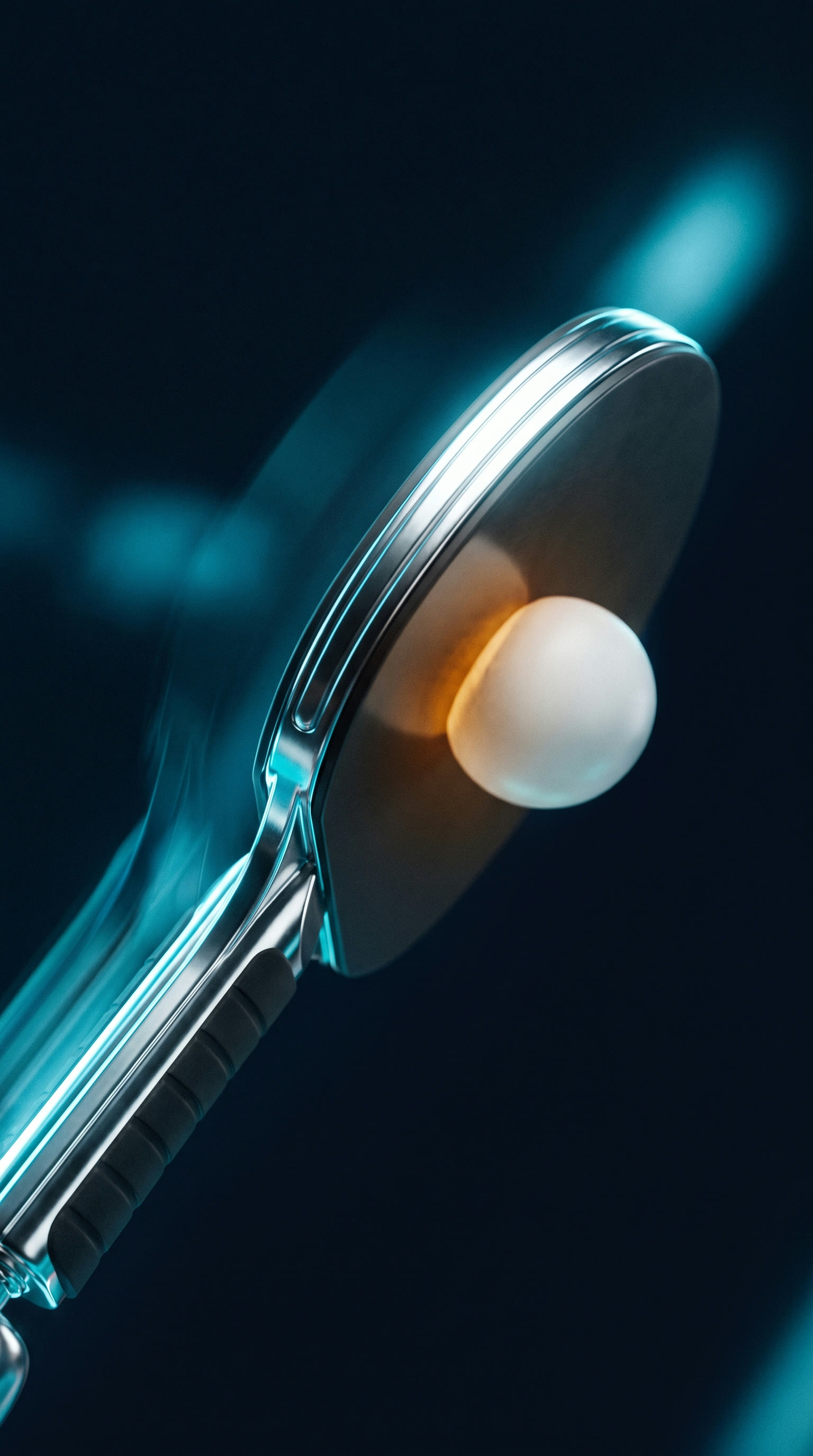
For forty years, roboticists kept hitting the same wall. Chess fell. Go fell. Gran Turismo fell. But put a paddle in a robot’s hand and ask it to rally with a human across a table, and the illusion cracked immediately. That wall came down on April 22, 2026.
Every few years, some lab would publish a “ping-pong robot” paper. The press would call it a milestone. Anyone who had actually played the game would watch the demo and politely look away. The robot was too slow. Or too blind. Or it could return a textbook shot but collapsed the instant a human threw in topspin at 400 rad/s.
Then Sony AI put a different kind of paper on the cover of Nature. The robot is called Ace. It didn’t just hit the ball back. It took at least one game off every professional player it faced - and it did it without ever rehearsing on a real table.
The 20-Millisecond Line
Ace has a custom-built, eight-degree-of-freedom arm made of lightweight alloys. Nine frame-based cameras watch the ball at 200 Hertz. Three event-based vision sensors - custom IMX636 chips from Sony Semiconductor Solutions - read the ball’s spin at up to 700 Hertz, sampling only when something changes so the bandwidth doesn’t get crushed by ambient movement.
From losing five to sweeping three: eleven months, zero real-world fine-tuning between versions.
The whole thing, from photon arriving at the camera to paddle beginning to move, takes 20.2 milliseconds. An elite human table tennis player runs around 230.
The 1983 Problem
The first “robot ping-pong” prototypes appeared in 1983. For the next four decades, the field kept getting two things wrong.
The first was perception. Table tennis is mostly about spin, and spin is what most cameras cannot see. A topspin loop and a backspin chop can leave the paddle with nearly identical position and velocity, and if your robot can’t tell them apart in the first few milliseconds off the bat, it sends the ball back into the net or over the end of the table.
The second was sim-to-real. You cannot train a robot this fast by letting it hit real balls, because the matrix of failures you have to explore is too large and the real world is too slow. You can train it in simulation, where you can play a billion games a day. But the moment you take the trained policy and drop it onto the physical arm, every tiny mismatch between your simulated physics and the real world stacks up, and the whole thing falls apart.
For forty years, the physical world was the one place AI kept losing.
Three Signals Inside the Same Shift
Zero real-world fine-tuning between the simulator and a pro-level match.
The policy controlling every joint was trained entirely in a simulator, then transferred to the physical arm without a single rehearsal on a real table. The privileged-critic trick worked. If it transfers to table tennis, it transfers to any physical system where failure in the real world is expensive.
Milliseconds from photon to paddle - eleven times faster than a human pro.
Nine frame-cameras at 200 Hz and three event-based IMX636 sensors at 700 Hz feed a custom 8-DoF arm built from lightweight alloys. The bottleneck moved from reaction speed to strategy. This is the hardware stack that will ship into rehabilitation robotics, assembly lines, and autonomous systems next.
In March 2026, Ace took at least one game off every pro it faced.
April 2025: lost 5-0 to pros. December 2025: beat one pro. March 2026: took a game off every pro in the room. Eleven months of iteration on the simulator, not the robot. Peter Stone calls it “the first human expert-level demonstration of competitive play in the real world, across any sport.”
The Reframe: Don’t Train on Real Courts
Here’s what Sony AI did differently. Ace never rehearsed on a real table. Not once. The reinforcement learning policy that controls every joint was trained entirely in a simulator, and then transferred to the physical robot with zero fine-tuning on the real system.
The trick was a technique called a “privileged critic.” During training in simulation, the part of the system that scored the robot’s actions had access to information the robot would never get in real life - perfect ball physics, perfect trajectory prediction, perfect knowledge of spin. The policy that actually controlled the arm only ever saw the noisy camera inputs it would see in a real match. But because the critic was omniscient, it could guide the policy to learn how to fuse its own sensor data and predict where the ball would end up without being told how.
This is the kind of idea that sounds obvious in retrospect and took about five years of work to get right. Sony AI built a version of it first in a game - Gran Turismo Sophy, which beat the top human drivers in 2022. Translating it into a physical system was a different problem. Peter Dürr, who led the project from Sony AI’s Zurich office, says out loud in the paper interviews that he didn’t think the privileged critic would work in the physical world. Then he saw the robot rally.
The Receipts
A Nature cover is easy to manufacture. What’s hard is showing up to a tournament and winning under someone else’s rules. Here’s the progression Sony AI published, every match refereed by licensed Japan Table Tennis Association umpires under standard ITTF rules.
Eleven months. Amateur to pro. With zero real-world training data added between versions, other than improvements to the simulator’s physics model.
What Actually Changed on April 22
Every major AI milestone lines up along one axis: where the intelligence lives.
Deep Blue played chess on a board that existed as a discrete grid of squares. AlphaGo played Go on another grid. GT Sophy drove simulated cars in a video game’s physics engine. All of those breakthroughs happened inside representations - tidy, bounded systems where the state of the world was knowable and the action space was finite.
Ace is the first time a reinforcement-learning system hit human-expert level in a sport that happens in physics. Not a grid. Not a game. The actual real-world, 9.4-meters-per-second, spinning-at-100-rotations-per-second, racket-catches-net-and-dribbles physics that elite humans train a decade to master.
Peter Stone, Sony AI’s chief scientist, calls it “the very first human expert-level demonstration of competitive play in the real world, across any sport.” That’s not marketing language. It’s a factual claim with a specific bar.
The Thing to Take Away
The number everyone will remember from this paper is 20.2 milliseconds. The right number is zero - the amount of real-world fine-tuning it took to move from simulation to pro-level match play.
If that transfer works in table tennis, where you need millisecond reaction and real-world physics to cooperate, it works in manufacturing lines where a robot needs to learn a new assembly step overnight without halting production. It works in rehabilitation robotics, where you cannot practice on real patients. It works in any autonomous system where the cost of failure in the real world is high and the cost of failure in simulation is zero.
Sony AI didn’t just build a ping-pong robot. They demonstrated that the gap between simulated intelligence and physical intelligence just closed.
Want the 75-second cinematic version? Watch the Short at the top of this page - or open it on YouTube Shorts.
April 22, 2026 is the day physical intelligence stopped being an asterisk.
For forty years, “AI beats humans” came with an implied footnote: on a grid, in a simulator, inside a video game, anywhere but here. On April 22, 2026, Sony AI took that footnote off the page. Ace learned the whole game in a simulator, then walked onto a real ITTF-regulation table and beat the people who had trained a decade to dominate it. The hardware is new. The architecture is new. But the thing that actually broke is older than the first ping-pong robot: the quiet assumption that the real world is too messy for machine learning to cross into. Save the date. You’ll want it when the next headline lands and you have to explain to someone which direction things started moving.