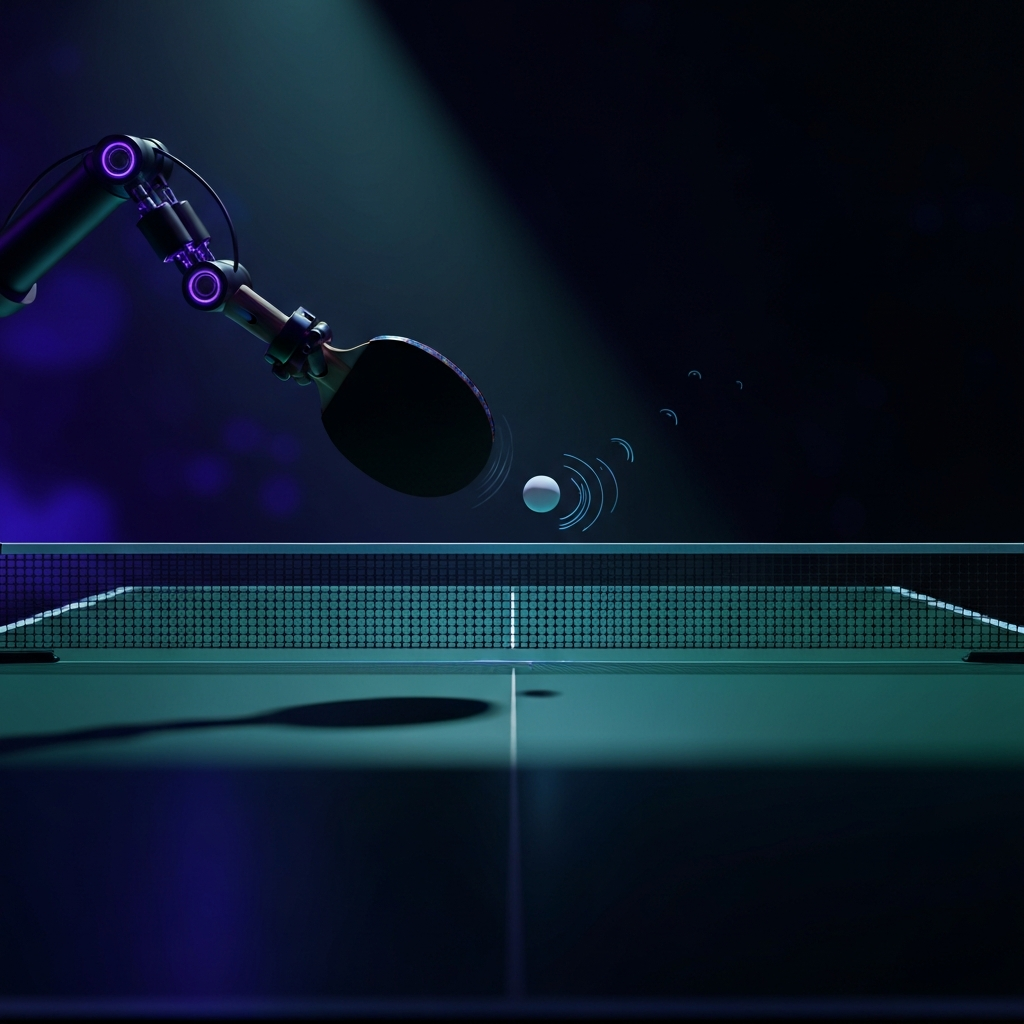
Sony's AI robot Ace just defeated 3 out of 5 elite table tennis players under official International Table Tennis Federation rules. The robot reacts in 20.2 milliseconds. Elite humans need about 230 milliseconds. That is an 11x speed advantage in a sport where milliseconds decide points.
This is the first time an autonomous robot has reached expert human level in a competitive physical sport. Not a board game. Not a video game. A real sport with real physics, real spin, and a real opponent standing across the table. And the implications stretch far beyond ping pong.
Here is what this means for AI, for robotics, and for every industry where machines need to interact with the physical world in real time.
The Crossover Threshold
There is a pattern in AI history that I think deserves a name. Call it the Crossover Threshold. It works like this: AI masters a domain in three stages. First, it plays the game in simulation. Second, it competes with amateurs in the real world. Third, it crosses over and defeats experts under their own rules.
From board games to real-world sport: the crossover timeline compresses.
IBM's Deep Blue crossed the threshold in chess against Garry Kasparov in 1997. DeepMind's AlphaGo crossed it in Go against Lee Sedol in 2016. Sony AI's own GT Sophy crossed it in Gran Turismo racing in 2022, but that was still virtual.
Ace is the first to cross the threshold in a physical sport. That is the framework to remember. Every domain has a Crossover Threshold. The question for any industry is not whether AI will reach it. The question is when.
The pattern also reveals something about pace. Chess took decades of computing progress. Go took years of neural network research. Gran Turismo took months of reinforcement learning. Ace took 5 years of training, but the gap between virtual and physical crossover shrank from decades to just 3 years. The compression is accelerating.
Why 20 Milliseconds Changes Everything
The strategic significance of Ace is not that a robot can play table tennis. It is what the robot had to solve to play table tennis. And those solutions unlock a category of problems that matter far more than sport.
Table tennis is what physicists call a partially observable, highly dynamic environment. The ball travels at speeds exceeding 14 meters per second. It spins in ways that change its trajectory mid-flight. The opponent's intentions are hidden until the moment of contact. And the net introduces random disruptions that no simulation can perfectly predict.
The 20.2 millisecond reaction time is the number that matters most. It is not just fast. It is fast enough to correct course after the ball clips the net. That kind of real-time physical adaptation has never been demonstrated at this level.
Consider what this means beyond sport. Manufacturing assembly lines require sub-50 millisecond adjustments when parts arrive slightly misaligned. Surgical robots need real-time correction when tissue behaves differently than the scan predicted. Autonomous vehicles must react to objects that appear from behind obstacles. Every one of these problems shares the same structure as a table tennis rally: sense, predict, act, correct, all within a window too narrow for human reflexes.
My read on this is that Ace is a proof of concept disguised as a sports story. Ace just showed it is solvable.
But the honest hedge matters too. It is unclear whether Ace's approach scales beyond constrained environments. The robot is as large as the table itself. It lost both matches against the two professional players, Minami Ando and Kakeru Sone. Elite player Mayuka Taira, a 2019 US Open women's singles finalist, noted that Ace's lack of readable emotions made it hard to exploit. But professionals found ways to challenge it with complex serves involving intense spin variations. The Crossover Threshold has been touched, not demolished.
The reinforcement learning approach also carries risk. Training a high-speed robotic arm through trial and error means accepting that the system will make dangerous mistakes during development. Sony's team flagged safety during training as a major concern. Hand-coding every scenario is impossible, which means unsupervised deployment in safety-critical settings remains a distant goal, not a near-term product.
There is also the simulation-to-reality gap. Ace trains in physics simulations that model air resistance and ball dynamics. But subtle real-world phenomena, like humidity affecting ball grip or slight table surface variations, require on-the-fly adjustments that push the system's limits. The robot's rally spin handling still shows a failure rate under certain conditions. Progress is real. Perfection is not.
2031. Zoom out 5 years. Where does this fit?
The compounding pattern in AI milestones tells a clear story. Chess in 1997. Go in 2016. Virtual racing in 2022. Physical sport in 2025. Each crossover required less time than the last. Each one solved a harder version of the same problem: making decisions under uncertainty with incomplete information.
By 2031, I think we will see physical AI systems operating in at least three domains that seem implausible today. The asymmetric advantage belongs to companies that are building the sensing and control infrastructure now, not waiting for the technology to mature.
Sony's trajectory is instructive. They went from GT Sophy in virtual racing to Ace in physical sport in 3 years. That is not a coincidence. It is a flywheel. The reinforcement learning techniques transfer. The simulation environments transfer. The engineering talent transfers. Sony AI Chief Scientist Peter Stone has framed this as building toward "safety-critical and interactive settings." Read that as manufacturing, logistics, healthcare, and defense.
The contrast pair that matters: companies investing in physical AI infrastructure today versus companies waiting for off-the-shelf solutions. The first group is accumulating compounding advantages in data, talent, and engineering knowledge. The second group will buy commoditized tools at commodity margins. Salary buys furniture. Infrastructure investment buys your future.
The Crossover Threshold framework predicts something uncomfortable for incumbents in any physical industry. If your competitive advantage depends on human dexterity, speed, or real-time judgment, the threshold is approaching. Not because robots will replace humans tomorrow. But because the gap between "amusing demo" and "commercially viable" is shrinking from decades to years.
Impermanence applies to competitive moats too. The table tennis professionals who beat Ace today may not beat the December 2025 version. Sony reported that post-submission improvements enabled wins against 4 out of 5 high-skill players, with faster shots and more aggressive edge placement. The system improves. Human reflexes do not.
Three signals inside the same shift
A robot just outreacted elite athletes by an order of magnitude.
Ace's 20.2ms reaction time versus a human's 230ms represents an 11x speed advantage in a sport governed by milliseconds. This is the first autonomous robot to reach expert human level in a competitive physical sport, not a board game or simulation.
Q1 2026 AI funding hit a record that dwarfs prior years.
Global AI startup funding reached $242 billion in a single quarter, with mega-rounds including xAI at $20 billion and Waymo at $16 billion. Capital is flowing toward physical AI infrastructure at a pace that suggests investors see the crossover pattern accelerating.
A major new AI model drops every three days.
March 2026 produced more than 30 major model releases, averaging one every 72 hours. Open-weight models like Gemma 4 (Apache 2.0) are increasingly rivaling proprietary systems, compressing the timeline for physical AI applications.
What to Build This Weekend
You are not building a table tennis robot this weekend. But the principle behind Ace, using AI to handle fast, repetitive decisions so humans can focus on strategy, applies to your work right now.
Step 1: Identify one decision in your workflow that you make more than 10 times per day. Email triage. Content formatting. Data categorization. Scheduling. Pick the most repetitive one.
Step 2: Build a simple automation that handles the 80% case. Use a tool like GenPPT AI to see this in action. Give it a single prompt describing a presentation topic and watch it produce a structured deck. The output will not be perfect. It will be 80% done. That is the point. Your job is the remaining 20%.
Step 3: Test it aggressively. Run 10 real examples through your automation. Note where it breaks. Note where it surprises you. Ace trained for 5 years through trial and error. Your automation will need a weekend of tweaking. Things will break. That is not failure. That is calibration.
Step 4: If you are exploring a new project or brand, run your idea through Naming Cube to generate launch-ready brand names with domain and trademark checks already done. This is the same principle: let the machine handle the high-volume screening so you can focus on the creative judgment call.
The lesson from Ace is not that robots are coming for your job. The lesson is that AI systems get better by doing reps in environments that match reality. Your automations work the same way. Build one tiny thing. Test it against real inputs. Improve it. Repeat.
Start small. Get your reps in. The Crossover Threshold in your own workflow is closer than you think.
Apply the Ace principle: automate the reps, own the strategy.
- Audit your repetitive decisions. Identify one task you perform more than 10 times per day. Email triage, data categorization, scheduling. Pick the most mechanical one and write down its decision rules in plain language.
- Build the 80% automation. Use any low-code tool or AI assistant to handle the predictable cases. Run 10 real examples through it this weekend. Note every failure point. That is not a bug, it is calibration data. Iterate until the tool reliably handles the routine so you focus on the 20% that requires judgment.
- Stress-test against edge cases. Ace trained for 5 years through trial and error in environments that matched reality. Feed your automation the hardest inputs you can find. Document where it breaks, fix the worst failures, and schedule a weekly review. Compounding improvement is the entire game.
The gap between "amusing demo" and commercially viable is now measured in years, not decades.
Sony went from virtual racing AI to physical sport dominance in three years. The Crossover Threshold framework says every industry built on human dexterity, speed, or real-time judgment is on the same clock. With $242 billion in quarterly AI funding and a new major model every 72 hours, the infrastructure buildout is already underway. Companies investing in physical AI sensing and control now are accumulating compounding advantages. The rest will buy commoditized tools at commodity margins.