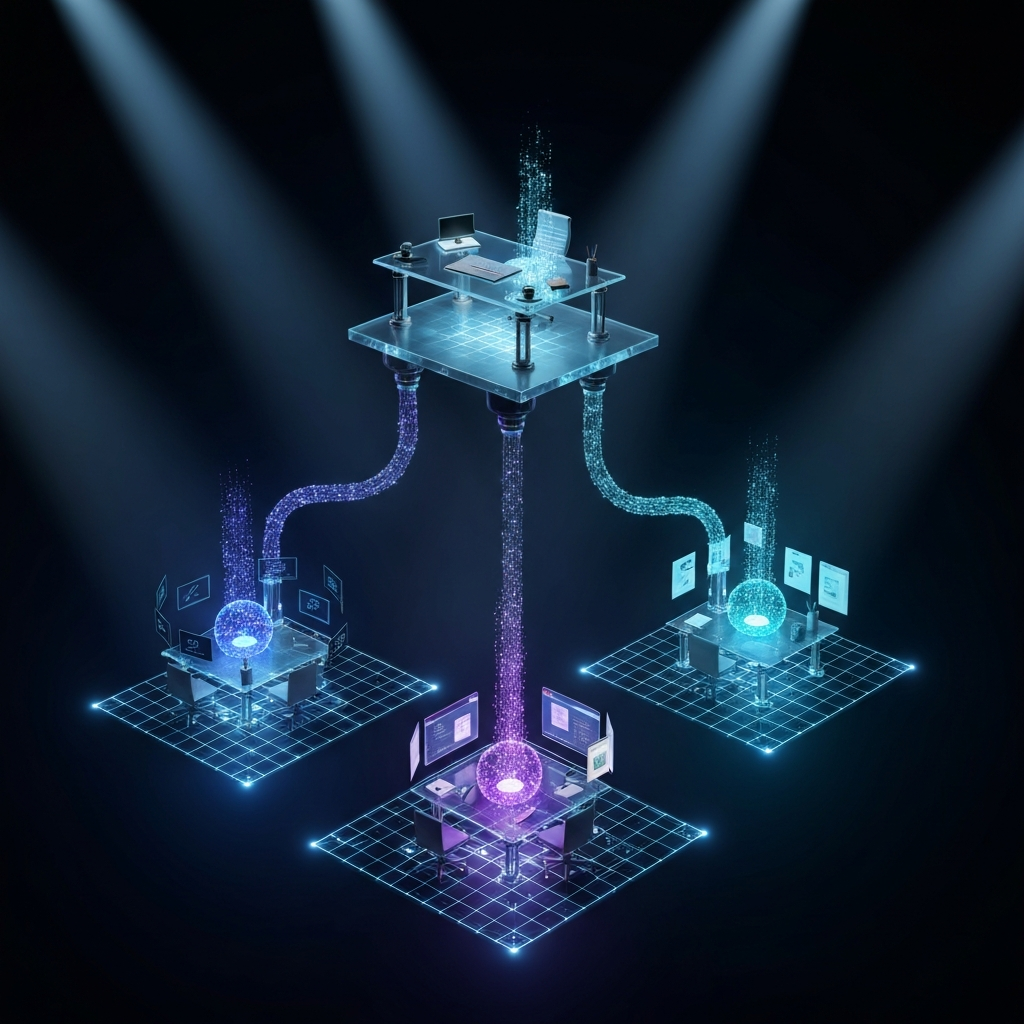
One coordinator agent can now spawn, direct, and synthesize output from multiple specialized sub-agents in a single workflow. Rakuten deployed specialist agents across five departments and went live in under one week each. Vibecode reported 10x faster infrastructure spin-up. The infrastructure layer that used to take teams three to six months to build just became a managed service priced at $0.08 per session-hour.
This is not an incremental API update. It is the moment "single model call" stops being the default production pattern and "coordinated agent team" takes its place. Here is why that matters, what it actually looks like under the hood, and what you should build with it before your competitors do.
The Delegation Stack
The mental model for this shift is simple. I call it The Delegation Stack. Three layers.
The cost-performance calculus of coordinated agent teams.
Layer 1: Single Call. You send a prompt, you get a response. This is 2023-era AI. One brain, one task, one context window.
Layer 2: Looped Agent. You give a model tools and let it iterate. Claude Code, AutoGPT, basic agent loops. Still one brain, but it can take multiple steps.
Layer 3: Orchestrated Team. One coordinator agent delegates to specialists, each with their own context window, tools, permissions, and conversation history. They share a filesystem. The coordinator synthesizes their outputs into a final deliverable.
Most developers are stuck somewhere between Layer 1 and Layer 2. Anthropic just made Layer 3 accessible to anyone with an API key. The Delegation Stack matters because each layer compounds capability. A single agent hits context limits at 100,000 tokens. An orchestrated team shards context across specialists, meaning you can tackle problems that would choke any single model.
The framework in one sentence: stop thinking about AI as one smart employee and start thinking about it as a team with a manager.
Why This Is a 500 IQ Intern Factory
Here is where it gets interesting. Multi-agent orchestration is not just "run three agents instead of one." It is a fundamentally different architecture that unlocks four workflows impossible with a single agent.
Hierarchical delegation. A coordinator with read-only access spawns specialists with scoped write permissions. Think of a project manager who can see everything but delegates the actual coding, research, and writing to people with the right tools.
Parallel processing. Notion deployed this pattern to run coding, slides, and spreadsheet generation simultaneously. Dozens of tasks running in parallel without leaving the workspace. That is not 3x faster. That is a different category of throughput.
Specialized tooling. Each sub-agent gets its own tool set. Your research agent has web browsing. Your code agent has a sandbox. Your writing agent has style guidelines. No single agent needs to juggle every tool in one context window.
Self-evaluation loops. Anthropic's "Outcomes" feature lets you define rubrics for what "done" means. A separate grader agent iterates revisions against those rubrics. The agent team literally grades its own homework.
The numbers back this up. On Anthropic's internal research evaluation, a multi-agent system with Claude Opus 4 as lead and Claude Sonnet 4 sub-agents outperformed single-agent Claude Opus 4 by 90.2%. On structured file generation, Managed Agents improved task success by up to 10 percentage points compared with standard prompting loops.
The honest trade-off, though. Multi-agent systems consume approximately 15x more tokens than standard chat interactions. Single-agent systems use about 4x more. So you are paying roughly 4x more than a looped agent for that 90% performance gain. For simple Q&A? Overkill. Simple always defeats complex when simple gets the job done.
The nicher you go with your sub-agents, the faster the whole system grows in capability. An ounce of work in pre-configuration (defining each specialist's scope, tools, and rubrics) is worth a pound in post-deployment debugging.
My read on this: the teams that win will not be the ones with the most agents. They will be the ones with the best-scoped specialists. A coordinator directing three tightly-defined sub-agents will outperform one directing fifteen vaguely-defined ones every time.
One thing worth flagging: it is unclear whether the current beta's observability tools adequately capture cascade failures across agent chains. Anthropic's own engineering team acknowledged that small changes to a lead agent's prompt can unpredictably affect sub-agent behavior. This is the "500 IQ intern" problem. Brilliant, fast, capable, but you still need to check their work.
The practical architecture for most teams right now: coordinator (Opus 4) handles planning and synthesis. Sub-agents (Sonnet 4) handle execution. Grader agent (separate instance) evaluates output against your rubrics. Shared filesystem for artifacts. OpenTelemetry traces for debugging. That is the 20% of the system that delivers 80% of the value.
2031. Pull back five years from today. Where does this land?
The pattern Anthropic just productized is not new in concept. It is how every effective organization already works. A CEO does not write code, close deals, and file taxes. They coordinate specialists. The Delegation Stack is just organizational design applied to AI systems.
By 2031, I think the default "AI product" will not be a model. It will be a team configuration. Companies will compete not on which foundation model they use but on how well they orchestrate specialists. The model becomes a commodity. The orchestration layer becomes the moat.
Consider the asymmetric bet. Anthropic's reported valuation hit $900 billion in 2026. That number does not price in chat revenue. It prices in the conviction that agentic infrastructure is the next monetization layer. The market is betting that whoever owns the orchestration runtime owns the margin.
The Costco hot dog principle applies. Anthropic prices Managed Agents at $0.08 per session-hour (roughly $58 per month for 24/7 operation) because the real revenue is token consumption. Multi-agent systems burn 15x more tokens. The infrastructure is the loss leader. The tokens are the hot dog.
Contrast this with OpenAI's Swarm (released April 2024), which offered basic multi-agent coordination but lacked managed infrastructure, secure sandboxing, and error recovery. Anthropic leapfrogged to production-scale. Google's agent efforts remain fragmented across Vertex and Gemini. The compounding advantage goes to whoever ships production-ready orchestration first and captures the developer workflow.
The contrarian view deserves airtime. Critics argue multi-agent adds latency (estimated 20-50% overhead from delegation), multiplies prompt injection attack surfaces, and creates "Very High" ongoing maintenance burden per Augmentcode's estimates (600-1,200 engineer-hours initial build, continuous routing and boundary tuning). Smaller teams may rationally stick with optimized single-agent loops. The evidence that multi-agent beats a well-tuned single agent on cost-adjusted metrics is still thin outside high-complexity workflows.
But the enterprise momentum is hard to ignore. Asana, Sentry, Notion, Rakuten, and Vibecode all shipped production multi-agent systems within weeks of the beta launch. Software engineering already accounts for 49.7% of all agent tool calls. Three hundred plus vertical markets remain largely untapped. The flywheel is spinning.
The beginner's mind question: if you were starting a company today, would you build around single model calls or orchestrated teams? The answer tells you where the industry lands by 2031.
Three signals inside the same shift
The Delegation Stack replaces single-call as default.
Anthropic productized a three-layer architecture: single call, looped agent, orchestrated team. Layer 3 is now accessible to anyone with an API key. Context sharding across specialists lets teams tackle problems that choke any single model.
Multi-agent burns 15x more tokens by design.
The $0.08 per session-hour infrastructure is the loss leader. Real revenue comes from token consumption that scales with agent count. Anthropic is applying the Costco hot dog principle to agentic compute.
Rakuten shipped five departments in days, not months.
What used to take three to six months of custom infrastructure became a managed service. Asana, Sentry, Notion, and Vibecode all deployed production multi-agent systems within weeks of the beta launch.
What to Build This Weekend
You do not need a CS degree for this. You need an Anthropic API key and a weekend.
Step 1: Pick one workflow you do repeatedly. Content research. Competitive analysis. Code review. Customer support triage. Something with clear inputs and outputs.
Step 2: Define three specialists. For content research, that might be: (a) a web research agent with browsing tools, (b) a synthesis agent that condenses findings, (c) a grader agent that checks for accuracy against sources. Write a two-sentence system prompt for each.
Step 3: Build the coordinator prompt. Tell it the goal, the specialists available, and the output format you expect. Keep it under 200 words. Don't make the coordinator think. Make it delegate.
Step 4: Use the Managed Agents API. Set the managed-agents-2026-04-01 header. Define your agents with scoped tools and permissions. Start a session. Let it run.
Step 5: Define your "done" rubric using Outcomes. What does success look like? Three bullet points maximum. The grader agent will iterate against these.
Things will break. Sub-agents will return garbage on the first run. Your coordinator prompt will need three or four rewrites. That is normal. The 73% of tool calls that involve humans in the loop exist for a reason. Start with approval-required mode. Graduate to monitoring-only after you trust the outputs.
If you want to go further, connect your orchestrated team to an n8n workflow that triggers on a schedule or webhook. Pair it with Pounce v1.6 to monitor Reddit conversations, feed relevant threads to your research agent team, and auto-draft responses for your review. Or use Tosea.ai to convert the research output into presentation slides for Monday's meeting.
First build the team. Then automate the trigger. Then remove yourself from the loop. That is the Delegation Stack in practice.
Deploy your first orchestrated agent team in five steps.
- Pick one repeatable workflow. Content research, code review, or competitive analysis. Choose something with clear inputs and outputs so you can measure success on the first run.
- Define three scoped specialists. Write a two-sentence system prompt for each sub-agent. Give each its own tool set and permissions. A research agent browses, a synthesis agent condenses, a grader agent checks accuracy.
- Set the managed-agents header and ship. Use the managed-agents-2026-04-01 API header. Define your coordinator prompt under 200 words. Add an Outcomes rubric with three bullet points maximum. Expect three to four coordinator prompt rewrites before it clicks.
The model is now a commodity. The orchestration layer is the moat.
Anthropic just collapsed three to six months of custom multi-agent infrastructure into a managed service starting at $8.25 per month. The 90% performance gain over single agents comes at 15x token cost, a trade-off that only makes sense for complex workflows. But enterprise adoption velocity from Rakuten, Notion, and others signals that coordinated agent teams are the new production default. The question is no longer whether to orchestrate. It is how well you scope your specialists before your competitors do.