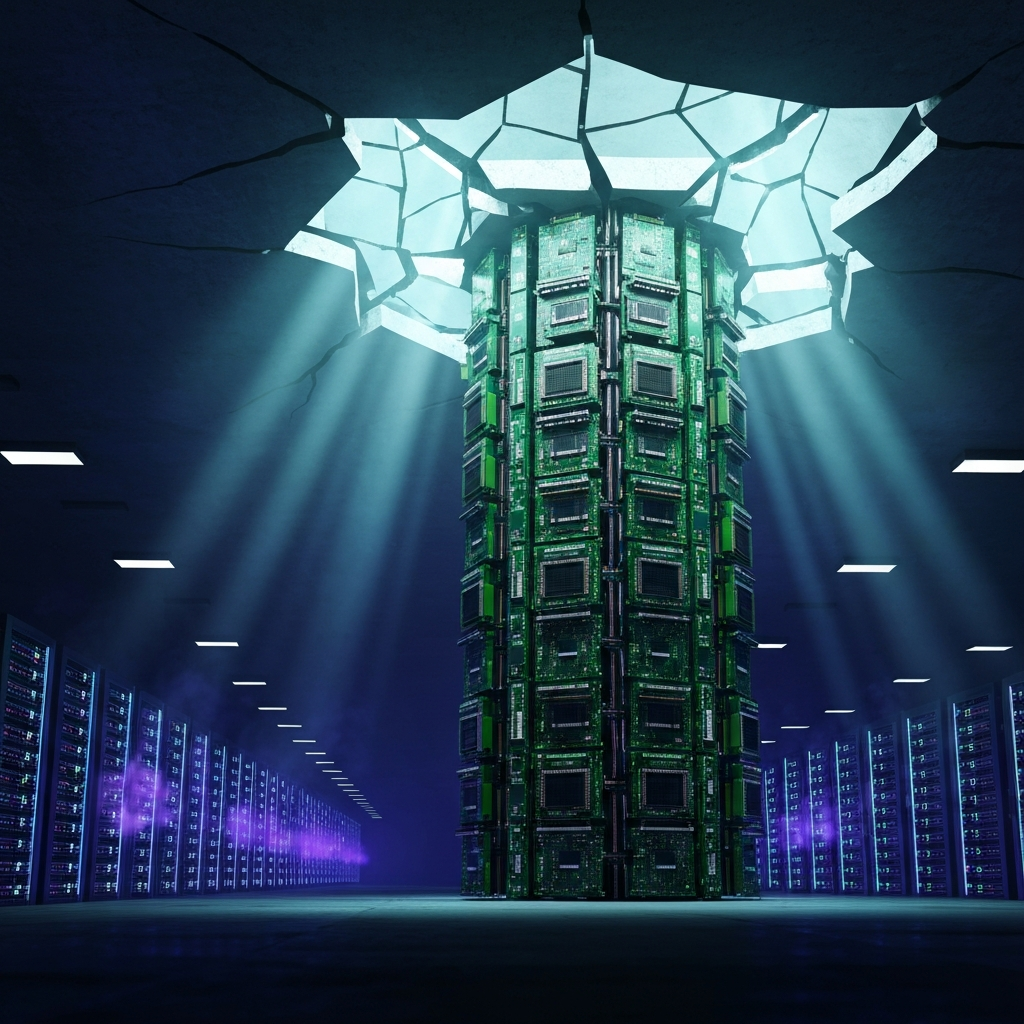
The Stargate supercomputing cluster behind it represents a reported $500 billion infrastructure commitment. That is not a typo. Five hundred billion dollars. To put it plainly: the cost of training one model now exceeds the GDP of 75% of the world's countries.
Not with a novel architecture. Not with a breakthrough in attention mechanisms. With raw, brute-force compute that smaller labs simply cannot access.
The era of winning with clever model design is ending. The era of winning with infrastructure is here. And most of the AI industry is not ready for what that means.
The Concrete Ceiling Principle
Here is the mental model for this moment. Call it The Concrete Ceiling Principle.
The numbers behind the shift from algorithms to infrastructure.
In the early days of AI, the ceiling on model performance was made of glass. A smart team with a better algorithm could shatter it. Transformers beat RNNs. Attention mechanisms beat everything before them. A PhD student with a good idea could leapfrog a billion-dollar lab.
That glass ceiling is now concrete. The only way through it is mass. Weight. Capital. Kilowatts.
The Concrete Ceiling Principle says this: once a technology matures past its algorithmic innovation phase, the binding constraint shifts from cleverness to resources. We saw it in semiconductors. We saw it in telecommunications. We saw it in oil exploration. Now we're seeing it in AI.
GPT-4 trained on an estimated 20,000 to 25,000 A100 GPUs, according to analyses compiled by Epoch AI and SemiAnalysis. GPT-6 trained on over 100,000 H100 and GB200 chips at minimum, with credible projections reaching into the millions. That is not a linear increase. That is a phase transition. The teams that can pour concrete, literally and figuratively, are the teams that will define the next generation of AI. Everyone else hits the ceiling and stops.
Why the Moat Moved from Code to Kilowatts
To understand why compute infrastructure is now the dominant competitive advantage, you have to think about AI labs the way you think about scaling any capital-intensive operation. The question is never "Can we build a better product?" The question is "Can we build the system that builds the product?"
Consider the numbers. NVIDIA's data center revenue hit $193.7 billion in fiscal year 2026, according to MLQ.ai's analysis of NVIDIA's financial disclosures. That is up from $27 billion just three years earlier. A compound annual growth rate of roughly 100%. The demand for compute is not growing. It is exploding.
Now look at the supply side. If you harness 2 million of them at 25 petaFLOPs each, the cluster peaks at approximately 5 times 10 to the 23rd FLOPs per second. Run that at 25% sustained utilization over 60 days and you get around 6.5 times 10 to the 30th total FLOPs. That is two to four orders of magnitude above GPT-4's estimated training compute.
The energy math is equally staggering. Two million GPUs at 800 watts each draws 1.6 gigawatts just for the accelerators. Add cooling, networking, and CPUs with a realistic power usage effectiveness of 1.3, and you approach 2 gigawatts. That is the output of two large nuclear reactors. A 60-day training run at that draw consumes roughly 2.88 million megawatt-hours. At $50 per megawatt-hour wholesale, the electricity bill alone is $144 million.
Think of this as a Replacement Ladder for AI competition. The first rung was talent. Hire the best researchers, win the benchmark. The second rung was data. Scrape the internet, curate the corpus, win the benchmark. The third rung, the one we are standing on now, is infrastructure. Build the datacenter, secure the power contracts, lock in the chip supply, win the benchmark. Each rung requires 10x more capital than the last. Each rung is harder to climb.
Here is the part that turns this into a true moat, not just a spending race. The feedback loop compounds. OpenAI uses GPT-6's capabilities to attract enterprise customers. Enterprise revenue funds the next training run. The next training run requires even more compute. More compute requires deeper relationships with NVIDIA, longer power contracts, and more physical real estate. Every cycle widens the gap.
I think this is why OpenAI structured Stargate as a $500 billion multi-year commitment rather than a series of smaller bets. They are not buying chips. They are buying the right to play the game in 2028 and 2030. Labs that cannot make commitments at that scale are not falling behind. They are falling out.
Can smaller labs find an architectural shortcut that breaks through the Concrete Ceiling? Maybe. Mixture-of-experts, sparse activation, and distillation techniques have all shown promise. But the evidence from 2025 and early 2026 suggests that these techniques delay the compute wall rather than eliminate it.
The DRIP Matrix helps categorize where different organizations sit. Delegate: hyperscalers like Microsoft and Google who fund the infrastructure and delegate model training to their AI divisions. Replace: labs like Mistral and Cohere who are being replaced at the frontier by compute-rich competitors, even when their architectures are arguably more elegant. Invest: sovereign AI funds in the UAE, Saudi Arabia, and Singapore that are pouring billions into datacenter construction. Produce: NVIDIA, TSMC, and ASML, the three companies that actually produce the physical substrate everything else depends on.
NVIDIA's position in this stack is particularly instructive. As Andrew Baker's analysis notes, NVIDIA dominates not because it builds everything, but because it controls the software layer, CUDA, where algorithms meet silicon. The switching cost runs so deep that researchers, cloud providers, and enterprises have built entire ecosystems around it. TSMC fabricates the chips. ASML builds the lithography machines. But NVIDIA owns the integration layer. That is a systems moat, not a product moat.
2031. Zoom out five years. Where does the Concrete Ceiling Principle take us?
My read is that we are watching the AI industry consolidate into something that looks more like the energy sector than the software sector. Three to five organizations will control the frontier. Everyone else will build on top of their models or specialize in narrow domains where compute requirements are lower.
By 2031, the cost of a single frontier training run will likely exceed $10 billion in compute alone, based on the current trajectory of 10x scaling every 18 to 24 months. The organizations that can afford that are the ones building power plants today. Literally. Microsoft has signed nuclear power agreements. Amazon has acquired datacenter campuses adjacent to power stations. Google is investing in geothermal.
The asymmetric advantage belongs to whoever controls the energy-to-intelligence pipeline. Chips are necessary but not sufficient. You need the chips, the interconnects, the cooling, the power, the land, and the regulatory approval to operate at scale. That is a five-year lead time, minimum. Anyone who starts building today is already late for 2031.
There is something worth sitting with here. For a decade, the AI story was about the brilliance of individual researchers. Ilya Sutskever's intuitions. Alec Radford's architectures. The shoshin, the beginner's mind, of a small team trying wild ideas. That era produced transformers, RLHF, and chain-of-thought reasoning. It was beautiful.
The new era is about logistics. Supply chains. Concrete and copper and cooling towers. Any single architectural advantage now has a shelf life measured in months, not years. What endures is infrastructure. Only cash is real. The rest is accounting. And right now, the cash is flowing toward datacenters at a rate the technology industry has never seen.
ChatGPT already has 894 million total users as of May 2026, according to First Page Sage's weighted analysis of 16 sources. OpenAI closed a $122 billion funding round at an $852 billion post-money valuation, per FatJoe's reporting. The flywheel is spinning. The question for every other lab, every startup, every government is simple: can you build your own flywheel before the gap becomes permanent?
Whether open-source efforts can serve as a counterweight remains genuinely unclear. Meta's Llama models and Mistral's releases have democratized access to capable models. But capable and frontier are increasingly different categories. The open-source community may own the 80th percentile of AI capability. The 99th percentile will belong to whoever owns the most compute.
Three signals inside the same shift
Two million Blackwell chips redraw the competitive map.
GPT-6's training cluster represents two to four orders of magnitude more compute than GPT-4. At 1.6 gigawatts just for accelerators and a 60-day run consuming roughly 2.88 million megawatt-hours, the electricity bill alone hits $144 million. This is infrastructure competition, not algorithm competition.
xAI collapses its model lineup into a single flagship.
Effective May 15, xAI deprecated Grok 4.1, Grok 4, Grok 3, and Grok Code variants, redirecting all requests to Grok 4.3 with its 1 million token context window. Pricing at $1.25 input and $2.50 output per million tokens signals aggressive commoditization at the API layer.
The US faces over 1,200 AI bills with no unifying framework.
Public submissions remain open through May 19, 2026, but the sheer volume of fragmented legislation reflects a governance system struggling to keep pace. For labs making $500 billion infrastructure bets, regulatory uncertainty adds a compounding risk layer on top of capital exposure.
What to Build This Weekend
You cannot build a datacenter this weekend. But you can build systems that make you resilient regardless of who controls the frontier.
First, set up an inbox triage system using Quartz, which auto-categorizes your email by importance and learns your preferences over time. The reason this matters now: as AI tools proliferate, the volume of AI-generated outreach, updates, and notifications is going to overwhelm anyone without a filtering system. Install Quartz, train it for one week, and measure how many minutes you save per day. Aim for 30.
Second, build a simple cost comparison spreadsheet for the AI APIs you use. List every model you call, its price per million tokens (input and output), and your monthly volume. OpenAI, Anthropic, Google, Mistral, and Groq all publish pricing. The Concrete Ceiling Principle means API prices will diverge as compute costs rise for frontier models and fall for older ones. Know your numbers before the next price increase hits.
Third, test one open-source model locally. Download Ollama. Pull Llama 3.1 8B or Mistral 7B. Run it on your laptop. Time how long a typical query takes. Compare the output quality to GPT-4o for your specific use case. For 60% of business tasks, the local model will be good enough. For the other 40%, you will understand exactly what you are paying the frontier tax for.
None of this requires a computer science degree. It requires about three hours and a willingness to test things that might break. The builders who survive the Concrete Ceiling era will not be the ones with the most compute. They will be the ones who know exactly when frontier compute matters and when it does not. Start learning the difference now.
Build resilience systems before the compute gap becomes permanent.
- Deploy an inbox triage layer. Set up Quartz or a similar AI-powered email filter that auto-categorizes by importance and learns your preferences. As AI-generated outreach volume explodes, unfiltered inboxes become a productivity bottleneck.
- Audit your model dependency stack. Map every API call your products make to a specific model slug. xAI just deprecated four model versions overnight on May 15. If your system hardcodes model names instead of using flexible routing, one deprecation notice breaks your pipeline.
- Benchmark your workloads against open-source alternatives. Run your top five production prompts through Llama and Mistral models side by side with your frontier API. Quantify the quality gap. If open-source covers 80% of your use cases, you reduce exposure to the compute oligopoly and cut costs immediately.
The frontier belongs to whoever owns the energy-to-intelligence pipeline.
The Concrete Ceiling Principle is not a metaphor. It is a capital allocation reality. Two million GPUs, 2 gigawatts of power, and $500 billion in committed infrastructure spending have moved the binding constraint in AI from architectural cleverness to raw physical resources. Three to five organizations will control the frontier by 2031. Everyone else builds on their models, specializes in narrow domains, or falls out entirely. The question is no longer whether you can design a better architecture. The question is whether you can pour enough concrete before the gap becomes permanent.