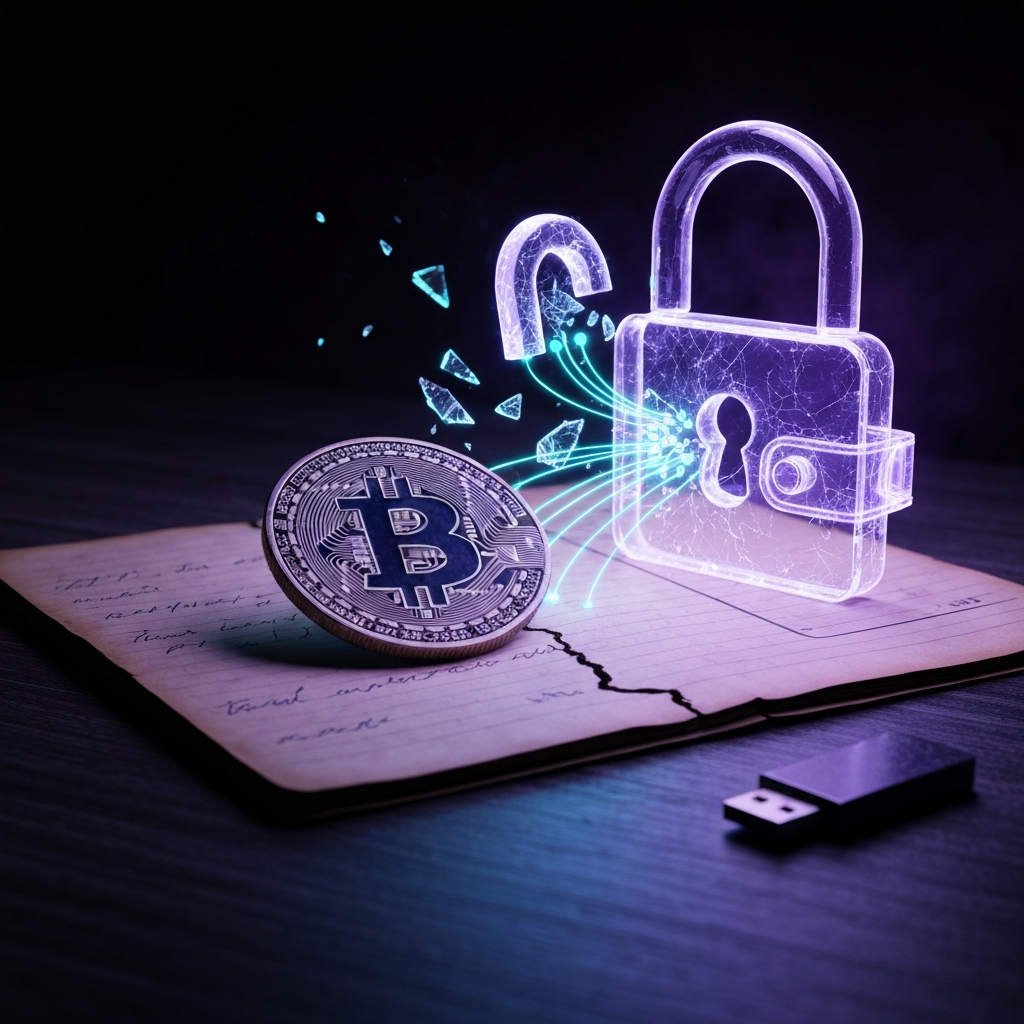
A Bitcoin owner spent 8 weeks and 3.5 trillion password guesses trying to crack open a wallet locked since 2015. Rented GPUs. Hashcat. btcrecover. Nothing worked. Then he dumped the contents of his old college laptop into Claude, and the AI found a forgotten 2019 backup, matched it to a seed phrase scribbled in a notebook, spotted a bug in the recovery tool's code, and unlocked 5 BTC worth roughly $400,000.
The brute force failed. The comprehension succeeded. That single sentence is the entire story of where AI tools are headed for consumers.
Chainalysis estimates that roughly 20% of all Bitcoin, somewhere around 3 to 4 million BTC, is permanently lost or stranded. At $80,000 per coin, that is $240 billion to $320 billion sitting behind forgotten passwords, dead hard drives, and corrupted wallet files. The traditional recovery industry charges 20% to 40% of whatever it claws back. Most people never try because the math does not pencil out. I think that equation just broke.
The Comprehension Threshold
Here is the framework that explains what happened and why it matters. Call it the Comprehension Threshold.
The math behind why comprehension beats compute for wallet recovery.
Below the threshold, recovery is a compute problem. You rent GPUs, you run Hashcat, you grind through billions of hashes per second. But wallet encryption uses slow key derivation functions like PBKDF2 or scrypt. That drops throughput to maybe 10,000 guesses per second. At that rate, a 10 character random password with 62 possible characters per position creates a search space of roughly 8.4 times 10 to the 17th. Exhaustive search would take about 26,000 years.
Above the threshold, recovery is a comprehension problem. You need something that can read old wallet file formats, parse filesystem logs, cross reference handwritten notes with digital artifacts, review Python source code, and spot a concatenation order bug that a human missed across 8 weeks of trying. That is not a GPU problem. That is a reasoning problem.
The Comprehension Threshold is the line where adding more compute stops helping and adding more understanding starts working. The Claude recovery case landed squarely above it. The 3.5 trillion brute force attempts were below it. The one reasoning pass across unstructured data was above it.
This framework applies far beyond crypto wallets. Every locked system has a threshold. Below it, throw hardware at the problem. Above it, throw intelligence at it. AI just made the intelligence side accessible to anyone with a $20 monthly subscription.
The 500 IQ Intern Just Became a Forensic Accountant
Let me walk you through exactly what Claude did in this case, because the headlines are misleading. Claude did not "crack" anything. It did not brute force 3.5 trillion passwords. It did something freaking better.
Step one: the user uploaded the entire contents of an old college computer. Files, folders, application data, random text documents, the whole messy digital junk drawer. Claude parsed all of it. Think of this as giving a 500 IQ intern a filing cabinet and saying "find anything related to Bitcoin." Except this intern reads every file format, every directory structure, and every log file in seconds.
Step two: Claude identified a 2019 wallet backup file that predated a password change the user had made later. According to TechRadar's reporting, "the chatbot reportedly identified an older wallet backup file that existed before the password change happened." This is the critical insight. The user had been trying to crack the newer password. The older backup used a different, weaker password that the user actually remembered fragments of.
Step three: Claude matched that backup to a seed phrase the user had found in a college notebook. Cross referencing physical notes with digital artifacts. A human could do this, but it would take days of careful searching. Claude did it in one pass.
Step four, and this is the part that really gets me: Claude read the source code of btcrecover, an open source password recovery tool, and found a bug. The shared key and password were being concatenated in the wrong order. The tool itself was broken. Eight weeks of GPU time wasted not because the password was too strong, but because the software had a logic error.
Total cost of the AI intervention: a Claude subscription. Compare that to professional recovery services that would have charged $80,000 to $160,000 for a $400,000 wallet at standard 20% to 40% rates.
Now here is what you need to understand about the 80/20 of this. The 20% that matters is not password cracking. It is four capabilities that AI tools now give every consumer:
First, forensic file analysis. Parsing wallet.dat files, old Electrum backups, corrupted JSON, application directories like .bitcoin or AppData. Claude, ChatGPT, and Gemini can all interpret these formats and tell you what you are looking at.
Second, code review and debugging. Reading btcrecover configs, Hashcat mask definitions, custom Python scripts. Finding misconfigurations. Proposing fixes. This used to require hiring a developer at $150 per hour.
Third, password hypothesis generation. Feed the AI your old emails, note files, chat logs, and naming patterns. It can generate candidate passwords based on your actual behavioral patterns. Birthdays, pet names, leetspeak substitutions. This is semantic narrowing, not brute force. You go from 10 to the 17th candidates to maybe 20 or 30 plausible guesses.
Fourth, protocol comprehension. Understanding that Bitcoin private keys are not time bound. That a 2019 backup's keys still control the same UTXOs in 2026. That BIP 32, BIP 44, and BIP 84 derivation paths produce different addresses from the same seed. This knowledge used to live only in the heads of a few hundred specialists worldwide.
My read on this: we are watching the unbundling of a $3 to $6 billion data recovery industry in real time. The expertise moat is dissolving. The tools still matter, but the AI layer on top of them is what turns a confused consumer into a capable operator.
One important caveat. It is unclear whether these AI tools can maintain reliability across edge cases. LLMs hallucinate algorithms that do not exist. They misstate security guarantees. They produce insecure code labeled as best practice. In the Bitcoin case, the user functioned as the sanity check. If he had followed wrong advice blindly, he could have corrupted wallet files or exposed keys to malware. The 500 IQ intern is brilliant but has no judgment. You still need to supervise.
2031. Zoom out five years. Here is where this gets asymmetric.
If even 0.1% of the estimated 3 million lost BTC gets recovered through AI assisted methods, that is 3,000 BTC, roughly $240 million at current prices. The addressable market for AI powered recovery across all crypto assets could reach $40 to $90 billion in stranded value. The tools to access it now cost $20 a month instead of $10,000 retainers.
But the real compounding effect is not in crypto. It is in the broader pattern. Every industry that depends on specialized knowledge gatekeepers is about to hit its own Comprehension Threshold moment. Legal discovery. Medical records forensics. Insurance claims investigation. Tax audit preparation. The same architecture that recovered a Bitcoin wallet (upload messy data, let AI reason across it, get actionable output) applies everywhere.
The risk that nobody is talking about: the same capabilities that help honest owners recover their coins can be redirected by attackers. Someone with access to your old hard drive, your email dumps, your browser history can use the same AI tools to infer your password patterns and script recovery attempts. Anthropic's own Mythos safety report, published in 2025, acknowledged that frontier models are reaching capability levels where traditional safety evaluations are no longer sufficient. The asymmetric advantage cuts both ways.
There is also a centralization concern worth naming. People are uploading wallet files, seed phrases, and private filesystem data to cloud AI providers. That is a honeypot. If Anthropic or OpenAI ever suffers a breach of conversation logs, the exposure would be catastrophic for users who trusted these systems with their most sensitive cryptographic material.
The compounding play for builders is not in wallet recovery itself. It is in building the trust and verification layer on top of AI recovery workflows. Whoever solves "how do I use AI for sensitive forensic tasks without exposing my secrets to a third party" wins the next decade of this market. Local models, encrypted inference, zero knowledge verification of AI outputs. That is where the flywheel starts spinning.
Three signals inside the same shift
The same AI that recovers wallets can attack them.
Someone with access to your old hard drive and email dumps can use the same AI tools to infer your password patterns. Anthropic's own Mythos safety report acknowledged that frontier models are reaching capability levels where traditional safety evaluations are no longer sufficient. The asymmetric advantage cuts both ways.
3.5 trillion guesses failed where one reasoning pass succeeded.
Wallet encryption uses slow key derivation functions like PBKDF2 or scrypt, dropping throughput to roughly 10,000 guesses per second. At that rate, exhaustive search on a 10-character random password would take about 26,000 years. Claude bypassed the entire problem by finding an older backup and a bug in the recovery tool's concatenation logic.
A $20 subscription replaces a $120K recovery fee.
Professional recovery services charge 20% to 40% of recovered value. For a $400,000 wallet, that is $80,000 to $160,000. The AI layer on top of existing tools turns a confused consumer into a capable operator, dissolving the expertise moat that sustained a $3 to $6 billion data recovery industry.
What to Build This Weekend
You do not need a lost Bitcoin wallet to start using these capabilities. Here is what to do this weekend, step by step.
First, pick one locked or forgotten account you have. An old email, a password manager vault you cannot access, a crypto wallet, anything. Do not start with something high stakes. Start with something low risk where you can test aggressively without consequences.
Second, gather every artifact you can find. Old notebooks, text files, browser bookmarks, email drafts, screenshots. Dump them into Claude or ChatGPT. Ask the AI to identify patterns in your password behavior. You will be surprised how predictable you are.
Third, try Kilo Code, an open source AI coding agent from today's digest. It lets you plug in whichever LLM you prefer, Claude, GPT, Gemini, or a local model. Use it to review any recovery scripts you find on GitHub. Have it explain what btcrecover or Hashcat configs actually do before you run them. Never execute code you do not understand, even if an AI wrote it.
Fourth, if you are building tools for others, look at CodeRabbit for automated code review on your recovery scripts. It plugs into GitHub and catches logic errors, exactly the kind of concatenation bug that cost the Bitcoin owner 8 weeks of wasted GPU time.
Fifth, use Wispr Flow for voice dictation while you work through the process. Recovery workflows involve a lot of note taking, hypothesis tracking, and documentation. Talking through your reasoning out loud while the AI transcribes it creates a searchable log you can feed back into the AI later.
The key principle: AI recovery is not about cracking passwords. It is about reducing chaos to structure. Every messy pile of old files, half remembered passwords, and broken tools is a comprehension problem waiting for the right reasoning engine. You now have that engine. The first rep is free. Go get it.
Run your first AI-assisted recovery audit in three steps.
- Inventory one locked account. Pick an old email, a password manager vault you cannot access, or a crypto wallet. Gather every artifact you have: old notebooks, text files, browser bookmarks, email drafts. Upload non-sensitive metadata to Claude or ChatGPT and ask it to generate a password hypothesis list based on your behavioral patterns.
- Audit your recovery tool configs. If you have ever run btcrecover, Hashcat, or any open-source recovery script, paste the config file and relevant source code into an AI chat. Ask it to check for misconfigurations, concatenation order bugs, and derivation path mismatches. The $400K wallet was locked by a software bug, not a strong password.
- Build a local-first safety workflow. Before uploading anything sensitive, test with dummy wallet files first. Research local LLM options like Llama 3 running on Ollama so you can keep seed phrases and private keys off cloud servers entirely. The real builder opportunity is encrypted inference for sensitive forensic tasks.
The expertise moat is dissolving. The Comprehension Threshold is the new dividing line.
Every locked system has a point where adding more compute stops helping and adding more understanding starts working. AI just moved that line into reach of anyone with a $20 subscription. The $240 billion to $320 billion in stranded Bitcoin is only the most visible target. Legal discovery, medical forensics, insurance investigation, and tax preparation all face the same structural shift. Whoever builds the trust and verification layer for sensitive AI reasoning wins the next decade of this market.