Anthropic just projected $10.9 billion in revenue for the June quarter. That is 130% higher than the $4.8 billion it posted in Q1. The company told investors it expects $559 million in operating profit. If that number holds, it will be the first profitable quarter in Anthropic's five-year history.
Here is the part nobody is saying out loud. That $559 million profit sits on top of $10.9 billion in revenue. That is a 5.1% operating margin. Anthropic simultaneously signed a deal to pay $1.25 billion per month for compute from xAI. Annualized, that single contract runs to $15 billion. More than the company's entire projected quarterly revenue times four.
One quarter of profit does not mean the economics of frontier AI are solved. It might mean the opposite. Let me explain.
The Mirage Margin Principle
Here is the framework for thinking about this moment. I call it the Mirage Margin Principle.
The numbers behind Anthropic's fragile margin.
A mirage margin appears when a fast-growing company hits profitability for a single period because revenue spiked faster than costs could catch up. It looks real. It feels like a turning point. Investors celebrate it. But the underlying cost structure has not changed. The company has simply outrun its own spending for one quarter.
Anthropic fits this pattern precisely. The Wall Street Journal reported on May 20, 2026, that the company "may not remain profitable throughout the year" because of large scheduled compute costs. The profit is real. The durability is not proven.
The Mirage Margin Principle says: watch the cost trajectory across three quarters, not the profit in one. A single quarter of positive operating income tells you the revenue engine works. It tells you nothing about whether the cost floor is rising faster than the revenue ceiling.
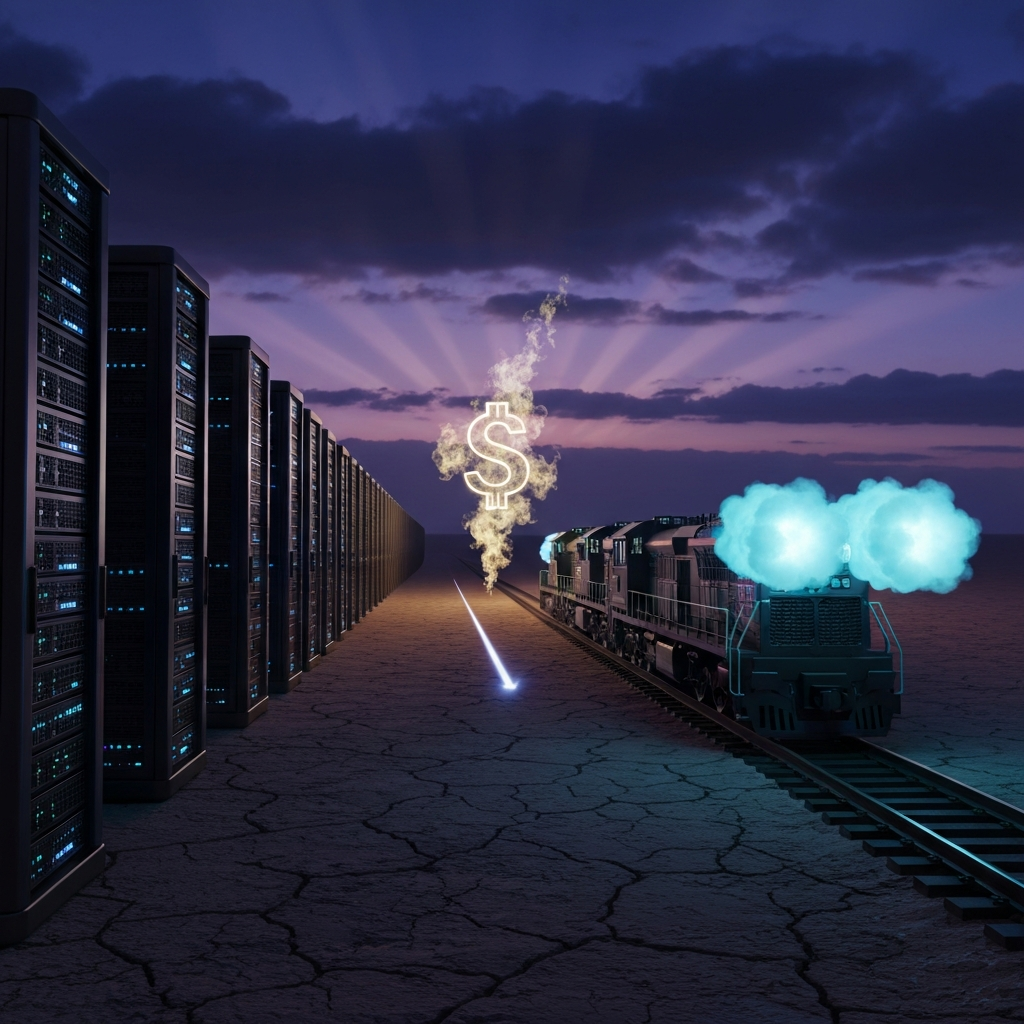
Think of it like a sprinter who briefly outruns a train. Impressive, yes. Sustainable, no. The question is whether the train slows down or the sprinter speeds up.
The Asymmetric Bet Behind $559 Million
Zoom out from the headline number and look at what Anthropic is actually doing. The company is making a classic asymmetric wager: spend aggressively now, bet that revenue compounds faster than costs, and use a single profitable quarter as proof of concept to raise more capital at a higher valuation.
The math tells the story. Anthropic closed a $30 billion Series G round on February 12, 2026, at a $380 billion post-money valuation. At the time, its annualized revenue run rate was roughly $14 billion. That puts the enterprise value to revenue multiple at about 27x. Mature large-cap tech companies trade at 5x to 15x revenue. Anthropic is priced for perfection and then some.
Now layer in the cost structure. According to reporting from The Information, Anthropic's gross margins in 2025 were approximately 40%. That is not a software margin. That is closer to a capital-intensive infrastructure business. Software companies that justify 27x revenue multiples typically carry gross margins between 70% and 90%.
This is the central tension investors are ignoring. Anthropic is valued like a software platform but spends like a power utility. The 300 megawatts of data center capacity it secured from the Colossus 1 facility near Memphis, Tennessee, is enough to run hundreds of thousands of high-end GPU servers. That is hyperscaler-level infrastructure commitment from a company founded in 2021.
The contrarian view, articulated most forcefully by the newsletter Where's Your Ed At, is that Anthropic's profitability claim is an accounting artifact timed to a fundraising cycle. The $559 million figure was shared with investors during an active funding round. Anthropic declined to comment to TechCrunch. Private companies choose their own accounting frameworks. Revenue recognition, cost capitalization, and expense timing are all discretionary until you file with the SEC. A profitable quarter on non-GAAP, non-audited books is not the same thing as a profitable quarter under public-company scrutiny.
But here is the counterpoint, and it is strong. Anthropic's revenue trajectory is genuinely extraordinary. The company hit $1 billion in annualized revenue in December 2024. By July 2025, it reached $4 billion. By December 2025, $9 billion. By February 2026, $14 billion. That is roughly 10x annual growth sustained for three consecutive years. No enterprise software company in history has scaled this fast at these absolute dollar amounts.
The enterprise mix reinforces the bull case. Approximately 86% of Anthropic's revenue comes from B2B sales. The company has at least 9 customers spending more than $100 million annually. Microsoft alone is reportedly on pace to spend over $500 million per year with Anthropic. Claude Code, the company's coding agent, crossed $1 billion in annualized revenue by November 2025.
My read on this: Anthropic has built a real business with real enterprise demand. The revenue is not fake. But the margin profile is fragile, and the cost commitments are staggering. The $1.25 billion monthly compute contract alone creates a floor of $15 billion in annual spending before a single engineer gets paid.
Whether Anthropic can sustain even modest operating margins once the next generation of models enters training is an open question. Every frontier model costs more to build than the last. Every efficiency gain gets competed away through lower prices and heavier usage. The company's own internal projections, shared with Series G investors, pushed cash-flow positivity from 2027 to 2028. That is a one-year slip in a company growing at 10x per year. It suggests the cost curve is winning.
2031. Pull back five years and ask the real question. What does this moment mean for the structure of the AI industry?
Anthropic's first profitable quarter is not primarily a story about Anthropic. It is a signal about a phase transition happening across frontier AI. The industry is moving from "spend whatever it takes to build the best model" to "prove you can turn compute into cash flow." That shift changes everything about who survives.
Consider the contrast. In 2023, the AI race was about capability. Who had the smartest model? In 2026, the race is about unit economics. Who can serve intelligence at a cost that leaves room for profit? By 2031, the race will be about compounding. Who built the flywheel where enterprise customers generate data that improves models that attract more enterprise customers?
Anthropic's acquisition of Fractional AI, a San Francisco consulting firm, points toward this future. The company is not just selling API access. It is building an integration and governance layer for large enterprises. That is a higher-margin, stickier business than raw inference. It is also a counterpositioning move against OpenAI, which has leaned more heavily into consumer products and partnerships with Microsoft.
The Costco hot dog analogy applies here. Costco sells hot dogs at a loss to get you into the store. Anthropic may be selling inference at thin margins to lock enterprises into a consulting and integration ecosystem where the real money lives. If that is the strategy, the 5.1% operating margin on Q2 revenue is not the point. The point is the 86% B2B revenue mix and the 9 customers spending over $100 million each.
But there is a genuine risk that frontier AI becomes a commodity faster than anyone expects. If model quality converges across Anthropic, OpenAI, Google, and Meta, pricing power evaporates. The safety-first positioning that differentiates Anthropic today could also limit its addressable market. The Pentagon reportedly labeled Anthropic a "supply chain risk" after CEO Dario Amodei refused to remove guardrails around mass surveillance and autonomous weapons. President Trump reportedly ordered federal agencies to stop using Claude. Principles are admirable. They can also be a revenue ceiling.
The beginner's mind approach here is to hold both truths at once. Anthropic has built something remarkable. And remarkable growth does not guarantee remarkable durability. The next 18 months, as the company reportedly considers an October 2026 IPO according to Bloomberg, will reveal whether the Mirage Margin becomes a real margin or evaporates under the weight of its own compute bills.
Three signals inside the same shift
Anthropic's compute contract totals $45 billion through May 2029.
At $1.25 billion per month, the xAI compute deal alone creates $15 billion in annualized spending before salaries, research, or infrastructure. Internal projections already pushed cash-flow positivity from 2027 to 2028, a one-year slip in a company growing at 10x per year.
Chinese models surged from 1% to 60% of OpenRouter usage in under two years.
DeepSeek V3.2 runs at $0.28/$0.42 per million tokens. Kimi K2.6 scores 90.5% on GPQA at $0.95 per million tokens. A full benchmark evaluation costs $544 on Chinese models versus $4,811 on Claude. Pricing power is eroding fast.
Anthropic's B2B revenue mix points toward a consulting flywheel.
With 86% of revenue from enterprise sales and at least 9 customers spending over $100 million annually, Anthropic is building integration and governance layers that outlast any single model generation. The Fractional AI acquisition signals a shift from API vendor to embedded platform partner.
What to Build This Weekend
You do not need to wait for Anthropic's IPO to act on what this story reveals. The insight is simple: enterprise AI adoption is accelerating, and the companies buying Claude are buying it to solve specific workflow problems. You can position yourself on the same trend.
First, pick one knowledge-heavy workflow in your own business or job. Financial research, content review, contract analysis, customer support triage. Anything where a person reads a lot and synthesizes a little.
Second, build a personal knowledge base using a tool like Recall v2. Save the 20 or 30 documents you reference most often. Articles, SOPs, templates, notes. Let the AI search layer sit on top of your actual working library. This is the same pattern Anthropic's enterprise customers are buying at $100 million per year, scaled down to one person and zero dollars.
Third, test whether AI-assisted content production saves you real time. Use HitPublish to generate a draft blog post or internal update from your knowledge base. Do not publish it raw. Edit it. The goal is to cut your first-draft time by 60% or more, not to remove yourself from the process.
Fourth, track your results for 2 weeks. How many hours did you save? What was the quality delta between AI-assisted drafts and your previous process? Write down the numbers. This is your personal unit economics experiment.
The companies spending $100 million a year with Anthropic started exactly here. One workflow. One test. One measurable result. Then they scaled. You can do the same thing this weekend with free tools and 3 hours. The frontier AI economy is not something that happens to you. It is something you participate in, one small build at a time.
Position yourself on the enterprise AI adoption curve before it prices you out.
- Audit one knowledge-heavy workflow. Pick the process where you or your team spend the most time reading and synthesizing: contract review, financial research, support triage. Map every input document and output decision. This is your automation surface.
- Build a personal knowledge base with 20 to 30 core documents. Use a tool like Recall v2 or NotebookLM. Upload your most-referenced SOPs, templates, and research. Layer an AI search interface on top and measure how much retrieval time you save in one week.
- Run a cost comparison across three frontier APIs. Test your workflow against Claude, a Chinese model like DeepSeek V3.2 at $0.28 per million tokens, and GPT-4o. Track quality, latency, and total spend. The price gap will show you where the market is heading before your competitors notice.
One profitable quarter does not solve the economics of frontier AI.
Anthropic has built a genuine enterprise juggernaut with $10.9 billion in projected quarterly revenue and 10x annual growth sustained for three years. That is extraordinary. But a 5.1% operating margin sitting on top of a $1.25 billion monthly compute bill is a sprinter outrunning a train. The next 18 months will reveal whether the Mirage Margin hardens into durable profitability or evaporates under the weight of the industry's most expensive cost floor. Watch the cost trajectory across three quarters, not the celebration in one.