Michael Burry says we are in an AI bubble. Ed Yardeni says the S&P 500 climbs higher on AI productivity. Both might be right, and it does not matter as much as you think.
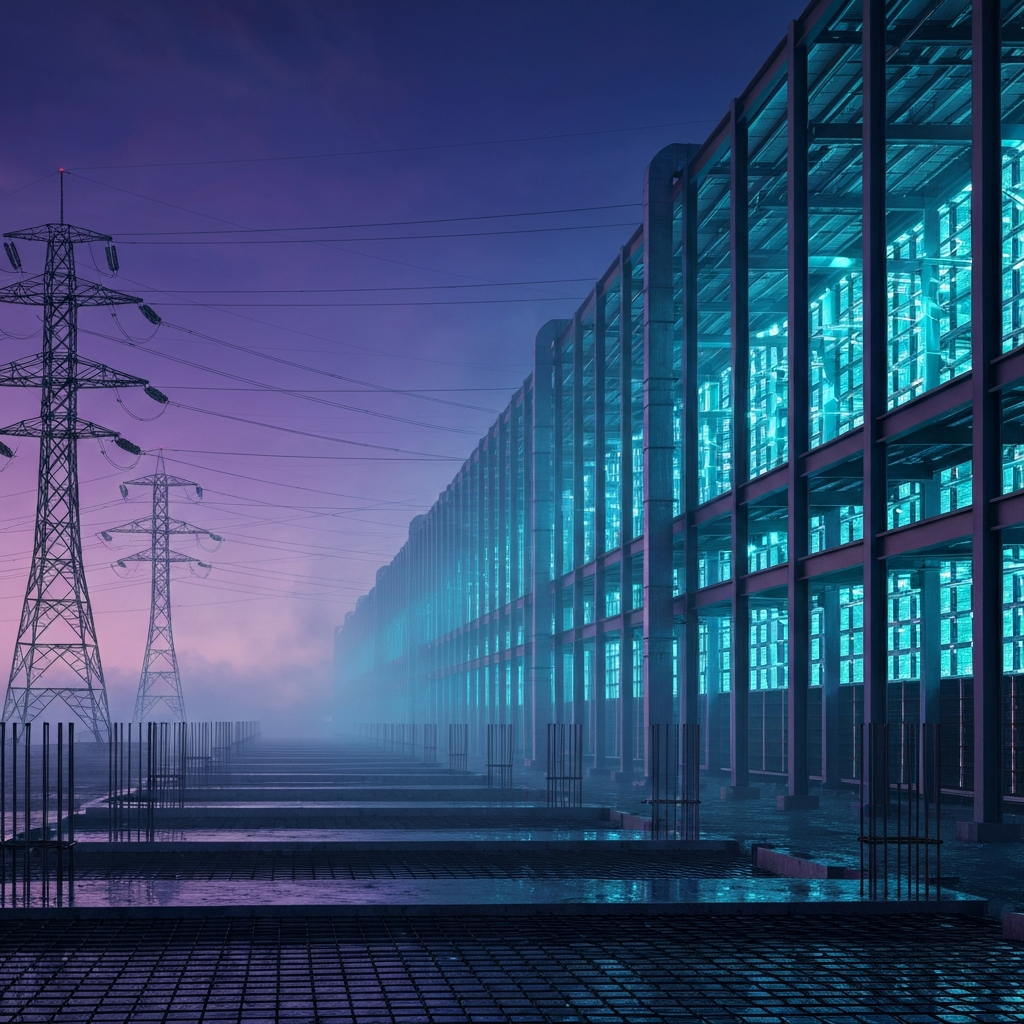
Here is the number that ends the argument. Microsoft, Google, Amazon, and Meta spent more than $200 billion on AI infrastructure in 2024. That money is not a stock quote. It is steel, concrete, chips, and power lines already in the ground.
I think the bubble debate is aimed at the wrong target. People argue about valuations. Valuations move with mood. The physical buildout moves with contracts, and contracts do not un-sign themselves when a stock drops 30%.
The Ground Truth Principle
Here is the framework: separate the price of the ticker from the presence of the concrete.
The concrete is measured in trillions, not stock quotes.
A stock price is a story about the future. It can double or halve on a single earnings call. A poured foundation, a signed grid interconnection, a five-year GPU purchase order: these are facts. They do not re-rate.
Call it the Ground Truth Principle. When you evaluate a boom, ask what is a belief and what is already built. Beliefs can vanish overnight. Buildings take years to demolish.
The bubble camp and the bull camp both fixate on beliefs. Yardeni tracks sentiment and multiples. Burry tracks depreciation schedules and overcapacity. Both are arguing about the story on top of the concrete, not the concrete itself.
The concrete is enormous. BloombergNEF expects capital spending by the 14 largest listed data center operators to approach $750 billion in 2026, up from less than $450 billion in 2025. That is the ground truth. Everything else is commentary.
The Buildout Is Locked In Before the Verdict
Pull back and look at this like a long-duration capital cycle, not a quarterly trade. The right question is not "Is AI overvalued?" It is "What happens when the largest firms on Earth pre-commit trillions to physical assets?"
McKinsey estimates about $7 trillion in data center investment through 2030, with over $5 trillion tied to AI-specific use, a projection the World Economic Forum cites. Morgan Stanley put it plainly in March 2026: AI-related investment now "looks more like industrial build-out than speculative tech spending," with nearly $3 trillion in infrastructure spending still ahead and roughly $2.9 trillion in data center construction projected through 2028.
Morgan Stanley went further. They expect AI-related capex to contribute a meaningful share of US GDP growth in 2026. Once capex becomes a macro variable, it stops behaving like a tech fad and starts behaving like railroads or the grid.
Here is the contrast that clarifies it. Amateurs ask "Will the stock hold?" Operators ask "Who gets paid while the concrete cures?" The second question is about cash flow and contracts, and it survives a valuation reset.
Consider the energy layer, because power is the constraint that proves the buildout is real. Deloitte forecasts US AI data center power demand growing from 4 GW in 2024 toward 123 GW by 2035. A single next-generation data center may draw up to 2 GW, roughly the output of two large nuclear reactors.
You cannot fake a grid interconnection. It requires substations, transmission lines, and years of planning. When 72% of surveyed organizations name power and grid capacity as their hardest constraint, that tells you the demand is running into physics, not into a marketing deck.
Now the honest part. This does not mean the equities are cheap or the returns are safe. Ground truth cuts both ways. Burry's warning about GPU depreciation is serious. Chips get leapfrogged every two to three years, while hyperscalers depreciate them over five to six.
That accounting gap can inflate profits today and bite later. There is also the "financial ouroboros" risk, where chipmakers fund customers who then buy chips. It is unclear whether all this demand is independent or partly self-referential. The data is mixed on true end-user willingness to pay.
But notice what the bears and bulls both concede: the concrete exists. The fight is over whether it earns its keep, not whether it is there. My read is that the physical capacity reshapes the economy regardless of who wins the valuation debate.
2031. Zoom out to 2031. ABI Research estimates AI-dedicated active data center capacity scaling from 11.5 GW globally in 2026 to 43.6 GW by 2031. By then, AI workloads are projected to overtake legacy workloads in active power capacity.
Think about impermanence here. The specific stock winners of 2026 may not be the winners of 2031. DeepSeek showed that a cheaper model can appear and reset the compute math overnight. Individual bets are fragile.
The infrastructure itself is not. Fiber laid in the dot-com bust looked like a stranded asset in 2001. It became the backbone of the streaming economy a decade later. Overbuilt capacity gets absorbed once the price of using it falls far enough.
That absorption is already visible. ARK reports that on OpenRouter, tokens inferred grew over 25-fold in the year after December 2024. Epoch AI's analysis of Artificial Analysis pricing shows the cost to hit a given benchmark fell roughly 99% in a year. Cheaper compute pulls in more usage, which fills the buildings.
Here is the asymmetric bet. If AI underdelivers, we have overcapacity that gets cheap and eventually absorbed. If AI delivers, we are short on power and compute for years. Both paths keep the concrete busy. The tail risk sits in the equity, not in the ground.
Three signals inside the same shift
Contracts do not un-sign themselves.
McKinsey estimates about $7 trillion in data center investment through 2030, with over $5 trillion tied to AI-specific use. Poured foundations and five-year GPU orders are facts that survive a valuation reset, unlike a stock price that can halve on one earnings call.
The grid proves the demand is real.
Deloitte forecasts US AI data center power demand growing from 4 GW in 2024 toward 123 GW by 2035. You cannot fake a grid interconnection, and 72% of surveyed organizations name power and grid capacity as their hardest constraint.
Cheaper compute fills the buildings.
Epoch AI's read of Artificial Analysis pricing shows the cost to hit a given benchmark fell roughly 99% in a year, while ARK reports tokens inferred grew over 25-fold after December 2024. Overbuilt capacity gets absorbed once the price of using it falls far enough, just like dot-com fiber.
What to Build This Weekend
Stop trading the debate. Start building on top of the infrastructure that already exists. The cheapest position in this whole cycle is being the person who uses the compute, not the one who finances it.
First, pick one boring workflow you do every week. Something with clear inputs and outputs. Do not chase the flashy idea. Nail one small problem.
Second, spin up a working version fast. Use Lovable to turn a plain-language description into a functioning web app, no CS degree required. It handles the front end while you focus on the logic. Expect it to break the first few times. That is normal.
Third, add a support layer. Drop Intercom in to handle common questions with its AI agents and knowledge base. This is one afternoon of setup, not a quarter of engineering.
Fourth, speed up your own iteration. Warp is a terminal with AI built in, so you can run and fix code faster without memorizing commands. If you want your demo to actually stop the scroll, use Jitter to add quick motion to your landing page, like Figma for animation.
Here is the point. Inference costs fell roughly 99% in a year, per Epoch AI's analysis of Artificial Analysis pricing. That means the tools sitting on top of this buildout keep getting cheaper for you. The trillion-dollar concrete is being poured whether or not you participate.
Get your reps in this week. Ship one tiny thing. Learn in public. Let the giants argue about the bubble while you quietly use the cheapest compute in history.
Stop trading the debate. Start using the cheapest compute in history.
- Pick one boring workflow. Choose something you do every week with clear inputs and outputs. Do not chase the flashy idea, just nail one small problem end to end.
- Ship a working version fast. Use Lovable to turn a plain-language description into a functioning web app, then drop Intercom in for AI-powered support in an afternoon.
- Speed up your own iteration. Run and fix code faster with Warp, an AI-built terminal, and use Jitter to add quick motion to your landing page so the demo stops the scroll.
Let the giants argue about the bubble while you use the concrete.
The bubble camp and the bull camp both concede that the physical capacity exists. The fight is only over whether it earns its keep. If AI underdelivers, overcapacity gets cheap and eventually absorbed; if it delivers, we are short on power and compute for years. Both paths keep the concrete busy, so the tail risk sits in the equity, not in the ground. Ship one tiny thing this week and let inference costs keep falling in your favor.