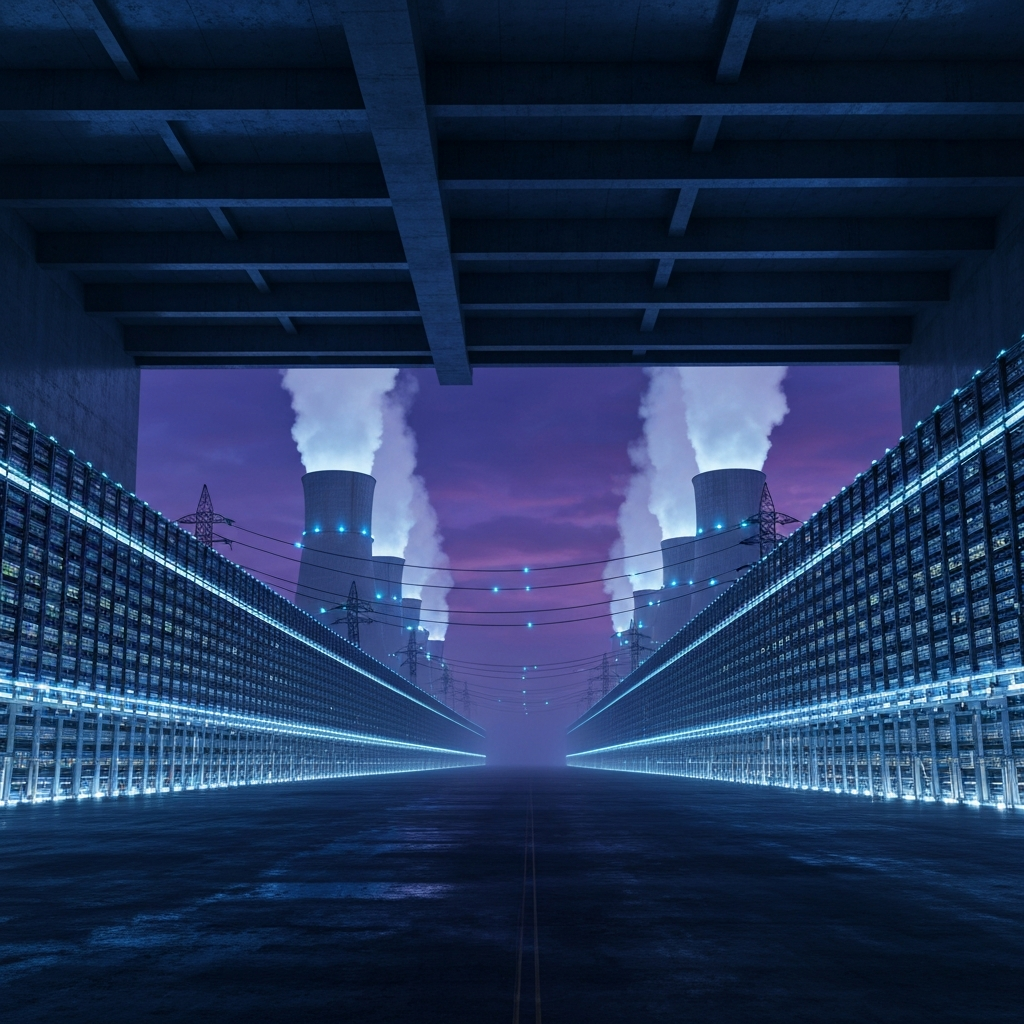
Meta just told the world its Louisiana data center will cost more than $50 billion. That number started at $10 billion in 2024. In under two years, it grew fivefold. And some people close to Meta told Bloomberg the full build could hit $200 to $250 billion.
Here is the part that matters for you. This single campus, nicknamed Hyperion, needs 5 gigawatts of power. That is about what New York City uses on a winter day. To feed it, the utility Entergy is planning 10 gas-fired power plants.
I think this is the clearest signal yet of where AI is heading. The frontier is no longer gated by smart people or clever code. It is gated by capital, power, and chips. Most builders cannot cross that line. This article is about what that means for you, and what you can still do about it.
The Concrete Ceiling
Here is the framework: The Concrete Ceiling.
The four numbers that define the frontier moat.
Software used to be the great equalizer. Two people in a garage could ship a product that competed with a giant. Cheap to build, cheap to copy, cheap to scale. Simple scales, complex fails.
Frontier AI broke that rule. Now the ceiling is made of concrete, steel, and gas turbines. You cannot code your way through it. You have to pour billions of dollars into land, power, and silicon before you serve a single request.
The Concrete Ceiling has three layers stacked on top of each other. Layer one is capital: a single frontier campus now costs over $50 billion. Layer two is power: Hyperion alone triggered 10 new gas plants. Layer three is chips: Meta still owns the AI accelerators, and that bill runs into the tens of billions on top of the building.
Miss any one layer and you do not compete at the frontier. That is the ceiling. Most builders are standing underneath it, renting space from the few who broke through.
The Systems View: Where the Real Bottleneck Lives
Let me put on my systems hat, because this is not really a spending story. It is a constraint story. When you scale any system, you find the one bottleneck that governs everything else.
Meta's own numbers tell you where the bottleneck sits. They said they would invest over $600 billion in the US by 2028. Those are not marketing numbers. They are the price of admission.
Now look at the financing. Meta did not put Hyperion on its own balance sheet. It formed a joint venture with funds managed by Blue Owl Capital, took roughly 20% equity, and let asset managers including PIMCO carry about $27 billion in debt. Meta keeps operational control and long-term access to compute. The debt sits somewhere else.
Study that structure and you see the real moat. It is not just money. It is the ability to assemble a financing package this complex without choking on it. Only firms with top-tier credit and strategic weight can do this. The structure is the barrier.
Here is the part most people miss. Even the giants are hitting the bottleneck. If a hyperscaler can run short, imagine everyone below them. Demand is outstripping supply, and supply is the governing constraint.
Then there is the layer under everything: energy cost. When your operating expense is measured in gigawatts, every dollar of energy compounds across 20-year utility agreements.
My read on this is simple. The bottleneck is not intelligence. It is watts and wafers. The company that solves power and chip access wins, and right now four or five firms control both. That is the definition of a moat.
But I want to be honest about the fragile parts. This moat leans hard on subsidies. Louisiana handed Meta a 20-year sales tax exemption. Louisiana regulators adopted a rule letting data center developers cover at least 50% of new power generation costs, potentially pushing the rest onto ratepayers.
Whether that arrangement survives a backlash is an open question. Meta's own deal reportedly lets it exit its lease as early as 2033, well before those gas plants are paid off. A moat built on political favors and a quiet exit door is not the same as a moat built on unbeatable technology. The data is mixed on how durable this really is.
2031. Pull back five years. Where does the Concrete Ceiling leave the rest of us by 2031?
I do not think the frontier gets cheaper. Efficiency gains help, but demand keeps growing faster than efficiency. The gap between the firms that own compute and the firms that rent it widens. That is compounding, and it favors incumbents.
But compounding cuts both ways. The same forces that lock a handful of players into the frontier create an asymmetric opening below it. When five companies own the biggest models, they need thousands of builders to make those models useful. You do not need a $50 billion campus to build on top of an API.
Think about the contrast. Meta is betting hundreds of billions on owning the engine. You get to build the car. Owning the engine is a capital game with brutal risk, including stranded gas plants if AI demand disappoints. Building the car is a distribution and workflow game with almost no capital risk at all.
Here is the strategic point. Do not fight uphill against the Concrete Ceiling. Counterposition against it. The frontier labs cannot chase every niche, every workflow, every small market. The nicher you go, the faster you grow. That is where the asymmetric advantage lives for anyone without a utility contract.
By 2031, I suspect the winners at your level will not be the ones who tried to train foundation models. They will be the ones who used frontier compute as a cheap raw material and turned it into products people actually pay for.
Three signals inside the same shift
The ceiling is now made of concrete and gas turbines.
A single frontier campus costs over $50 billion, up fivefold from $10 billion in 2024. You cannot code your way through land, power, and silicon. Most builders stand underneath the ceiling, renting space from the few who broke through.
Energy is the governing constraint, not code.
Hyperion alone needs 5 gigawatts, about what New York City uses on a winter day, and triggered 10 new gas plants. When operating expense is measured in gigawatts, every dollar of energy compounds across 20-year utility agreements.
The asymmetric advantage lives below the ceiling.
By 2031 the winners at your level will not train foundation models. They will use frontier compute as cheap raw material. Meta owns the engine at hundreds of billions in risk. You build the car with almost no capital risk.
What to Build This Weekend
You cannot pour a data center this weekend. You can build something that rides on one. Let me show you exactly where to start.
First, pick one boring, repetitive task you do every day. Not a big vision. One tiny thing. The goal is to feel how cheap frontier compute has become when someone else pays for the concrete.
Try typedesk, the AI text expander. Set up shortcuts that expand into full messages across every app you use. It kills repetitive typing, and it takes about 20 minutes to feel the payoff. Get your reps in on something small first.
Then go one level deeper. If you write code, look at Leanstral 1.5, Mistral's Lean 4 formal proof model and code agent that helps construct machine-checkable proofs of correctness, not just raw code. That means it checks its own work is provably right, which matters when you cannot afford silent bugs.
Want to build a product, not just save time? xAI's Voice Agent Builder is a no-code beta for assembling production-ready voice agents. No CS degree required. You are wiring together compute you did not have to buy. If brainstorming is your bottleneck, Artypa pairs an AI chat partner with image tools to get you unstuck fast.
Expect things to break. Test aggressively, fix, repeat. Build one tiny thing, ship it, then build the next. The people who own the ceiling need people who build under it. Be one of them.
Ride the data center you cannot pour.
- Kill one repetitive task. Set up typedesk, the AI text expander, with shortcuts that expand into full messages across every app. It takes about 20 minutes to feel the payoff and get your reps in on something small.
- Ship provable code. If you write code, try Leanstral 1.5, Mistral's Lean 4 formal proof model that builds machine-checkable proofs of correctness. It checks its own work is provably right, which matters when you cannot afford silent bugs.
- Build a real product. Use xAI's Voice Agent Builder, a no-code beta for assembling production-ready voice agents, to wire together compute you never had to buy. Ship one tiny thing, then build the next.
Do not fight the ceiling. Counterposition against it.
Meta is betting hundreds of billions on owning the engine, complete with a 20-year sales tax exemption, ratepayer subsidies, and a quiet lease exit as early as 2033. That moat leans hard on political favors, not unbeatable technology. But five firms owning the frontier need thousands of builders to make those models useful. The nicher you go, the faster you grow. Turn cheap frontier compute into products people actually pay for.