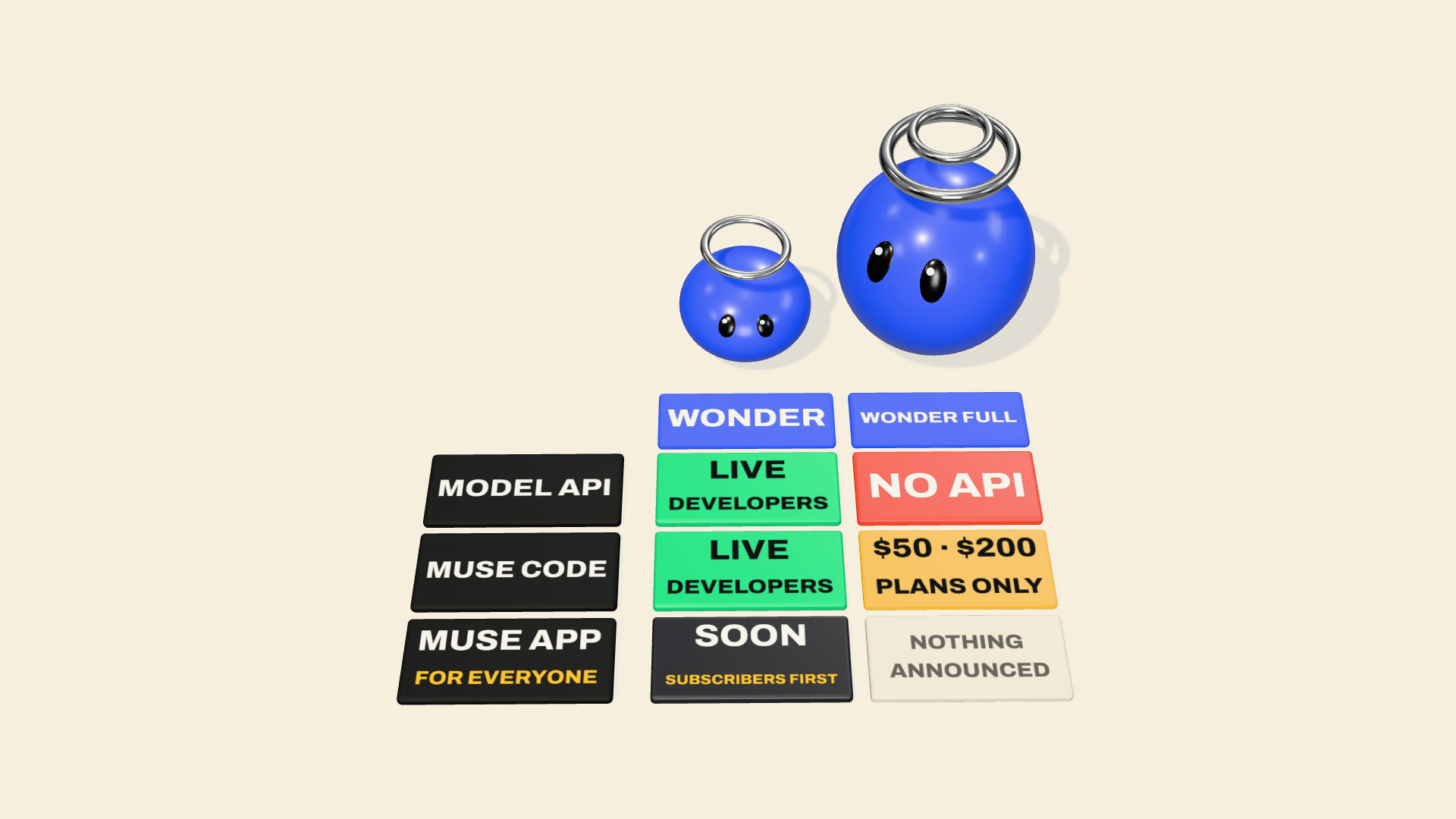
Meta launched two new models on October 12: Muse Wonder and Muse Wonder Full. It calls them its most capable models to date and says they were built for agents, which is software that takes a job and finishes it. We made a short film about what the two models promise and who can use them today. You can watch it on this page, or as a YouTube Short.
Two promises
Meta gives the new abilities names. Active Memory is "the ability to carry what matters to you across conversations and bring back the details that are relevant to the task at hand". Active Focus is the ability to "keep working toward your goal when a task gets hard, try other approaches, recover from errors, and follow through".
What each number does and does not say
The jobs Meta has in mind are ordinary ones. Its announcement names an insurance claim, a lease and "someone's finances". Its demos show a model planning a Saturday run around a person's preferences and seating the guests at a wedding.
There is a third promise inside the second. Meta says the models ask for clarification when they need it and check in "before following through on anything important". If you have ever let an agent near a payment or a filing, that is the sentence to test first.
Which one can you use
This is where the launch gets narrower than the headline.
Muse Wonder is available today through the Meta Model API and in Muse Code, Meta's coding agent. The API price is $4 per million input tokens and $20 per million output tokens, with a context window of 1 million tokens.
Muse Wonder Full has no API price, because it is not on the API. Meta's model page lists its access as "Muse Code subscription only", on the Power Usage plan at $50 a month and the Maximum Usage plan at $200 a month. Muse Code also has plans at $5 and $15 a month, and the page does not list Wonder Full on them.
The Muse app is the product Meta describes as a personal agent built for everyone. Meta says Wonder "will soon power experiences in Muse, and will roll out first to subscribers". It gives no date, and the announcement does not mention Wonder Full in the app at all.
So on launch day a developer can call Wonder, a coder on a $50 plan can use Wonder Full, and a person who opens the Muse app gets neither yet.
Three numbers to act on
MemoryBench, Muse Wonder
The highest score in Meta's own table. Wonder Full is just behind it.
A month, for Wonder Full
The Power Usage plan in Muse Code. The bigger model is not on the API.
Artificial Analysis Index, Wonder
The score of the model you can build on. The stronger numbers belong to Wonder Full.
What the scores say
Meta published a table that compares both models with Claude Fable 5.1, GPT-6 Astra and Claude Opus 5.5. Read it with the access list next to it, because the two Meta models do not score the same.
On Vals Finance Agent V2, which the table describes as financial analyst research, Wonder Full scores 59.1 and Wonder scores 56.6. Claude Fable 5.1 is at 58.9 and Claude Opus 5.5 at 58.6. On the Artificial Analysis Index, Wonder Full scores 56 and Wonder 52, against 58 for Opus 5.5. On MemoryBench the two Meta models lead the table, at 85.5 for Wonder Full and 85.6 for Wonder.
The stronger numbers mostly belong to the model without an API. If you plan to build on Wonder, compare the Wonder column.
All of these figures come from Meta's own page. Meta also says a full report with additional safety evaluations "will be available soon", so that part cannot be checked yet.
Why a finance team should care
I run AI on real finance work every day, and two things in this launch matter to me.
Memory changes what you have to control. A model that carries context from one conversation to the next can carry a wrong assumption as easily as a right one. Before a team relies on it, someone should know how to see what it remembers and how to correct it.
The check-in is the feature to test. An agent that stops before it pays or files is an agent you can put a control around. Ask what counts as important, and whether you can set that line yourself.
Sources. Meta, Introducing Muse Wonder and Muse Wonder Full, October 12, 2026. Meta, Muse Wonder: A Frontier Model For Personal & Professional AI Agents, October 12, 2026. Meta, Muse Wonder model page and Muse Code, both checked on October 12, 2026. The launch thread on Hacker News had 533 points and 297 comments 9 hours after it was posted.
The running route, the wall and the "OK to submit?" card in the film are illustrations of what Meta describes. They are not recordings of the product.
Three things to do this week
- Test the check-in. Give the agent a task that ends in a payment or a send. See where it stops, and whether you can move that line.
- Read the right column. If you build on the API, compare Wonder's scores. Wonder Full is not there.
- Ask what it remembers. Find where stored context can be seen and corrected before a team relies on it.
It wants to do your work. For now it works for developers.
On memory, Meta's two models top its own table. But the version most people will meet is the one in the Muse app, and that has no date yet.