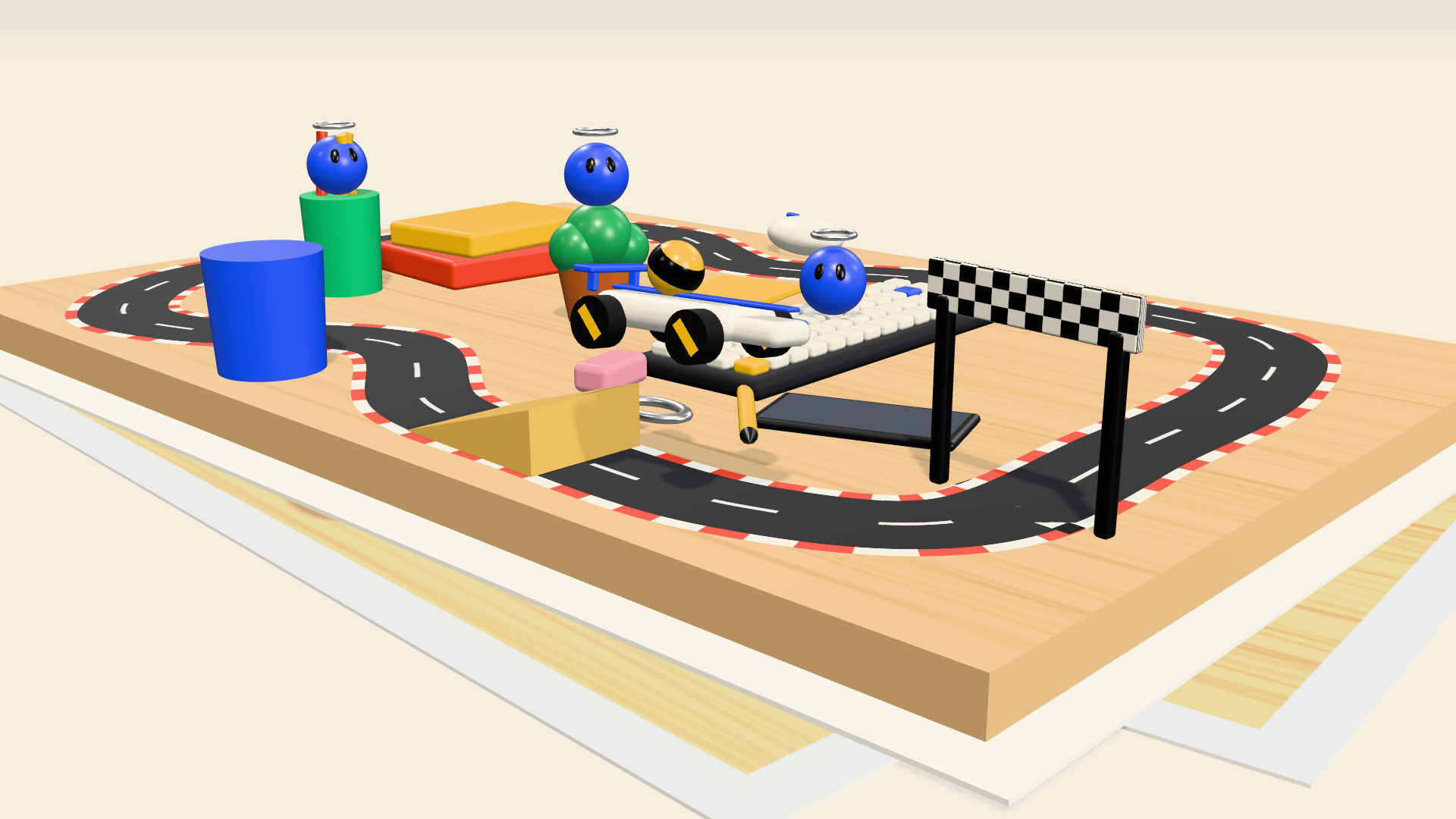
Google's new model, Gemini 4 Argon, rolled out on October 13. One of the launch demos has a pitch you can say in a breath: photos of a real desk go in, and a miniature racing game you can play comes out. We made a one-minute film that rebuilds that demo one tool at a time. You can watch it on this page, or as a YouTube Short.
What Google showed
Google's caption for the demo is two sentences, and they are worth reading slowly. "Argon turned pictures of a real desk into a playable miniature racing game using a multi-agent loop in Antigravity. The desk objects, room and race track were modeled and collision-checked using Blender MCP, textured with Nano Banana, and wired with physics, custom shaders, and car engine audio from Gemini Omni Flash in Three.js."
What each number does and does not say
People noticed. The launch thread on Hacker News had 949 points and 734 comments 8 hours after it was posted.
Five tools around one model
Count what that caption names besides Argon. There are 5.
Antigravity is Google's agent platform, and it is where several agents ran in a loop. Blender, reached through an MCP connection, modelled the desk objects, the room and the track and checked them for collisions. Nano Banana made the textures. Three.js carries the physics and the shaders. And the engine sound came from a second Google model, Gemini Omni Flash.
So the headline is true, and it is also short. One model did not turn a desk into a game on its own. One model worked through five tools.
I don't say that to shrink the demo. Most serious agent work is built this way now, and it changes what to ask when someone shows you one. Ask which model, with which tools, set up by whom.
Three numbers to act on
Tools around one model
Ask for the tool list before you judge an agent demo. With the model, that is 6 things to license and keep working.
A month, for Argon in the Gemini app
Google AI Pro in the US. The free tier is not on Google's list for Argon.
A month and up, for Argon in Antigravity
The demo was built there. Google says that access is for Ultra subscribers.
What it costs to try
Google put the finished game in AI Studio with a "Try it now" link. The link asks you to sign in with a Google account.
Using Argon yourself is a different matter. In the Gemini app and in AI Mode in Search, Google says Argon is for Google AI Pro and Ultra subscribers. On Google's US plans page, Pro is $19.99 a month and Ultra starts at $99.99 a month.
Argon inside Antigravity, where the desk game was built, is narrower. Google's launch post and the Antigravity team's own post both say it is for Google AI Ultra subscribers. Businesses can also reach it through eligible Gemini Enterprise subscriptions and the API.
Developers pay by use. Google lists Argon on the Gemini API at an introductory $2 per million input tokens and $10 per million output tokens until November 30, 2026. After that the price is $4 and $20.
The desk was free. The AI that turned it into a game is not.
What Google did not say
The caption gives no build time, no count of agents, no number of photos and no cost for the run. Those are the figures you would need to repeat it. Until they exist, I would treat the demo as proof that this can be done, and not as a recipe.
Why a finance team should care
I run AI on real finance work every day, and I read a launch demo the way I read a budget request.
The tool list is the real scope. A project that needs one model and five tools has 6 things to license, secure and keep working. Ask for that list before you approve a pilot.
The price depends on where you use the model. The same Argon is $19.99 a month in an app, at least $99.99 a month in the agent platform, and a metered rate on the API. Find out which of those your team would use before anyone quotes you a saving.
And a demo with no run cost is half a business case. Somebody has to supply the hours and the tokens.
Sources. Google, Gemini 4 Argon: Built to solve your hardest problems, October 13, 2026. Google, Gemini 4 Argon is now available for developers, October 13, 2026. The Antigravity team, Gemini 4 Argon in Google Antigravity, October 13, 2026. Google AI plans, US prices checked on October 13, 2026. The game: Desk Racer in Google AI Studio.
The desk, the kart and the track in the film are our own drawing of the idea. They are not Google's footage.
Three things to do this week
- Ask for the tool list. Write down every tool the demo used, and who would own each one in your team.
- Price the place, not the model. App plan, agent platform or API: find out which one your work would run in.
- Ask for the run cost. Hours and tokens for one full build. Google has not given them for this one.
The desk was free. The AI is not.
One model and five tools turned photos into a game. Using that model yourself takes a paid plan, and the platform it was built in takes the dearest one.