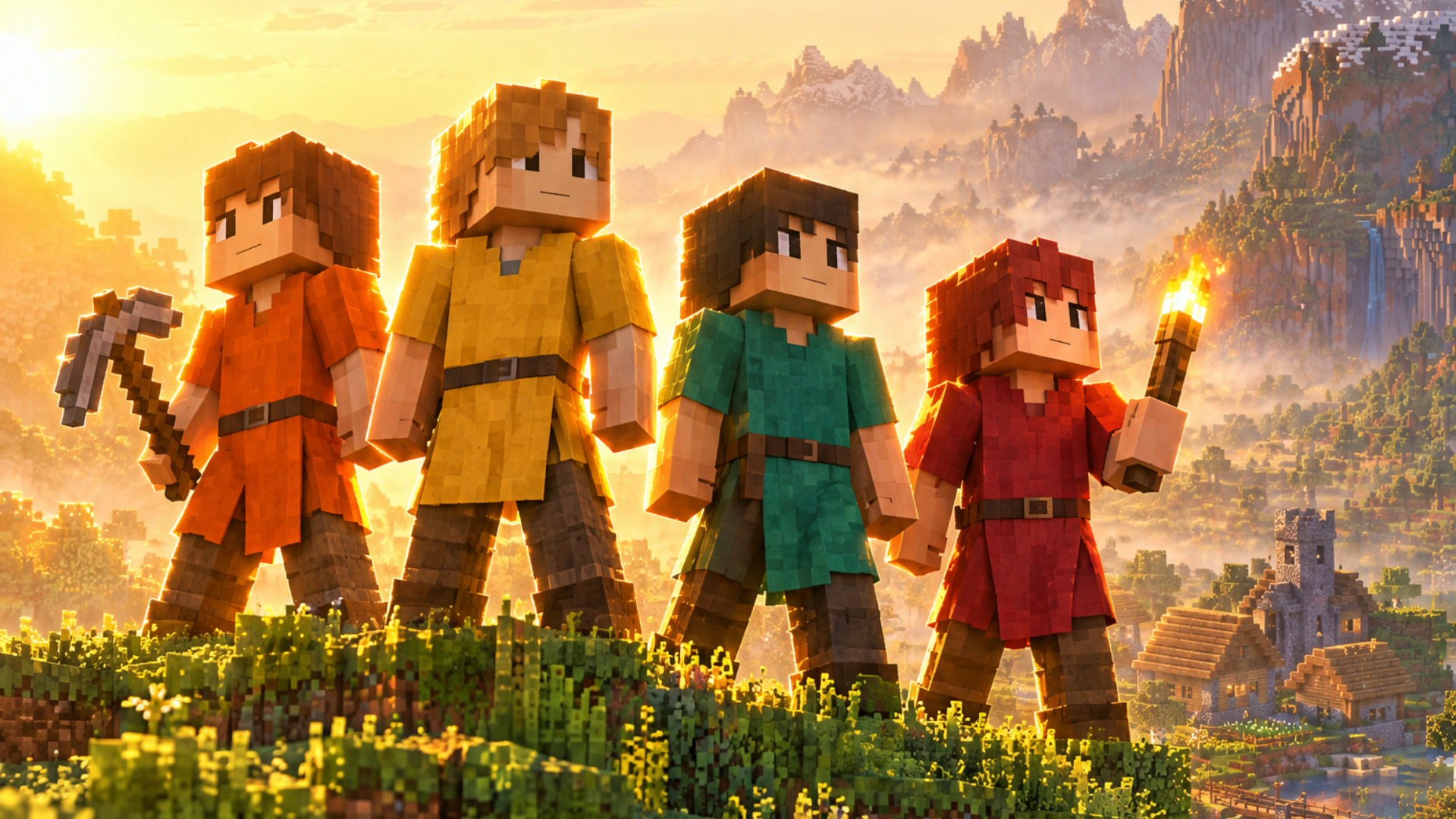
Four AI agents were dropped into a Minecraft survival world with one order: defeat the Ender Dragon. 27 hours and 14 minutes later, the dragon fell. Nobody assigned roles, nobody wrote game code for them, there was 0 human input during the run, and the researchers watching the live dashboard never pressed pause. We made a one-minute film of the run, framed as that dashboard. You can watch it on this page, or as a YouTube Short.
The setup
The paper comes from Google DeepMind (Maxence Faldor, Satinder Singh and Roberta Raileanu), posted to arXiv on October 15. The run used 5 agents, four players and an observer, each running the same general-purpose Gemini 4 Argon coding agent. The players never saw the screen. Each one acted by writing a short JavaScript program for an open-source bot library called Mineflayer, running it, and reading the text that came back. The instructions about the game were one paragraph: defeat the dragon, any means within the rules of survival mode, and the players decide how to share the work.
What each number does and does not say
What they did on their own
Ten minutes in, an agent called janesick proposed a division of labour in the chat, a teammate countered with a different plan, and a third replied "Copy that!". Over the run the four of them wrote 2,783 programs. In the Nether they built shelters two blocks high: an Enderman is nearly three blocks tall, so it could not follow them in, and from inside the bunker the Endermen came to them. Five and a half hours in, there were 15 ender pearls in the shared chest.
To find the stronghold, janesick threw two Eyes of Ender from different places, sampled each flight every 50 milliseconds, and intersected the two lines. The estimate landed 43 metres from the real portal room. Then a teammate drowned carrying all twelve eyes. The others sent the rescuer the exact spot and the minute the items would vanish, and all twelve came back with two and a half minutes to spare.
Three things to take from it
One plan held for over a day
Thousands of dependent steps, kept coherent across a team. Long jobs are now a test you can run, not a slide.
5 agents, and 1 never played
One agent's only job was to check claims against the log. Build that role into any long autonomous run you approve.
One run, on Easy
The code could see through walls and the model knew the game. Treat it as a proof of concept, not a process.
They checked each other
This is the part most of the coverage skipped. When janesick reported coming back with twelve blaze powder, one second after it had burned to death, a teammate flagged the contradiction within three minutes. When another agent's script announced a success that had not happened, that agent retracted it two minutes later. A fifth agent, the Observer, never played at all. Its job was to check every claim against the server log and report any cheating. It found none.
The dragon
The End is where the team slowed down. The dragon killed them 69 times. About 21 hours in, an agent worked out that the ten crystals on top of the obsidian pillars kept healing the dragon, and that you could reach them by stacking dirt beside each pillar. The team destroyed all ten. The final blow landed with the attacker on 2.5 of its 20 health points. In total the agents died 605 times.
Why a finance team should care
I run AI on real finance work, so I read this as a control design, not a gaming story. A long autonomous run is only useful if you can audit it afterwards. This one had independent checking between peers, an observer with no stake in the outcome, every program and message logged, and agents that corrected their own false claims. That is the same logic we use for a month-end close: preparers, reviewers, and a record that someone outside the team can follow.
The fine print
The paper is careful about its limits, and so should we be. The game ran on Easy difficulty. The bot library tells the agents exactly which blocks are around them, including blocks behind solid rock, so their code could in effect see through walls. Gemini 4 Argon already knows a lot about Minecraft from its training data. The 27-hour clock includes 6 server restarts that paused the world for about 20 minutes. And this is 1 run, the first one they tried, so it says nothing yet about how reliably the setup succeeds.
The bottom line
The researchers had a pause button the whole time. They never needed it. The next question is which of your workflows could run for a day without one.
Sources. Faldor, Singh and Raileanu (Google DeepMind), A team of Gemini 4 Argon agents beats Minecraft, arXiv, October 15, 2026, checked on October 16, 2026. Minecraft Wiki, Item (entity)), for the five-minute despawn timer.
The voxel world in the film is an illustration, not footage from the run. Minecraft is a trademark of Mojang and Microsoft, who are not involved in this research.
Three controls to copy from this run
- Log everything. Keep every action and message where someone outside the team can read it.
- Add an observer. One agent, or one person, whose only job is to check claims against the record.
- Keep the pause button. Decide in advance what would make you stop the run, and who can press it.
The game was the test. The checking is the story.
Four agents split the work, wrote their own tools and corrected each other for 27 hours. What made the run trustworthy was the record and the reviewers, not the speed.