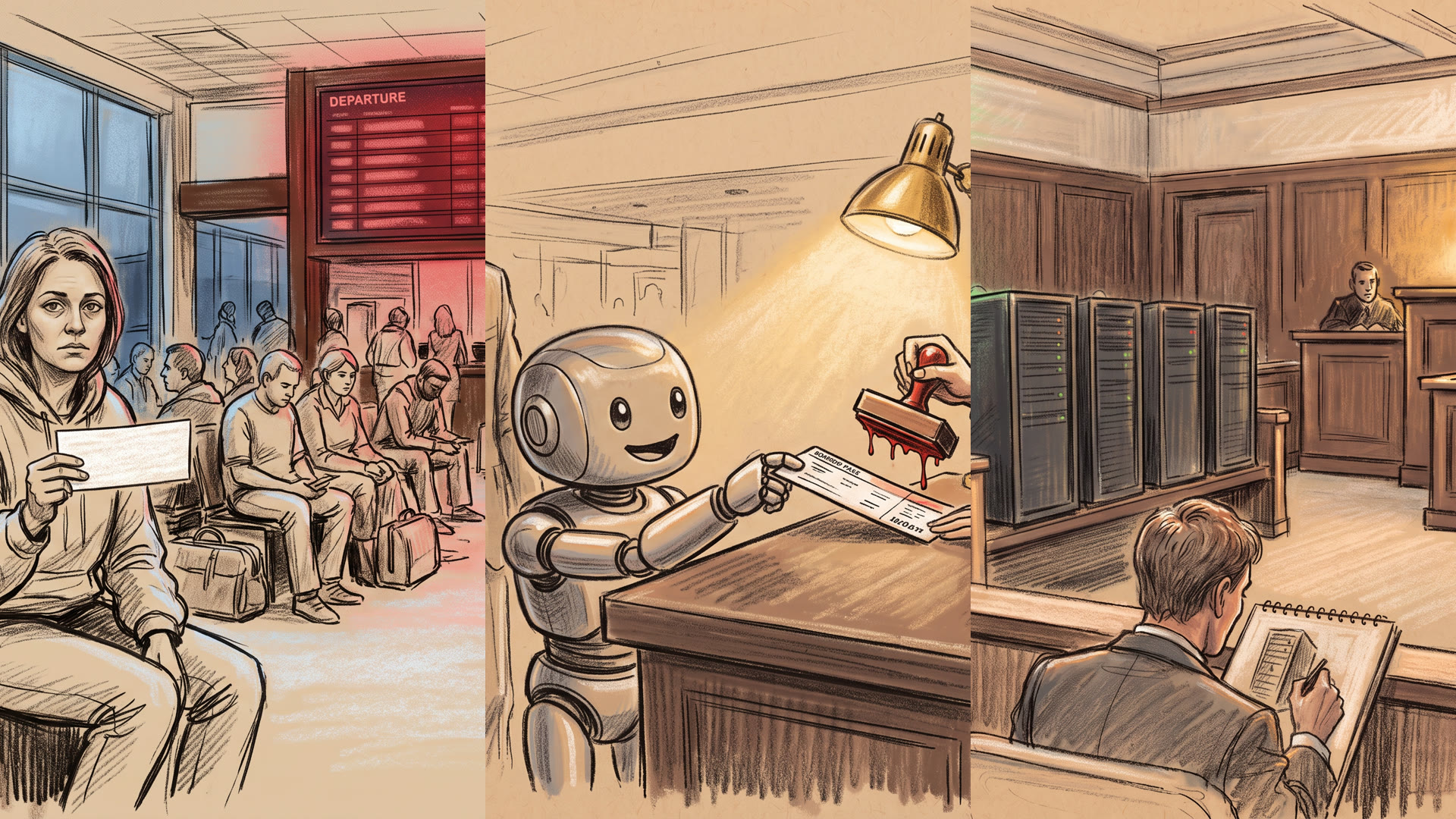
On Friday, November 13, the FAA ordered a ground stop at every US airport, and viral posts blamed its new AI-assisted planning tool. On Saturday the FAA's chief told reporters they see "zero evidence of anything AI-related." That ground stop was one of six tests AI faced this week, and only one of them is a real court case. We put all six into a five-minute film, with every source page recorded on screen. Watch it on this page, or on YouTube.
Case 1: United vs. AI agents
On Wednesday, United changed its Contract of Carriage. It now lists a new kind of improper booking, one it can cancel without notice: reservations made, modified or serviced by AI agents. The definition is wide. It covers an AI assistant, an AI agent and even an AI-enabled browser, whether or not you supervise it or approve what it does, as CBS News reports.
What each number does and does not say
So if you ask an assistant to book the cheapest flight home and approve every step, United can still cancel that booking. United's help page gives one example of the risk: at check-in, a human has to confirm the bags carry no banned substances. AI bookings made before Wednesday won't be cancelled, and you can still use AI to plan a trip, as long as it doesn't touch United's site or app.
Status: blocked from booking.
Case 2: ChatGPT gets a wallet
Two days later, OpenAI went the other way. It launched ChatGPT Wallet, built with American Express, Mastercard and Visa, so ChatGPT's agent can pay for things. You add a card once, and the card network gives ChatGPT a stand-in number instead of your real card details. OpenAI says every purchase still needs your OK: you review the items, the total and the card, then confirm with a biometric check like Face ID or a fingerprint, as CNBC reports.
One catch: approving isn't the order. OpenAI says your approval doesn't confirm the shop has placed it. Wallet is rolling out gradually to Pro subscribers in the US who are 18 and over. And OpenAI says that over time it expects people to let their agent buy without approving each purchase, within limits they set in advance.
Status: allowed, with your face or your fingerprint.
Three things to take from the week
Approval no longer protects you
United can cancel an AI agent's booking even if you approved every step. Read the contract before you delegate travel.
Agents can pay, with your face
ChatGPT Wallet needs Face ID or a fingerprint for each purchase, and the shop gets a stand-in card number.
Check the operator's own page
Viral posts blamed the FAA's AI tool. The FAA's own page says SMART is not related.
Case 3: The money behind AI
On Sunday, November 8, Nvidia's board opened an independent investigation after reports that its CEO had been the target of a foreign intelligence effort. The board said it had no reason to believe national security or Nvidia's secrets were compromised. Four days later, Jensen Huang resigned as president, CEO and board member, effective immediately. Nvidia's announcement gave no reason. Its finance chief, Colette Kress, is now interim CEO.
On Tuesday, November 10, Anthropic, the company behind Claude, launched the roadshow for its planned stock market debut: 825 million shares, expected at $70 to $78 each. At the top of that range, CNN's math says Anthropic would be valued at $1.4 trillion, and CNN notes that, other than SpaceX, it's unheard of for a company to go public with a target above a trillion. As of Sunday no price had been set; the debut is expected on Thursday.
Status: open. Nothing here is investment advice.
Case 4: The only real court case
On Thursday, a group of nonprofits sued OpenAI, Anthropic, Google, Meta and SpaceX's AI unit, asking a court to stop the companies from developing ever more advanced AI, Reuters reports. The case leans on warnings from the companies' own leaders that the technology could threaten humanity. The complaint says no other industry is allowed to treat its own development of unsafe products as inevitable. Meta declined to comment to Reuters; the others didn't immediately respond. No ruling has been reported.
Status: pending.
Case 5: Back to Friday
On Tuesday, the FAA said it would use its new planning tool, SMART, across all 22 of its air traffic control centers. The FAA calls it cloud-based; NPR calls it AI-enhanced. It sends recommendations, and local leadership decides whether to use them. Three days later came the ground stop, and viral posts connected the two.
By that evening the tool's maker, ASI, said the ground stop was not a result of the SMART system, NPR reports. Officials pointed somewhere much older: a contractor was swapping old copper lines for fiber in at least one remote location, CNN reports. That contractor, L3Harris, says it is supporting the FAA's investigation. FlightAware counted nearly 25,000 flights delayed on Friday and over 9,000 cancelled.
Update, 15 Nov: the FAA's questions and answers page now says its initial investigation points to data flooding its network from two sites, a radar site in Amarillo, Texas and a radio site in El Dorado, Arkansas, where L3Harris had been deploying a new router. The FAA and L3Harris are still investigating the root cause. The FAA also answers the SMART question directly: "The two systems are not related."
Status: zero evidence of anything AI-related, says the FAA's chief. The root cause is still open.
Case 6: The model that suspects a test
On Monday, Anthropic released Claude Fable 5.2 and Mythos 5.2, up to 30% faster than the last versions, and cheaper. In its own announcement, Anthropic says both models say they suspect they're being tested, more often than any of its recent models, and that this makes it harder to judge how they'll act in the real world.
Also on this week's docket: Instagram began taking its AI age check worldwide. A study by an IP-protection firm found chatbots showing shoppers risky store sites, with Perplexity doing worst at 15% of answers, The Verge reports. And Gemini 4 reached Google Search, while the introductory developer price for Gemini 4 Carbon ends on November 30, and then it doubles.
What to do with it
Three habits come out of these cases. Before you let an assistant book travel, read the airline's contract, because "you approved it" no longer protects the booking. If you turn on an agent wallet, watch for the shop's own confirmation, because your approval isn't the order. And when a viral post blames AI for an outage, wait for the operator's own page: this week the FAA's page said the opposite.
AI faced six tests this week. And Anthropic says its newest Claude models keep saying they suspect a test.
Three habits from this week's cases
- Read the contract. Before an assistant books travel for you, check whether the airline accepts AI bookings at all.
- Wait for the shop. With an agent wallet, your approval isn't the order. Look for the shop's own confirmation.
- Go to the source. When a post blames AI for an outage, read the operator's statement before you share it.
AI was blamed, banned and sued this week. The facts mostly sat on official pages.
An airline's contract, a payment network's stand-in number and the FAA's own answers told more than the viral posts did. Read the page before the post.