Monday, March 23, 2026
Koda Intelligence Briefing
AI · World · Markets · Tools — Your daily edge
8
AI Stories
4
World Events
Fear
Market Mood
6
Tools Featured
Daily Summary
The world is on fire, oil is at $111, and AI just got a 1-million-token brain. Pick which one you care about more. Both will reshape how you work this week.
AI
OpenAI shipped GPT-5.4 with a 1.05 million token context window and the ability to autonomously execute multi-step workflows. That is not an upgrade. That is a category shift. At the same time, Google Stitch dropped free and Figma stock fell 12% on day one. The pattern is clear: AI is making professional tools free. Finance reporting is next.
World
Day 23 of the US-Israel-Iran war. Iran struck Arad and Dimona, injuring 100+. Trump threatened to obliterate Iran's power plants. Then he backed off for 5 days, citing "productive conversations." The Strait of Hormuz is still disrupted. IEA says this is the largest oil supply shock in history. Cuba went dark for the third time this month. Sudan lost 64 civilians in a hospital strike.
Markets
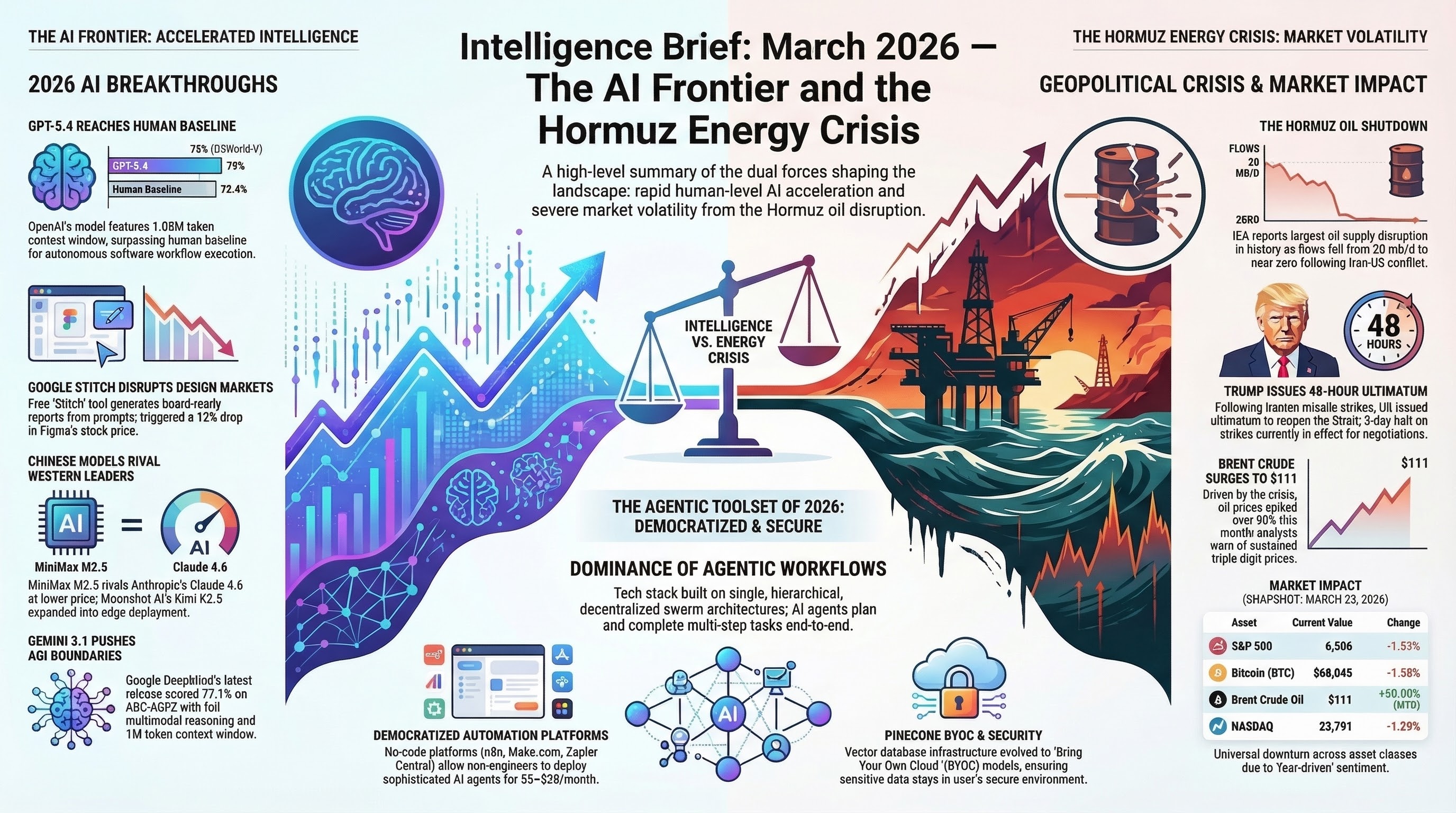
Everything is red. S&P 500 down 1.51%. NASDAQ down 1.29%. BTC at $68k, ETH at $2,062. The one thing going up: oil. Brent crude at $111, up over 50% this month alone. Hormuz flows dropped from 20 million barrels per day to nearly zero. Goldman Sachs says triple-digit oil could stick for years. Energy sector is the only hedge that's working right now.
Wild Card
Chinese AI is not losing. Five Chinese models dropped this month. MiniMax M2.5 now rivals Claude Opus 4.6 at a fraction of the cost. Kimi K2.5 runs on Cloudflare's edge. The West is spending billions on AI infrastructure. China is shipping cheaper, faster models. The cost war is on. And the winner is every developer who does not care which flag is on the model card.
Full breakdown below. Start with the infographic. →
Today's Focus
1
GPT-5.4 Goes Live: 1M Tokens, Autonomous Workflows
OpenAI's GPT-5.4 is not just a better chatbot. It can read your entire codebase, your full contract history, your year of emails, all at once, and take action across software environments autonomously. The 1.05M-token context window is now the commercial standard. If you haven't tested it on a real work task yet, today is the day. Release notes ↗
2
Hormuz Crisis: Oil at $111 and Climbing
The Strait of Hormuz handled 20 million barrels per day before the war. It's now near zero. Brent crude is up 50% this month. Trump paused US strikes for 5 days to negotiate, but nothing is resolved. This is not a short-term spike. Plan your energy exposure and supply chain accordingly. CNN Live Updates ↗
3
Google Stitch: Free AI Design Tool Disrupts Professional Work
Google Stitch turned a napkin sketch into a board-ready CFO report with one prompt. It's free. It critiques its own work in real time. Figma lost 12% of its stock value the day it launched. If you're still manually building financial presentations, stop. Test Stitch today. finstory AI ↗
AI Developments
OpenAI
GPT-5.4: 1.05M Tokens, Autonomous Execution, 75% on OSWorld-V
OpenAI's GPT-5.4 sets a new commercial benchmark with a 1.05-million-token context window. The model scores 75% on OSWorld-V, just above the human baseline of 72.4%, and can autonomously execute multi-step workflows across software environments. Mini version now rolling out to Free and Go users. OpenAI has surpassed $25B in annualized revenue and is eyeing a late-2026 IPO.
↗ OpenAI Release Notes
Google DeepMind
Gemini 3.1 Pro: 77.1% ARC-AGI-2, 1M Context, Full Multimodal
Google DeepMind's Gemini 3.1 Pro scores 77.1% on ARC-AGI-2 with a 1M-token context window and multimodal reasoning across text, images, audio, video, and code. Flash-Lite variant offers 2.5x faster responses at just $0.25 per million input tokens, making it the most cost-effective frontier model available.
↗ LLM Stats
Google
Google Stitch: Free AI Design Tool Crashes Figma 12%
Google Stitch builds working, high-fidelity reports and interfaces from plain-language prompts. No wireframes, no design background needed. It critiques its own work in real time, responds to voice, and deploys in one click. The day it launched, Figma dropped 12%. Finance reporting, legal documents, and board materials are all in the crosshairs next.
↗ finstory AI Deep Dive
China AI
Five Chinese Models Drop: MiniMax M2.5 Rivals Claude Opus 4.6
Tencent, Alibaba, Baidu, ByteDance, and MiniMax all launched models in March. MiniMax's M2.5 rivals Anthropic's Claude Opus 4.6 at a significantly lower cost. Moonshot AI's Kimi K2.5 is now available in Cloudflare Workers AI for edge inference, no server management required. Chinese models are winning the cost war.
↗ Model Releases
NVIDIA
Nemotron 3 Super: 120B Parameters, 12B Active, Built for Agents
NVIDIA's Nemotron 3 Super is a 120B-total-parameter hybrid Mixture-of-Experts model with only 12B active parameters per forward pass. Announced at GTC on March 11, it's designed specifically for complex multi-agent enterprise applications where inference efficiency matters as much as raw capability.
↗ LLM News
Anthropic
Anthropic Rolls Out Memory for All Claude Users
Anthropic's persistent memory feature is now available to all Claude users. The assistant retains context, preferences, and project history across conversations. Combined with Claude Sonnet 4.6 and Opus 4.6 (released in February), Anthropic now offers a 1-million-token context window in beta with improved coding capabilities. Over 30 OpenAI and Google employees publicly backed Anthropic's DOD lawsuit.
↗ AI Breakthroughs 2026
MIT Research
MIT AI Model Slashes Drug Development Costs by Billions
MIT's protein-based drug design model predicts how synthetic proteins fold and interact with molecular targets, cutting pharmaceutical R&D costs by billions of dollars. The model accelerates treatment development for cancer, autoimmune diseases, and rare genetic disorders. Medical AI matured from research curiosity to pipeline reality this month.
↗ AI Global Developments
Infrastructure
Kimi K2.5 on Cloudflare Edge: Frontier AI Without Servers
Moonshot AI's Kimi K2.5 is now available in the Cloudflare Workers AI ecosystem, enabling developers to run a frontier-level AI model directly on edge computing infrastructure. No servers to manage, no GPU clusters to provision. This signals the next phase: frontier-grade AI as a commodity infrastructure layer.
↗ Build Fast With AI
World News
Conflict
Iran-US-Israel War Day 23: Hormuz Ultimatum, Trump Pauses Strikes
Iran struck the Israeli cities of Arad and Dimona (near Israel's nuclear research center), injuring 100+ people. Trump issued a 48-hour ultimatum to reopen the Strait of Hormuz or face strikes on Iran's largest power plant. Iran warned it would "completely close" Hormuz if power plants are struck. Trump then halted all US energy infrastructure strikes for five days, citing productive diplomatic conversations. Nothing is resolved.
↗ CNN Live Updates
Energy Crisis
Strait of Hormuz: IEA Calls It the Worst Supply Shock in History
The International Energy Agency warns the Hormuz disruption is the largest supply shock in the history of the global oil market. Crude and oil product flows through the Strait have fallen from around 20 million barrels per day before the war to near zero currently. Goldman Sachs says triple-digit oil prices could persist for years if the conflict is not resolved.
↗ IEA March 2026 Report
Conflict
Ukraine: Low-Tech Overhead Netting Deployed Against Russian FPV Drones
Ukrainian towns are installing overhead netting as a low-cost defense against Russian FPV (first-person view) drones — the latest generation of cheap, precise, lethal weapons deployed by Russian forces. Cities along the advancing eastern front line are preparing infrastructure for sustained urban combat. Russia's full-scale invasion is now in its fifth year.
↗ NPR World
Crisis
Cuba Goes Dark for Third Time in March as Grid Collapses Again
Cuba's power grid collapsed for the third time in March, leaving the entire country without electricity. The communist government is battling a combination of decaying Soviet-era infrastructure, lack of investment, and a US oil blockade that has gutted energy generation capacity. The recurring blackouts signal a systemic collapse, not a temporary failure.
↗ NPR News Roundup
Market Snapshot
S&P 500
6,506
-1.51%
NASDAQ
23,791
-1.29%
BTC
$68,045
-1.50%
ETH
$2,062
-2.01%
Brent Oil
$111
+50% MTD
Sentiment
Fear
Hormuz Risk
Sources: Yahoo Finance · CoinMarketCap · IEA
Newsletter Intelligence
Competitive Landscape
🤖
OpenAI
Scaling
GPT-5.4 launched with 1.05M token context and autonomous execution (75% OSWorld-V). $25B annualized revenue, eyeing a late-2026 IPO. GPT-5.4 mini rolling out to Free and Go users. Autonomous multi-step software execution marks a shift from assistant to agent.
↗ Release Notes
🌍
Google DeepMind
Shipping
Gemini 3.1 Pro at 77.1% ARC-AGI-2. Flash-Lite at $0.25/M tokens (2.5x faster). Stitch design tool disrupted Figma on day one. Google is attacking incumbents with free AI tools while also competing at the frontier model level.
↗ Model Updates
🌟
Anthropic
Expanding
Memory features now live for all users. Claude Sonnet 4.6 and Opus 4.6 released in February with 1M-token context in beta. Over 30 OpenAI and Google employees publicly backed Anthropic in its DOD lawsuit. Cross-industry support signals growing trust in Anthropic's safety-focused approach.
↗ TechCrunch
🦄
Mistral
Enterprise Push
Forge enterprise platform launched at NVIDIA GTC, enabling "build-your-own-AI" for enterprises. On track to surpass $1B annual recurring revenue this year. Mistral's bet: enterprises want full control over their AI stack, not dependence on OpenAI or Google.
↗ TechCrunch
🥈
Meta AI
Open Source
Llama deployments continue expanding across enterprise. Meta's open-source strategy keeps Llama in every stack where developers want to avoid vendor lock-in. No major model launch this week but Meta's infrastructure bets (custom silicon, data center expansion) keep it competitive on cost.
↗ AI Breakthroughs
🏭
China AI
Cost War
Five models launched this month from Tencent, Alibaba, Baidu, ByteDance, and MiniMax. MiniMax M2.5 rivals Claude Opus 4.6 at a fraction of the cost. Kimi K2.5 runs on Cloudflare's edge. Chinese AI is winning on price and shipping speed. The West's infrastructure spending advantage may not translate to model quality lead for long.
↗ Model Releases
AI Tool Guide
TIP 01 — Mindset
Don't Let AI Become Your Exoskeleton
GPT-5.4 and Claude Opus 4.6 can do your thinking for you. That is exactly the problem. Use AI to accelerate your thinking, not replace it. Feed your analysis to the model. Don't ask the model for your analysis. The exoskeleton effect is real: professionals who outsource judgment to AI lose the muscle over time. Keep the hard thinking in your head. Use AI for execution and research.
↗ MIT Tech Review
TIP 02 — Build
Build Agentic Workflows Without Code
n8n, Make.com, and Zapier Central all let you build AI agents visually. No code required. A research agent that runs daily costs $5-20/month in API fees. The 2026 architecture that matters most: a RAG-grounded agent with a vector database backend (Pinecone), a frontier model for reasoning (GPT-5.4 or Claude), and a workflow layer for orchestration (n8n). Build this and you have an employee that works 24/7 for $25/month.
↗ Agentic AI Guide
TIP 03 — Finance
Turn Napkin Numbers into CFO Reports with Google Stitch
Google Stitch is free. Go to stitch.google.com, upload a photo of your hand-drawn numbers or paste raw data, and use this prompt template: "Build an executive financial report. Lead with a single headline that states the conclusion. Show three key metrics with context. Include a 12-month trend chart where green = over plan, red = under. Add three driver callouts explaining the story." You will get a board-ready report in under 60 seconds.
↗ finstory AI
TIP 04 — Coding
GPT-5.4 is Now the Best Coding Model for Long Context
1.05 million tokens means GPT-5.4 can read your entire codebase in one pass. For refactoring, debugging across files, and architecture reviews, this is the new standard. Use it with a strong system prompt: "You are a senior engineer reviewing this codebase. Identify the three highest-risk areas. For each, explain the risk, the impact, and the fix." You get a full engineering audit in seconds.
↗ OpenAI Updates
TIP 05 — Productivity
Use Pinecone + n8n for Persistent AI Memory
Anthropic added memory to Claude. But if you want cross-platform, cross-model AI memory, build it yourself. Store all your conversations, documents, and work outputs as vector embeddings in Pinecone. Connect it to n8n. Every time you start a new AI conversation, retrieve the top 5 most relevant memories first. This gives you context persistence across any model, any tool, any platform.
↗ Pinecone
TIP 06 — Edge AI
Deploy Frontier AI on Cloudflare Workers: Zero Servers
Kimi K2.5 is now available in Cloudflare Workers AI. You can call a frontier-level AI model in a Cloudflare Worker with three lines of code. No GPU servers, no scaling headaches, no cold starts. This is the cheapest way to add AI to any web application. Response times are under 200ms globally. Try it: build a one-page app that summarizes any URL you paste into it. Cost: near zero.
↗ Build Fast With AI