Biotech
Meta TRIBE v2 Maps Brain Responses at Scale
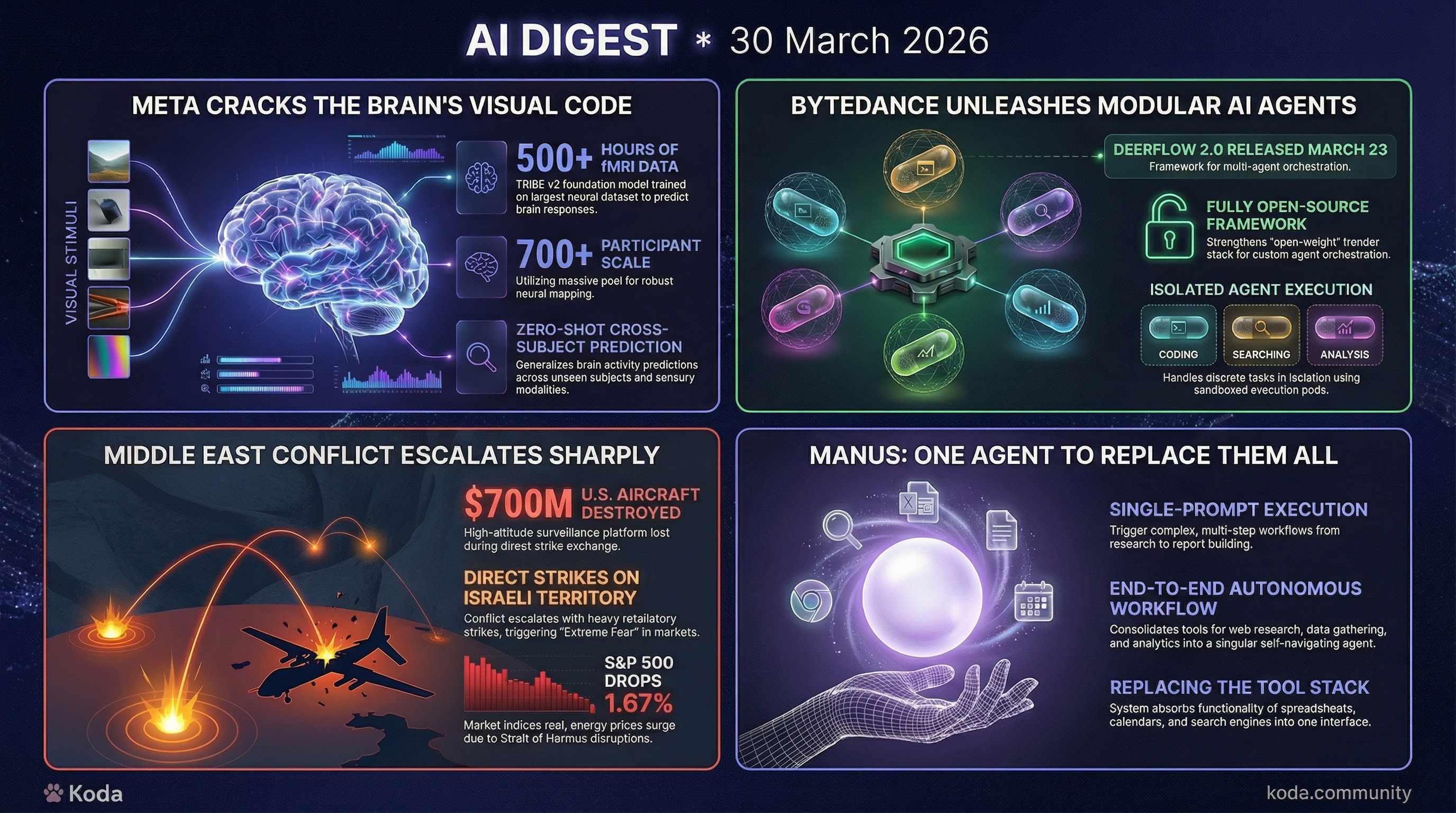
Meta released TRIBE v2 on March 26, a foundation model that predicts human brain responses to visual and auditory stimuli using over 500 hours of fMRI data from more than 700 participants. The model supports zero-shot predictions across subjects, languages, and tasks, outperforming standard neuroscience approaches. Meta open-sourced the full codebase, paper, and demo for the research community. Source →
Open Source
ByteDance DeerFlow 2.0 Ships Isolated Agent Architecture
ByteDance released DeerFlow 2.0 on March 23, an open-source framework that runs isolated AI agents for discrete tasks. The system represents ByteDance's continued push into agentic infrastructure, offering developers a modular approach to multi-agent orchestration. Details on benchmarks and enterprise adoption remain limited. Source →
Trend
Late March AI Release Pipeline Hits Quiet Stretch
No major AI model releases or benchmark updates were reported in the 48 hours spanning March 28 to 30, marking a notable lull after a record-setting Q1 that saw 255 model releases through late March. The pause follows a concentrated burst of launches including GPT-5.4, DeepSeek V4, and eight Qwen3.5 variants in the final week of March. Labs appear to be shifting focus from launches to integration and enterprise deployment. Source →
Trend
Q1 2026 Model Count Settles Near Record High
With the March release window effectively closing, Q1 2026 is on track to finish with approximately 255 distinct model releases, the highest quarterly total on record. The surge was driven by open-weight competition between Alibaba, Meta, and ByteDance, alongside frontier pushes from OpenAI and DeepSeek. The final days of the quarter suggest labs are pausing to assess positioning before Q2 strategies take shape. Source →
Model Release
Open-Source Neuroscience AI Gains Momentum From Meta
TRIBE v2's open release signals Meta's growing investment in neuroscience-adjacent AI, a niche that has attracted less corporate attention than language or vision models. The model's ability to generalize brain response predictions across unseen subjects without fine-tuning could accelerate clinical and cognitive research. Researchers can access the demo and weights immediately. Source →
Benchmark
GPT-5.4 Holds Intelligence Index Lead at 57.17
OpenAI's GPT-5.4, launched March 28, continues to top the Intelligence Index at 57.17, with no challenger emerging over the weekend. MiniMax-M2.7 sits second at 49.62, while Alibaba's Qwen3.5 series clusters in the mid-tier. No new benchmark submissions were recorded in the March 29 to 30 window. Source →
China
China's Open-Weight Labs Consolidate Q1 Gains
Alibaba's eight Qwen3.5 variants and ByteDance's DeerFlow 2.0 cap a quarter in which Chinese labs dramatically expanded their open-weight footprint. Combined with earlier releases from DeepSeek, Chinese-origin models now represent a significant share of the publicly available frontier stack. The strategic implications for export controls and compute policy are likely to surface in Q2 debates. Source →
Agents
Agentic Frameworks Proliferate as Labs Shift Focus
With DeerFlow 2.0 from ByteDance and Meta's Hyperagents both shipping in late March, the agentic AI infrastructure space is becoming crowded heading into Q2. The trend toward isolated, self-modifying, and autonomous agent systems suggests that the next competitive frontier may center less on raw model capability and more on orchestration and reliability. Enterprise adoption timelines remain unclear. Source →