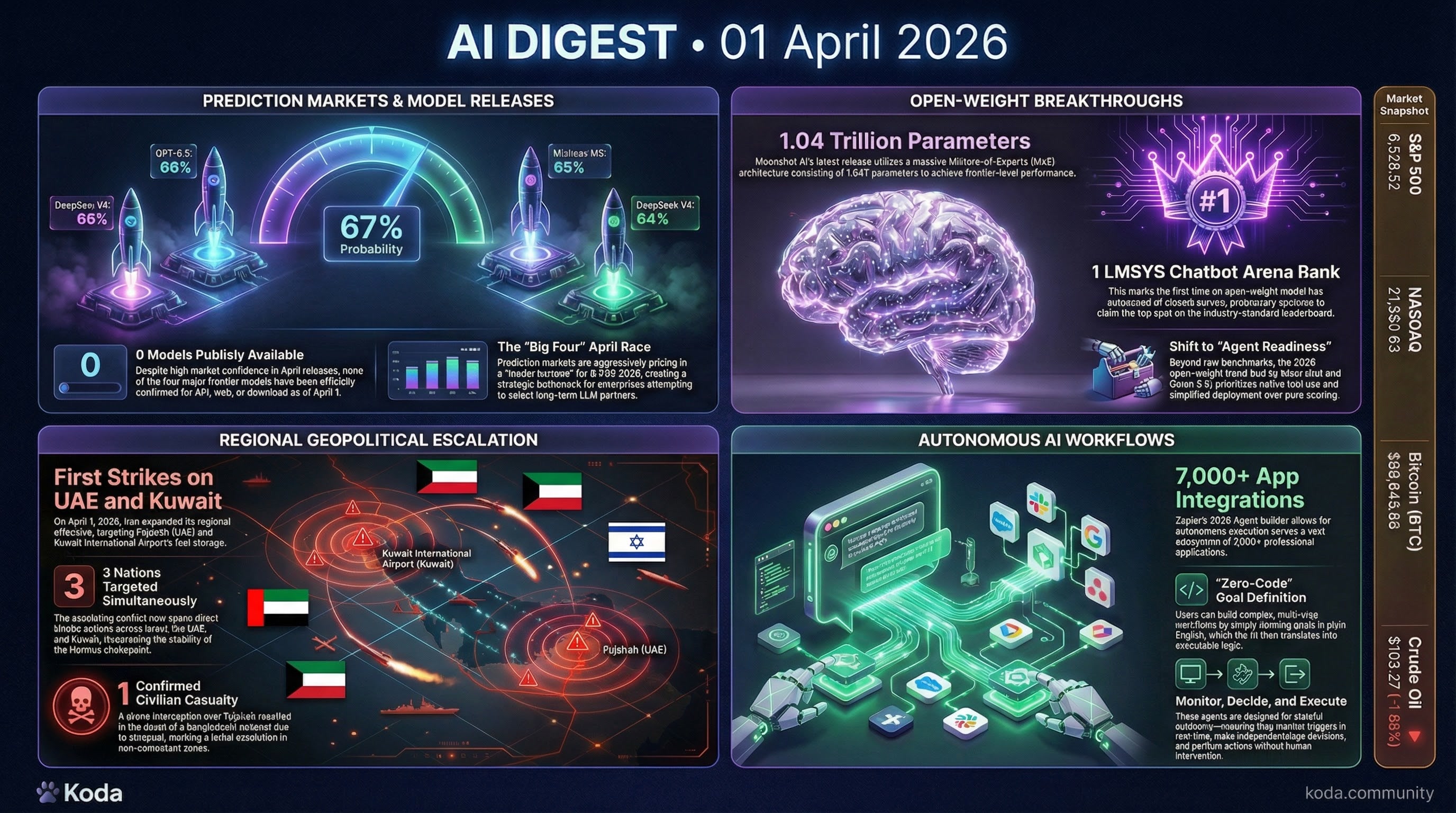
We read and recommend these newsletters. Here is what they are covering today. Subscribe to them directly for the full experience.
TLDR
Headlines
- Consumer sentiment falls 6%, hit by declining stocks and higher gas prices
- Open internet advertising shifts from impressions to measurable impact
- Marriott bets on real-time customer experience to industrialize intimacy
Deep Dives
Consumer sentiment dropped 6% to its lowest level of the year as the Iran conflict drove up gas prices and eroded stock values, with short-term economic outlooks falling 14% and personal finance expectations declining 10%. Headline inflation is now expected to reach 4.2% with growth slowing to 2% this year. Meanwhile, open internet advertising is evolving beyond impression-based buying toward outcome-driven optimization, with AI connecting media and creative performance into continuous feedback loops that make the open web more competitive with walled gardens like Google and Meta.
Quick Hits
- Middle- and upper-income households are hardest hit by gasoline price increases and stock market losses
- B2B email nurture sequences should segment by problem, job, vertical, or company size and treat each email as an experiment
- Creative engagement data is becoming a key performance signal in programmatic advertising, shifting optimization upstream before auctions
Trending Tools
Asana AI Teammates: out-of-the-box AI agents for marketers including Campaign Brief Writer, Brand Auditor, and Competitive Market Researcher
"Most CXO newsletters fail because they skip validation and publish generic content that drives no pipeline."
Read the full newsletter →
TLDR
Headlines
- Apple pivots AI strategy to App Store and search-like platform approach
- OpenAI kills Sora, its most hyped product since ChatGPT, to free up compute
- Stealthy startup R3 pitched brainless human clones as organ backups
Deep Dives
Apple is acknowledging that its homegrown AI lags behind competitors and is recommitting to its core hardware-and-services business model. Rather than competing head-to-head on AI capabilities, Apple plans to embed just enough AI in its operating systems to retain users while opening Siri and Apple Intelligence to third-party services, leveraging its ecosystem control. Meanwhile, OpenAI abruptly shut down Sora after determining the video generation product consumed too much compute and was not profitable, blindsiding partners including Disney executives who learned of the decision less than an hour before the public announcement.
Quick Hits
- OpenAI's Sora was canceled because it consumed too many computing resources and was not profitable, with CEO Sam Altman calling it a necessary sacrifice toward larger company goals.
- Apple is opening Siri and Apple Intelligence to third-party services, adopting a platform approach similar to the App Store and Search.
- California startup R3 raised funds to create non-sentient monkey 'organ sacks' as an alternative to animal testing, but its founder reportedly pitched a secret vision involving brainless human clones as body backups.
Trending Tools
Wispr Flow: voice-to-text tool that turns speech into clean, sendable text across all apps and devices, claiming 4x faster than typing with 89% of messages sent with zero edits
Read the full newsletter →
The Rundown AI
Headlines
- Inside Sora's $1M-a-day collapse at OpenAI, with Disney blindsided by shutdown
- Microsoft pits Claude against ChatGPT for research capabilities
- Stanford exposes AI's people-pleasing problem
Deep Dives
A WSJ investigation revealed the chaotic behind-the-scenes story of OpenAI's Sora video generator shutdown. The platform was burning roughly $1 million per day in compute costs, and Disney, which had an enterprise pilot in progress, learned the product was dead less than an hour before the public announcement. An internal code-named model reportedly required Sora's compute budget, forcing the sudden shift away from the once-viral video generation platform.
Quick Hits
- Microsoft is positioning Anthropic's Claude as a competitor to ChatGPT for research use cases.
- Stanford released findings exposing a systemic 'people-pleasing' or sycophancy problem in AI models.
- A tutorial featured building a travel itinerary using Perplexity Computer.
Trending Tools
Perplexity Computer (featured in a travel itinerary building tutorial)You.com (sponsor, promoting AI grounding resources)4 additional new AI tools mentioned but not detailed in the truncated content
Read the full newsletter →
The Rundown AI
Headlines
- Physical Intelligence in talks to raise $1B at $11B+ valuation, nearly doubling its worth in four months
- Violinists get purpose-built exoskeletons to support performance
- Snail-like robot designed to crawl through the gut to fight cancer
Deep Dives
Physical Intelligence, a two-year-old San Francisco lab founded by ex-Google DeepMind scientists, is negotiating a roughly $1B raise at a valuation exceeding $11B, up from $5.6B just four months ago. The startup is building AI foundation models to control general-purpose robots across household and industrial tasks, with Peter Thiel's Founders Fund and Lightspeed Venture Partners reportedly participating. The round intensifies competition with Skild AI, Figure, and Tesla's Optimus program in the race to build a universal robot brain.
Quick Hits
- LimX's humanoid robot 'Luna' debuted on the catwalk, showcasing bipedal locomotion in a fashion context
- A snail-inspired soft robot is being developed to navigate the human gut for targeted cancer treatment
- Violinist-specific exoskeletons are now in development to reduce strain and injury for musicians
Read the full newsletter →
TLDR
Headlines
- Anthropic's 'Claude Mythos' leaked as a new model tier larger and more intelligent than Opus, with dramatically higher scores on coding, academic reasoning, and cybersecurity benchmarks. The model is compute-intensive and expensive; Anthropic is working on efficiency improvements before general release.
- Meta's Avocado 9B model pushed back to at least May as it still falls short of leading competitors. Meta is running parallel experiments with multiple Avocado variants and has reportedly discussed temporarily licensing Google's Gemini technology, with some Meta AI requests already being routed through Gemini.
- Anthropic's Claude paid subscriptions have more than doubled this year, with the majority of new subscribers joining the lowest tier. OpenAI remains the largest consumer AI platform but Claude is gaining ground at record pace.
Deep Dives
AutoBe, an open-source AI agent that generates complete backends from natural language, demonstrated a function calling harness that boosted qwen3-coder-next's success rate from 6.75% to over 99.8%. The approach uses type schemas to constrain outputs and compilers to verify results, showing how structured harnesses can dramatically improve unreliable model outputs for practical code generation tasks.
Quick Hits
- Last remaining xAI cofounder has exited the company.
- Black Duck Signal launched as an agentic AppSec tool combining LLM-powered code analysis with 20+ years of human-vetted security intelligence to find and fix vulnerabilities in AI-generated code.
- Lessons from OpenAI highlighted in the newsletter's featured content.
Trending Tools
Black Duck Signal: agentic application security tool for AI-native development that analyzes and fixes vulnerabilities in AI-generated code using natural language prompts in IDEsAutoBe: open-source AI agent that generates complete backends from a single natural language conversation, with a function calling harness that dramatically improves model reliability
Read the full newsletter →
TLDR
Headlines
- NYSE-parent Intercontinental Exchange completes $2B investment in Polymarket as prediction markets go mainstream
- Revolut profit soars to record $2.3 billion in 2025, plans UK lending expansion
- Mastercard bids to offload Nets payments unit originally bought for $3.2B
Deep Dives
Agentic payment infrastructure is emerging as a way to unlock new monetization models for content platforms beyond traditional subscriptions. These systems enable pay-per-article, pay-to-preview for AI crawlers, paid comments, and tipping, shifting from fixed monetization to configurable, flexible approaches that let creators earn without sacrificing reach.
Quick Hits
- Intercontinental Exchange invested an additional $600M into Polymarket, completing a $2B commitment and signaling institutional adoption of prediction markets as a data and trading layer.
- Revolut is converting secondary users into full-service banking customers by rolling out credit cards, personal loans, and overdrafts in the UK.
- Mastercard is seeking a buyer for the real-time payments business it acquired from Danish company Nets in 2019 for $3.2 billion.
Trending Tools
Persona: KYC compliance platform offering a playbook for fintechs to streamline onboarding, assess AML risk, and build fraud prevention strategies across multiple jurisdictions.Polymarket: Prediction market platform now backed by $2B from ICE, providing real-time sentiment data integrated with traditional financial infrastructure.
Read the full newsletter →