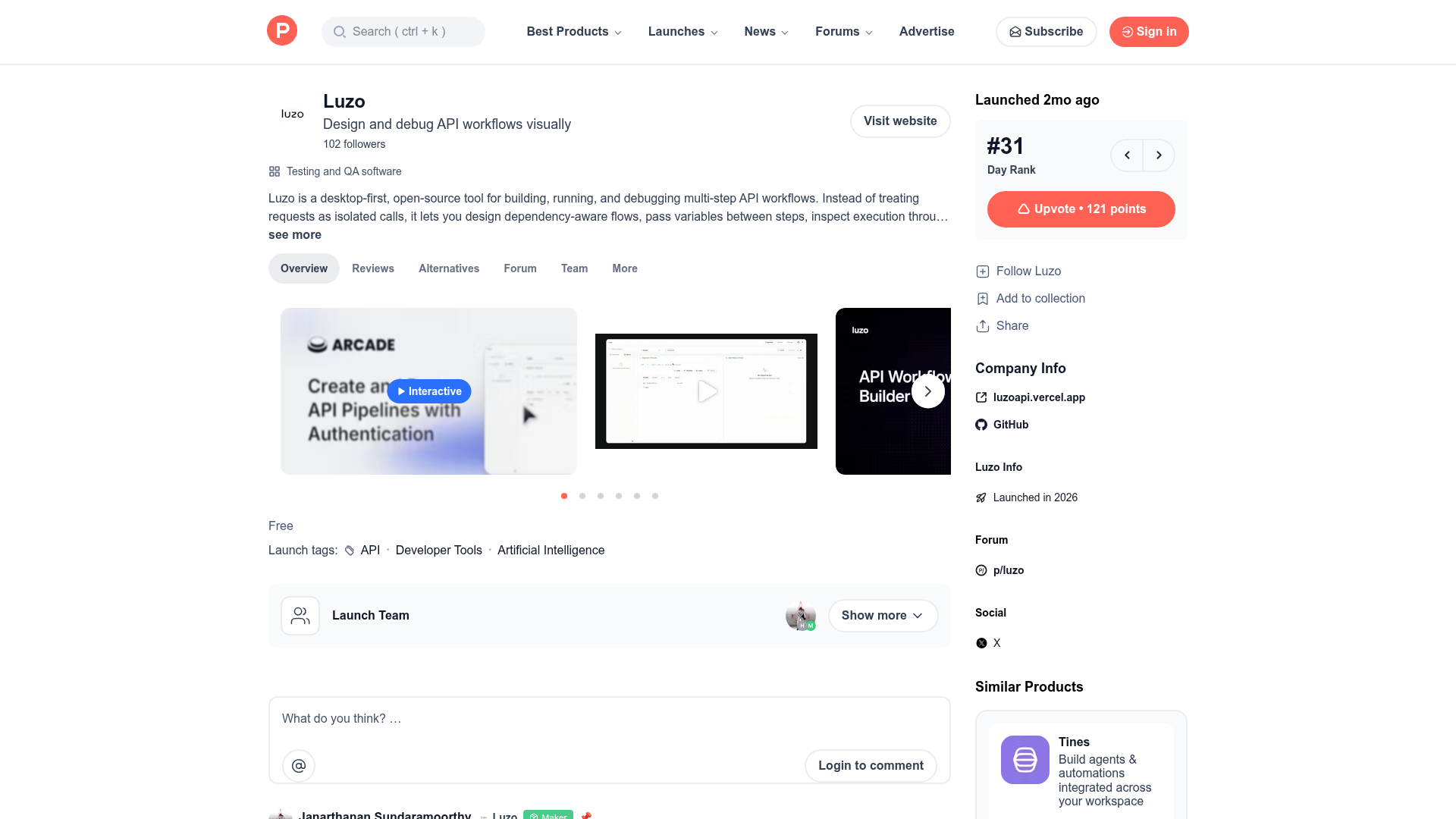
An open-source, desktop-first visual debugger for building, running, and tracing multi-step API workflows. Replace fragile Postman chains with a dependency-aware canvas and live timeline inspector.
Luzo fills a genuine gap for backend engineers and QA teams who spend too much time tracing failures across chained API calls. The visual canvas with dependency awareness and the ability to retry from a specific failure point (without restarting the entire flow) are its standout features. If you are building or maintaining microservice integrations, webhook sequences, or multi-step API pipelines, the free tier is worth trying immediately. The $15/month Pro plan makes sense once you need collaboration or workflows with more than a handful of steps. It is not a Postman replacement for simple one-off requests; it is a purpose-built debugger for complex, sequential API logic.
Pricing
Two tiers. The free plan covers solo debugging. Pro includes team workflows.
- Basic API workflow design
- Full visual interface and canvas
- Limited steps per flow
- Live timeline inspection
- Variable passing between steps
- Everything in Free
- Unlimited steps per flow
- Team collaboration features
- Priority support
- Full integration access
Pricing as captured on 2026-04-04. Check the live site before you commit.
Key Features
What Luzo actually does, and why it matters for API debugging.
Visual Workflow Design
Drag and drop API steps onto a canvas. Connect them visually to define execution order. No more mentally tracing JSON configs or YAML files to understand what calls what.
Dependency-Aware Flows
Steps understand their dependencies. If Step 3 depends on the output of Step 1 and Step 2, Luzo enforces that ordering and surfaces broken links before you run anything.
Live Timeline Inspector
Watch each step execute in real time on a timeline view. See request/response payloads, status codes, latency, and headers at every stage of the chain.
Variable Passing Between Steps
Extract values from one step's response and inject them into the next step's request. Token chaining, ID forwarding, and dynamic URL construction are all handled natively.
Retry From Failure Point
When step 7 of 12 fails, you do not have to re-run steps 1 through 6. Luzo caches intermediate state and lets you retry from the exact point of failure. This alone saves significant debugging time.
Open Source
The core is open source. You can inspect the code, contribute, or fork it for internal use. This matters for teams with strict security requirements who need to audit their tooling.
Integrations
Current integration support. The list is short but covers the essentials.
Who Should Use Luzo
Specific scenarios where Luzo earns its place in your stack.
Webhook Sequence Debugging
If you maintain webhook chains where service A triggers B triggers C, Luzo lets you visualize the entire sequence and pinpoint exactly which hop fails. No more grepping through logs across three different services.
Microservice Integration Testing
Backend teams building or maintaining microservice architectures can map out cross-service API calls, test them in sequence, and verify that data flows correctly between services before deploying.
QA Engineers Testing Complex Flows
QA teams who need to validate multi-step API workflows (user signup, payment processing, notification delivery) can build reusable test flows and re-run them on demand without writing custom scripts.
Collaborative API Project Management
On the Pro plan, teams can share workflow definitions. This is useful when onboarding new engineers who need to understand how services interact, or when debugging production issues collaboratively.
Replacing Postman Collection Runners
If you have outgrown Postman's collection runner for sequential API testing and find yourself fighting with pre-request scripts and test scripts to pass data between calls, Luzo's visual approach is a cleaner alternative.
Limitations
Honest gaps you should know about before committing.
Desktop Only
Luzo is desktop-first with no web or mobile version. If your workflow involves debugging from a tablet, a remote server terminal, or a browser-based dev environment, you are out of luck. This also means no quick checks from your phone when something breaks at 2 AM.
Learning Curve for the Visual Paradigm
Engineers accustomed to cURL, Postman, or scripted API testing will need time to adapt to the canvas-based approach. The visual model is powerful once internalized, but the initial setup of a complex flow takes longer than writing a quick script.
Free Tier Step Limits
The free plan caps the number of steps per flow. For simple 3 to 5 step chains this is fine. But real-world microservice debugging often involves 10 or more steps, which pushes you to the $15/month Pro plan quickly.
Limited Integration Ecosystem
Three integrations (GitHub, Slack, Postman) is a thin list. There is no native support for CI/CD pipelines, cloud provider APIs, or observability tools like Datadog or Grafana. You will need to work around this with manual exports or custom scripting.
Early-Stage Maturity
As an open-source project still building its community, expect rough edges. Documentation may be sparse in places, and feature requests may take time to land. This is not a polished enterprise product yet.
Debug Visually.
If you are tired of tracing chained API failures through logs and Postman scripts, give Luzo a try.
Open Luzo