- SPECIMEN
Kilo Code
- FILED AS
Open-Source AI Coding Agent With Model Flexibility
- INTAKE DATE
- 2026-05-17
- CLASS
- Coding
- METHOD
- desk research, filed before the Lab logged its counts
No dimension scores were recorded for this specimen, so no Koda Score is published. Read the verdict instead.
Build, ship, and iterate with any model, everywhere you work. Swap LLMs per task, from cheap boilerplate generation to frontier-model refactors, all inside your editor.
Open Kilo Code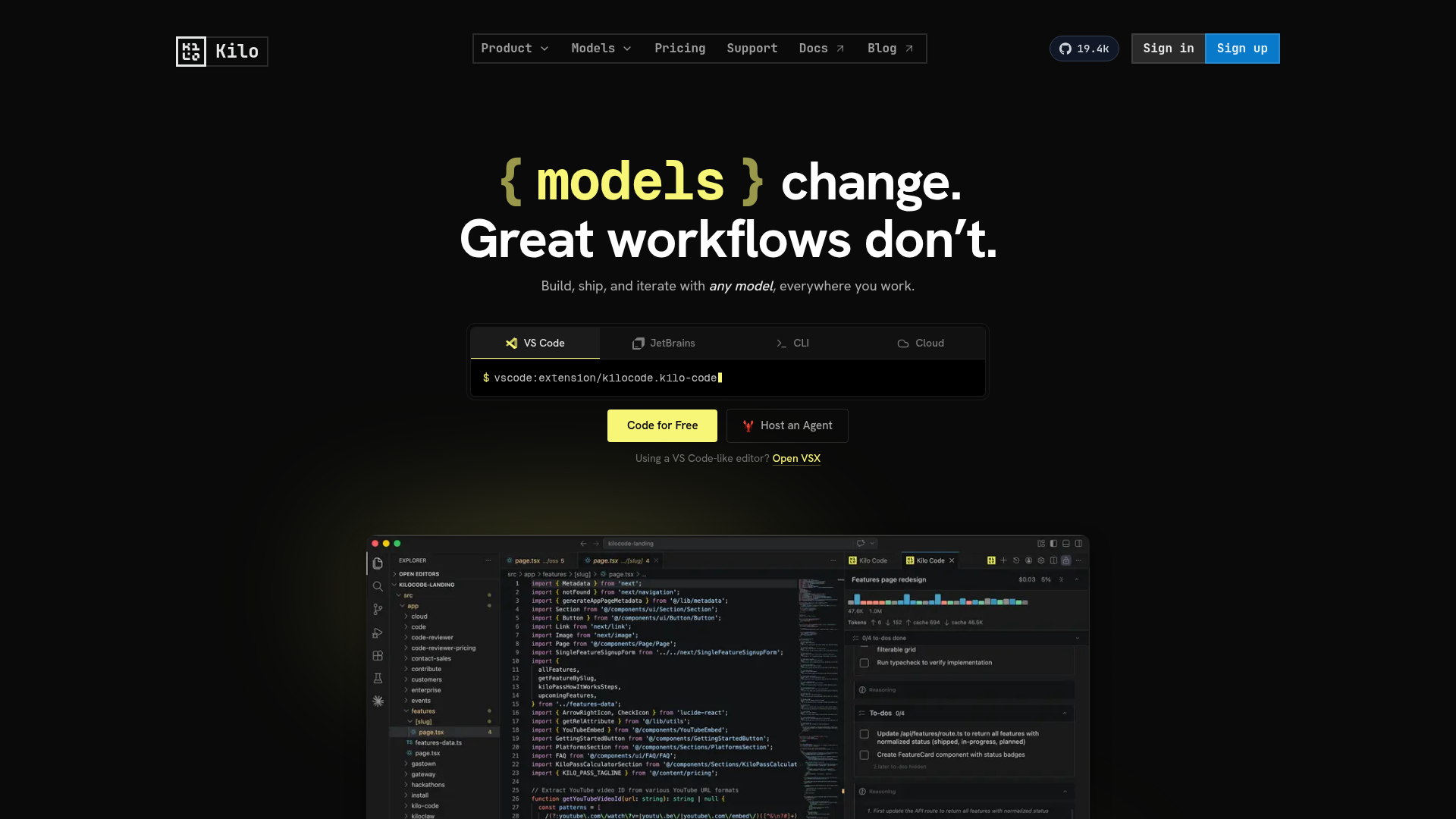
The verdict.
Kilo Code is the strongest option right now for developers who refuse to be locked into a single AI provider. If you want to route GPT-4o at boilerplate, Claude at architecture decisions, and a local Llama model at sensitive proprietary code, this is the tool that actually lets you do that without switching editors. The free tier under Apache-2.0 is genuinely usable for solo developers; teams needing managed cloud agents and advanced modes will need to talk to sales for Pro pricing, which is the one friction point in an otherwise compelling package.
Pricing, straight.
Forever. Apache-2.0 licensed.
- End-to-end AI coding
- Open source, Apache-2.0 license
- Basic agent modes
- Cloud agents support
- Code review capabilities
Custom pricing for teams.
- Multiple specialized agent modes
- One-click deploy for KiloClaw
- 500+ AI models
- Fully managed services
- Auto-restart and updates
Pricing as captured on 2026-05-17. Check the live site before you commit.
Note: You bring your own API keys. LLM costs (OpenAI, Anthropic, Google, etc.) are separate from Kilo Code pricing.
What it actually does.
Model Swapping Per Task
Route cheap models at boilerplate and scaffolding, then switch to Claude or GPT-4o for complex refactors. No restart required. This is the core differentiator over locked-in tools like Cursor or Windsurf.
5 Specialized Agent Modes
Different modes for different workflows. Whether you need autonomous file creation, guided debugging, or code review, each mode constrains the agent's behavior to match the task at hand.
Terminal and File System Access
The agent can run terminal commands, create files, modify existing code, and manage your project structure. You review diffs before anything is committed, keeping you in control.
Multi-IDE Support
Works in VS Code, JetBrains IDEs, and via CLI. Also integrates with Slack, Discord, and Telegram for notifications and remote triggering. Not just a VS Code extension anymore.
Cloud Agents (KiloClaw)
Run coding agents in the cloud with auto-restart and updates. Useful for CI/CD pipelines, background tasks, or when you want agents working while your laptop is closed.
Open Source (Apache-2.0)
Full source code available. You can audit what the agent does, fork it, contribute, or build custom integrations. No black box. This matters for security-conscious teams and enterprises.
Built-in Code Review
Point the agent at a PR or a file and get structured feedback. Not a replacement for human review, but a solid first pass that catches obvious issues before your teammates see them.
500+ Model Support
GPT, Claude, Gemini, Mistral, Llama, and hundreds more. Connect via API key or point to a local model. The breadth here is unmatched by any competing coding agent.
Who it is for.
Solo Developers Who Want Cost Control
If you are paying for API tokens out of pocket, the ability to route cheap models at routine tasks and only burn frontier tokens on hard problems is a real money saver. The free tier covers everything a solo dev needs.
Teams That Need Model Flexibility
Some teams have compliance requirements that mandate specific providers. Others want to benchmark models against each other. Kilo Code lets you standardize on one tool while keeping model choice open.
Security-Conscious Developers
Open source under Apache-2.0 means you can audit every line. Pair it with a local model for sensitive codebases and nothing leaves your machine. That is a hard requirement for some organizations that closed-source agents cannot meet.
Anyone Drowning in Repetitive Tasks
Boilerplate generation, test scaffolding, migration scripts, config file creation. These are the tasks where an autonomous agent shines. Point it at the pattern, review the diff, move on to the interesting work.
The honest part.
-
Pro pricing is opaque.
"Contact Sales" with no published price makes it hard to budget. Competitors like Continue.dev are fully free and open source. If you are evaluating tools for a team, expect a sales call before you can compare costs.
-
No full self-hosting for KiloClaw.
The cloud agent feature (KiloClaw) cannot be fully self-hosted. For organizations that need everything on-premises, this is a dealbreaker for the cloud agent workflow specifically. The local VS Code extension still works fine offline.
-
Output quality depends entirely on your model choice.
Model flexibility is a double-edged sword. Pick a weak model and the agent produces weak code. There is no guardrail that warns you when a model is underperforming for a given task. You need to know your models.
-
Free tier has limited agent modes.
You get "basic" agent modes on the free plan. The multiple specialized modes are gated behind Pro. For many solo developers this will not matter, but if you need the full range of agent behaviors, you will hit the paywall.
-
Cloud features require internet connectivity.
This is obvious but worth stating. Cloud agents, remote triggers via Slack/Discord, and managed services all need a connection. The local extension with a local model works offline, but that is a reduced feature set.
Open model-flexible AI coding
Install the extension, connect your API keys, and start routing the right model to the right task.
Open Kilo Code