- SPECIMEN
MemSync
- FILED AS
Give Every App a Shared AI Memory Layer
- INTAKE DATE
- 2026-04-09
- CLASS
- Security
- METHOD
- desk research, filed before the Lab logged its counts
No dimension scores were recorded for this specimen, so no Koda Score is published. Read the verdict instead.
Aggregates your data, learns who you are, and personalizes your AI on any platform. Built by OpenGradient, MemSync creates a unified, privacy-focused memory layer that persists context across your apps, notes, and APIs so your AI tools stop forgetting what you told them yesterday.
Open MemSync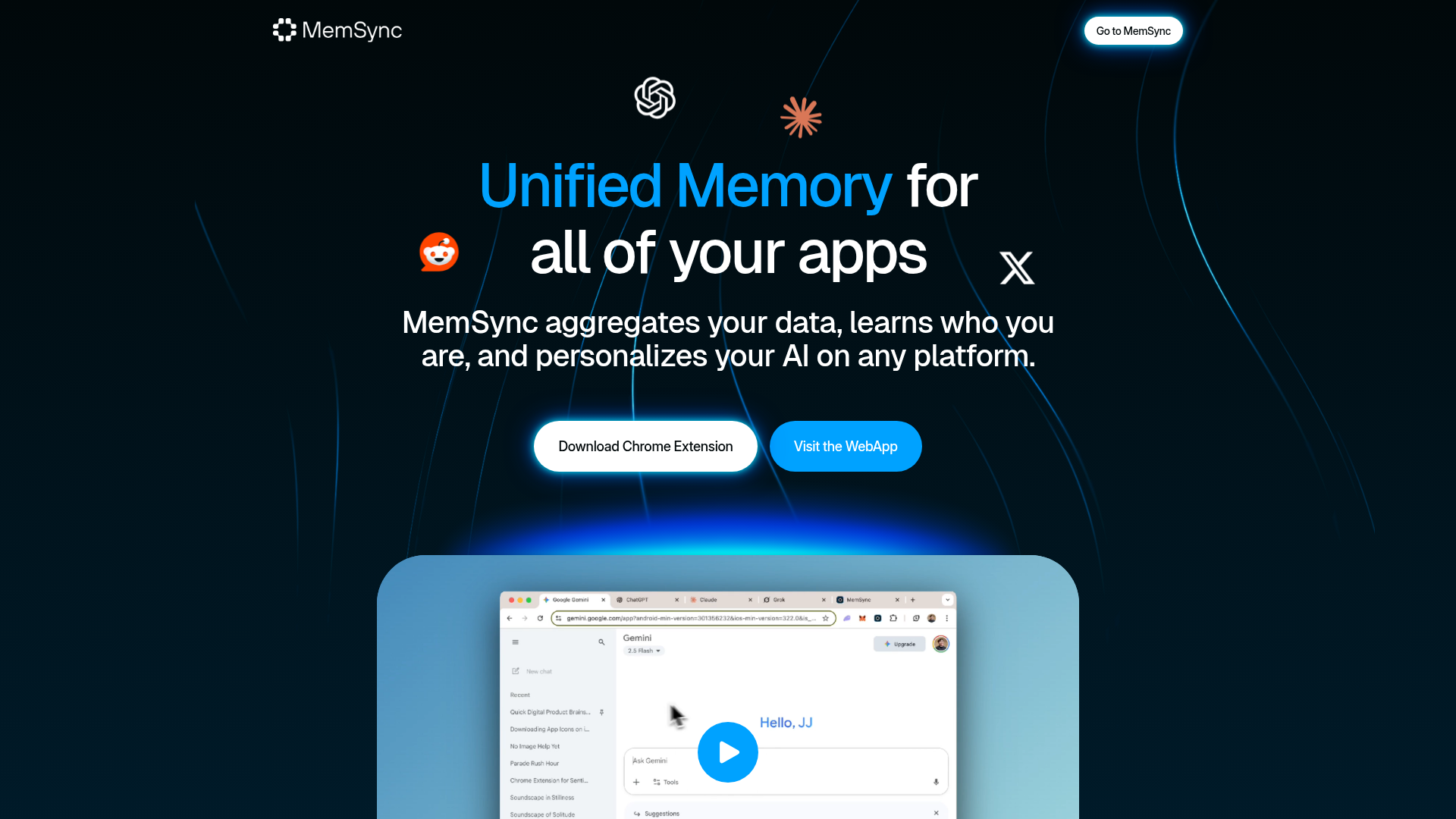
The verdict.
MemSync solves a real and growing pain point: every AI tool you use starts from scratch, with zero memory of what you told another one five minutes ago. If you juggle ChatGPT, Claude, Copilot, or custom LLM workflows and find yourself re-explaining your role, preferences, or project context constantly, MemSync is worth testing immediately. The free tier is functional enough to validate the concept, and the $9.99/month Pro plan is a reasonable bet for anyone whose repeated prompts eat 15+ minutes a day.
Pricing, straight.
Free to start. Pro includes the full personalization engine.
- Basic data aggregation
- Limited personalization features
- Chrome Extension access
- Advanced data aggregation
- Full AI personalization
- Prompt tuning optimizer
- Web App + Chrome Extension
- Custom integrations
- Dedicated support
- High-level security features
- API access for third-party apps
Pricing as captured on 2026-04-09. Check the live site before you commit.
What it actually does.
What MemSync actually does under the hood.
Personal AI Database
MemSync builds a structured profile of your preferences, context, and history. This becomes the shared memory that any connected AI tool can reference, eliminating the cold-start problem every time you open a new chat.
Instant Personalization
Connect a new app and it immediately inherits your context. No manual setup, no pasting system prompts. The memory layer injects relevant background so AI responses are tailored from the first interaction.
One-Click Prompt Tuning
The Pro tier includes a prompt optimizer that rewrites your inputs based on your stored profile. Think of it as an auto-prefix that adds the right context before your prompt hits the model. This is where the "repeated prompts shrink by half" claim becomes tangible.
End-to-End Encryption
Your memory data is encrypted at rest and in transit. MemSync claims zero-knowledge architecture, meaning they cannot read your stored context. For a tool that aggregates personal data across apps, this is table stakes, and they appear to meet it.
User Control Over Data
You can view, edit, and delete any piece of stored memory. This is not a black box. If MemSync inferred something wrong about your preferences or role, you correct it directly. Data portability and deletion are supported.
Chrome Extension + API Access
The Chrome Extension is the fastest on-ramp, injecting memory context into web-based AI tools. For developers and power users, the API opens up custom integrations with internal tools, Slack bots, or automation pipelines.
Who it is for.
MemSync is not for everyone. Here is where it delivers real value.
Multi-LLM Power Users
If you use ChatGPT for drafting, Claude for analysis, and a coding assistant for development, you are re-explaining yourself constantly. MemSync eliminates that friction. Connect your top three tools and your context follows you everywhere.
Freelancers and Consultants
People who switch between client contexts throughout the day will appreciate a memory layer that knows which project you are working on. Instead of maintaining separate system prompts per client, MemSync can manage that context switching for you.
Productivity Obsessives
If you track your workflows and notice that 20-30% of your AI interactions start with "I am a [role] working on [project] and I prefer [format]," MemSync directly attacks that waste. The prompt tuning optimizer on Pro makes this measurable.
Developers Building AI Workflows
The API access (Enterprise tier or potentially Pro) lets you pipe MemSync's memory layer into custom applications. If you are building internal tools that need persistent user context across LLM calls, this saves you from building your own memory infrastructure.
The honest part.
Where MemSync falls short or needs improvement.
Free Tier Is Quite Limited
Basic data aggregation and limited personalization means the free plan is essentially a demo. You will hit the ceiling quickly if you are serious about using this daily. The real product starts at $9.99/month.
Setup Requires Effort
MemSync is dependent on user data input, especially early on. The memory layer does not magically know everything about you. You need to connect tools, correct inferences, and actively train it. Expect a week or two before the personalization feels genuinely useful.
Integration Depth Is Narrow
Right now, the integration surface is Chrome Extension, Web App, and API. There are no native integrations with specific AI platforms like OpenAI's API, Anthropic, or popular tools like Notion or Obsidian. The Chrome Extension bridges some of this gap, but deeper, native connectors would make the product significantly stickier.
Trust Requires a Leap
You are handing a single company a cross-platform profile of your AI usage, preferences, and work context. End-to-end encryption is reassuring, but OpenGradient is still a relatively young company. If long-term data sovereignty matters to you, evaluate their privacy policy carefully before going all in.
Competing With Platform Memory
ChatGPT now has its own memory feature. Claude has project-level context. As major AI platforms build native memory, MemSync's value proposition narrows to cross-platform persistence. That is still valuable, but the moat is thinner than it looks.
Open MemSync
Install it, connect your top three daily tools, and test whether your repeated prompts shrink by at least half.