- SPECIMEN
LikeClaw
- FILED AS
Cloud-Native AI Agent Deployment
- INTAKE DATE
- 2026-04-11
- CLASS
- Security
- METHOD
- desk research, filed before the Lab logged its counts
No dimension scores were recorded for this specimen, so no Koda Score is published. Read the verdict instead.
The AI agent platform that actually does things. Secure sandboxed execution, multi-model access, and a skills marketplace, all from a single interface with transparent pricing.
Open LikeClaw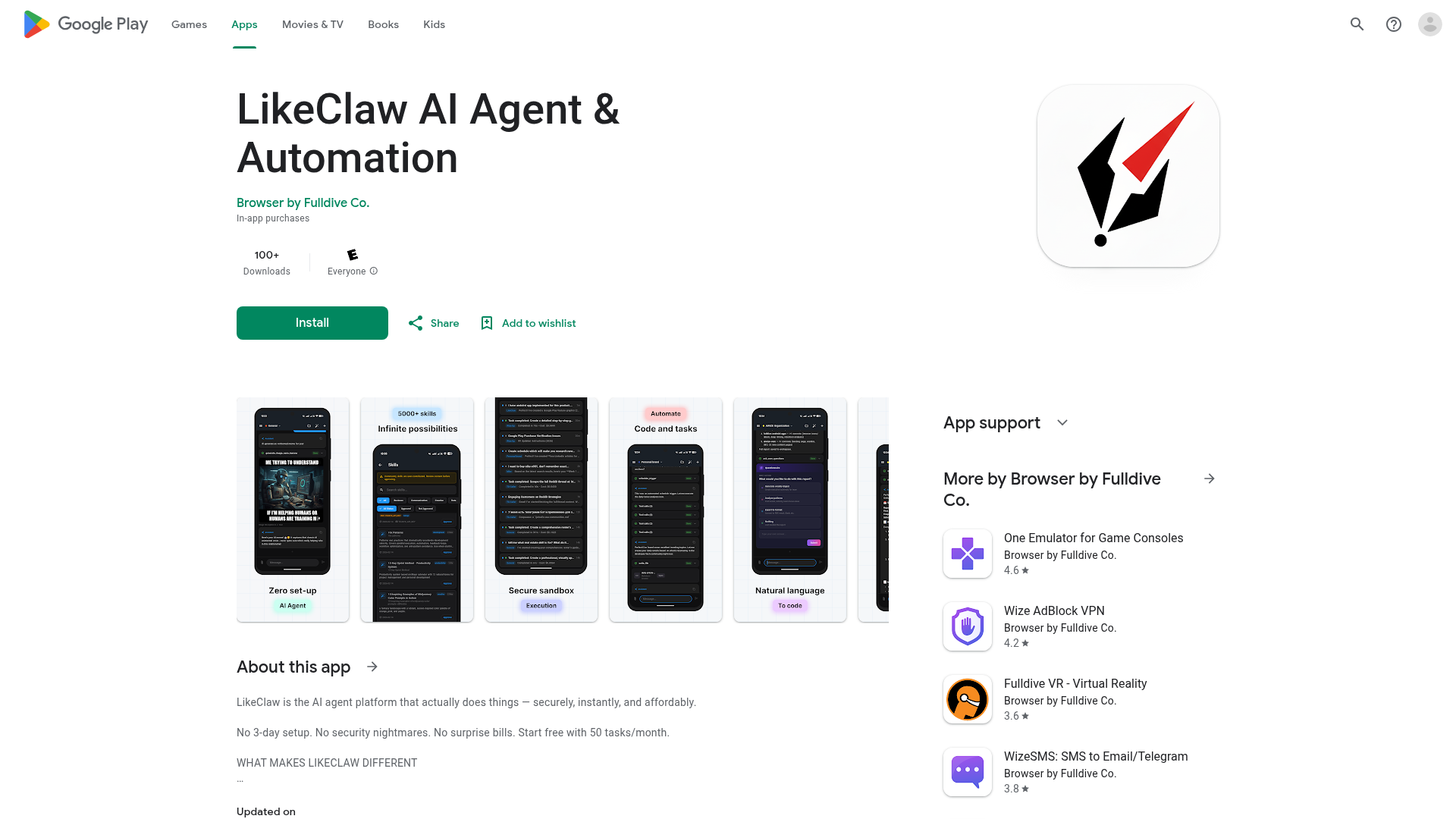
The verdict.
LikeClaw is built for developers and small teams who want sandboxed AI agent execution without stitching together five different services. If your workflow involves running code, automating API calls, or processing files through AI models, and you care about data governance, this is a credible option at a price point that undercuts most enterprise alternatives. The free tier is tight at 50 tasks per month, but it is enough to validate whether the platform fits your stack before committing to the $15 to $20 Pro plan.
Pricing, straight.
Credit-based, no mystery bills. All plans include core platform access.
Free
$0
- 50 tasks/month
- Basic models
- 1 workspace
Pro
$15-20/mo
Price varies by region
- Unlimited chat
- 500 executions
- All models (Claude, GPT-4, DeepSeek)
Power
$40/mo
- Unlimited everything
- Bring Your Own Key (BYOK)
- Priority support
Pricing as captured on 2026-04-11. Check the live site before you commit.
At $40/month for unlimited executions with BYOK, the Power tier is notably cheaper than running equivalent workloads on most competing agent platforms.
What it actually does.
What makes LikeClaw different from a generic chatbot wrapper.
Sandboxed Code Execution
Run Python, JavaScript, and Bash directly in secure E2B-isolated containers. No local setup, no risk to your host environment. This is the core differentiator: agents can actually execute code, not just generate it.
Multi-Model Access
Claude, GPT-4, and DeepSeek available through a single interface. Switch models mid-conversation or let the platform route to the best option. No separate API keys needed on the Pro tier.
Skills Marketplace
Pre-built, vetted automations you can deploy without writing code. Think of it as an app store for agent capabilities. The marketplace is still growing, but the curation approach prioritizes security over volume.
Persistent Workspaces
Your AI agent retains context across sessions. Files, conversation history, and project state persist in your workspace. This eliminates the constant re-prompting problem that plagues stateless chat interfaces.
File System & Storage
Upload files, save agent outputs, and access everything through a built-in file manager. Useful for data processing pipelines where you need to chain multiple agent tasks together.
Enterprise Security (SOC 2)
SOC 2 compliant with E2B isolation for all code execution. This matters if you are in a regulated industry or your compliance team needs to sign off before you can use AI tooling in production.
30-Second Setup
Email signup, no installation, no CLI configuration. You are running agents within a minute. This is a genuine advantage over self-hosted alternatives that require Docker, Kubernetes, or cloud infrastructure setup.
BYOK (Bring Your Own Key)
On the Power plan, plug in your own API keys for the underlying models. This gives you direct cost control and lets you use enterprise agreements you may already have with OpenAI or Anthropic.
Who it is for.
LikeClaw targets a specific set of workflows. Here is where it makes the most sense.
Developers & DevOps Teams
Safe code execution, debugging assistance, and DevOps task automation in isolated containers. If you need an AI that can run your scripts without touching your production environment, this is the primary use case.
Security Professionals
Code auditing, log analysis, and penetration testing workflows. The sandboxed execution environment means you can run potentially risky analysis scripts without compromising your workstation.
Automation-Heavy Workflows
API integrations, data transformation pipelines, and recurring task automation. If you are currently chaining together Zapier, custom scripts, and ChatGPT, LikeClaw consolidates that into one platform with actual execution capability.
Creative & Media Teams
Bulk media processing, asset generation, and content workflows. The file system integration means you can upload assets, process them through AI, and download results without leaving the platform.
The honest part.
What to know before you commit.
Free tier is very limited
50 tasks per month is barely enough for evaluation. If you are doing any real testing, you will burn through that in a day or two. Plan to upgrade to Pro quickly if you are serious about benchmarking.
No raw system access
The sandboxing that makes LikeClaw secure also means you cannot access underlying system resources directly. If your workflow requires low-level OS access, GPU passthrough, or custom kernel modules, this is not the right tool.
No listed integrations
The platform does not advertise native integrations with common tools like Slack, GitHub, Jira, or cloud providers. You can likely bridge gaps through API calls within the agent, but there is no plug-and-play connector ecosystem yet. This is a notable gap compared to more established platforms.
Young platform, unproven at scale
LikeClaw is new. There is limited public information about uptime history, latency benchmarks under load, or large-scale deployment case studies. If you are evaluating this for production workloads, run your own latency and reliability tests before committing.
Mobile-first distribution (Google Play)
The primary distribution channel appears to be the Google Play Store, which is unusual for an enterprise-focused agent platform. It is unclear how the desktop and web experience compares. If you need a full desktop workflow, verify the web interface meets your needs before relying on it.
Test LikeClaw.
Start with the free tier. Run 50 tasks. Benchmark latency against your current setup. Then decide.