- SPECIMEN
TasksMind
- FILED AS
Filed without a one-line summary.
- INTAKE DATE
- 2026-05-01
- CLASS
- Coding
- METHOD
- desk research, filed before the Lab logged its counts
No dimension scores were recorded for this specimen, so no Koda Score is published. Read the verdict instead.
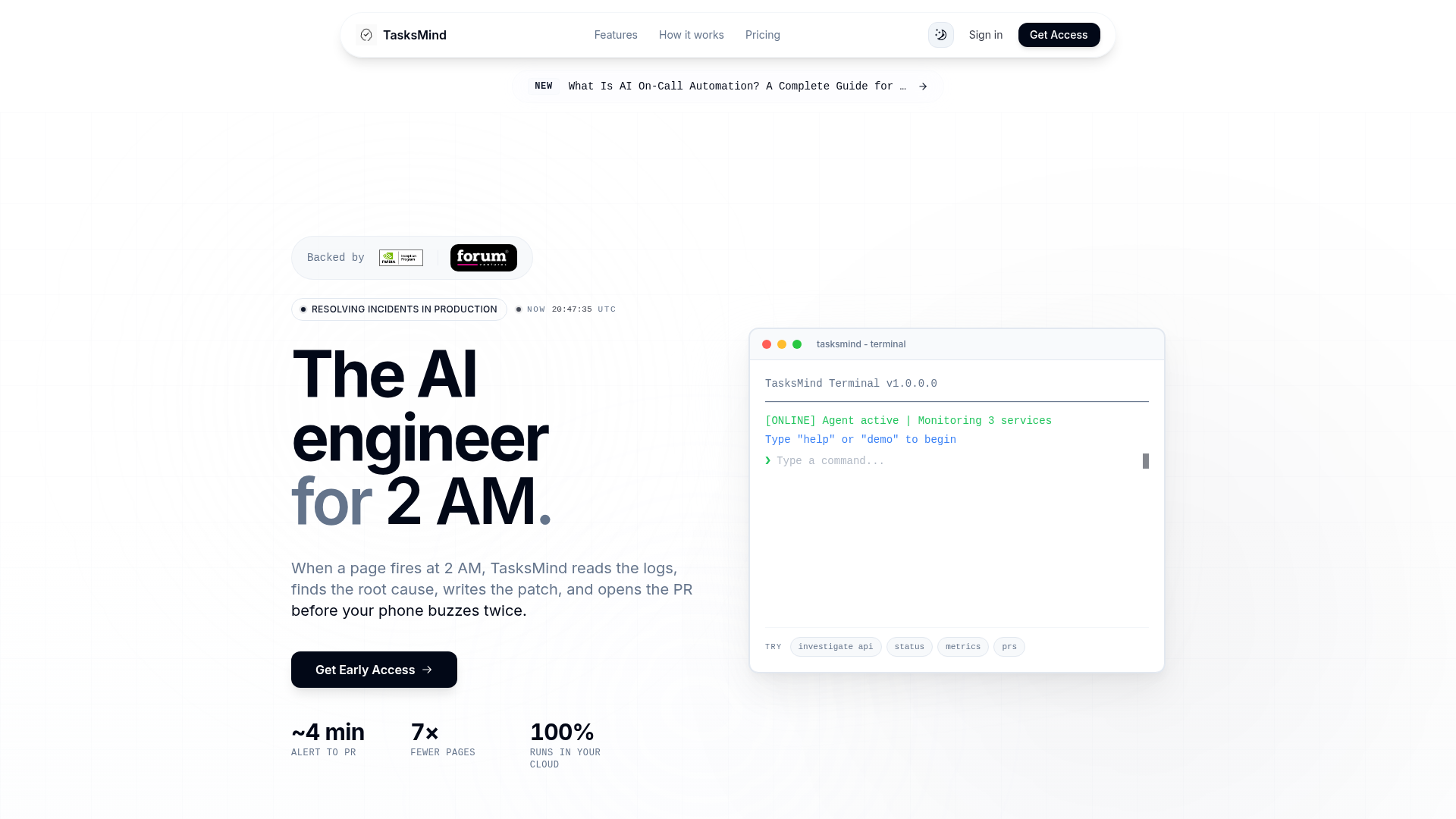
Let AI Handle On-Call Incidents While Engineers Sleep. Autonomous detection, triage, diagnosis, and resolution for production incidents, so your team stops dreading the 2 a.m. page.
Open TasksMindThe verdict.
TasksMind is built for engineering teams drowning in on-call rotations, particularly mid-size to enterprise shops running standard observability stacks like Datadog and PagerDuty. If your incidents are mostly structured and repeatable (API errors, performance degradation, known failure modes), this tool could meaningfully reduce alert fatigue and after-hours burnout. The enterprise-only pricing model and early-stage origins (University of Nebraska founders) mean you should pressure-test it in a pilot before going all-in, but the value proposition is sharp and the integration list is solid.
Pricing, straight.
Contact for Pricing
Custom pricing based on team size and incident volume
- Unlimited AI-powered investigations
- Root-cause analysis with evidence
- Auto-generated PRs with tests
- Real-time incident detection
- Log and trace correlation
- SOC 2 Type II certified
Pricing as captured on 2026-05-01. Check the live site before you commit.
No public self-serve tier or free plan is listed. The single enterprise plan suggests TasksMind is targeting teams with meaningful incident volume and budget. If you are a small startup or solo developer, the lack of a starter tier is a real barrier. Expect to go through a sales conversation to get numbers.
What it actually does.
Autonomous Incident Investigation
When an alert fires, TasksMind autonomously investigates the incident without waiting for a human to wake up, open a laptop, and start digging through logs.
Real-Time Log and Trace Correlation
Pulls together logs, traces, and metrics from your observability stack in real time to build a coherent picture of what went wrong and where.
Automated Patch Generation
Goes beyond diagnosis. TasksMind can auto-generate pull requests with tests to fix the identified issue. This is the most ambitious claim and the one worth scrutinizing in a trial.
Deep Integration Ecosystem
Connects to PagerDuty, Datadog, New Relic, Sentry, GitHub, GitLab, Bitbucket, Slack, Microsoft Teams, plus custom webhooks and REST API. Covers the standard enterprise stack well.
Root-Cause Analysis with Evidence
Does not just flag the symptom. Provides a root-cause analysis backed by correlated evidence from your systems, giving the on-call engineer (or the morning crew) a clear trail to follow.
SOC 2 Type II Certified
For a tool that needs access to your production logs, traces, and source code, SOC 2 Type II certification is not optional. TasksMind has it, which clears a major procurement hurdle for enterprise buyers.
Who it is for.
Teams Burned Out by On-Call Rotations
If your engineers are losing sleep to pages that turn out to be routine, repeatable incidents, TasksMind directly addresses that pain. The core pitch is reducing the human cost of after-hours incident response, and that resonates with any team that has experienced sustained on-call fatigue.
Organizations Needing Faster MTTR
If your mean time to resolution is dragged up by the lag between alert and human response, an AI agent that starts investigating immediately could compress that window significantly. Especially valuable for teams with SLA commitments.
Teams with Structured, Repeatable Incident Patterns
API errors, performance degradation, known failure modes in microservices. If a significant portion of your incidents follow recognizable patterns, TasksMind is well-suited. Teams dealing mostly with novel, unprecedented failures will see less value.
Mid-Size to Enterprise Engineering Orgs
The enterprise-only pricing, SOC 2 certification, and integration depth all point toward teams of 20+ engineers running production services at scale. Small teams or early-stage startups likely cannot justify the cost or the setup investment.
The honest part.
Novel Incidents Are Still Your Problem
TasksMind is built for structured, repeatable incidents. When something truly unprecedented breaks, the AI will hit its limits. You still need humans on standby for the weird stuff, which means on-call does not fully disappear. It gets lighter, not eliminated.
No Public Pricing or Free Tier
Enterprise-only, contact-sales pricing is a friction point. You cannot spin this up on a weekend to test it against your stack. Every evaluation requires a sales conversation, which slows adoption and makes it harder for individual engineers to champion internally.
Integration Setup Is Non-Trivial
Connecting TasksMind to your alerting pipeline, observability tools, source control, and communication channels requires real setup work. This is not a plug-and-play widget. Expect to invest engineering time upfront to get the integrations right and tune the system to your environment.
Auto-Generated PRs Need Trust Building
The claim that TasksMind can auto-generate pull requests with tests is bold. In practice, most teams will want to review these carefully before merging, especially early on. The feature is promising, but trusting AI-generated patches in production code requires a confidence ramp that takes time.
Early-Stage Company Risk
Founded by University of Nebraska students, TasksMind is a young company. That is not inherently a problem, but it means less track record, potentially smaller support teams, and the usual startup risk factors. Enterprise buyers should evaluate the team's ability to scale support alongside customer growth.
Let AI Take the 2 a.m. Page.
Connect TasksMind to your alerting pipeline and see how many incidents resolve before a human needs to intervene.