- SPECIMEN
NemoClaw
- FILED AS
Filed without a one-line summary.
- INTAKE DATE
- 2026-05-04
- CLASS
- Security
- METHOD
- desk research, filed before the Lab logged its counts
No dimension scores were recorded for this specimen, so no Koda Score is published. Read the verdict instead.
Run always-on agents with greater control, privacy, and flexibility. Installed with a single command. Built by NVIDIA.
Open NemoClaw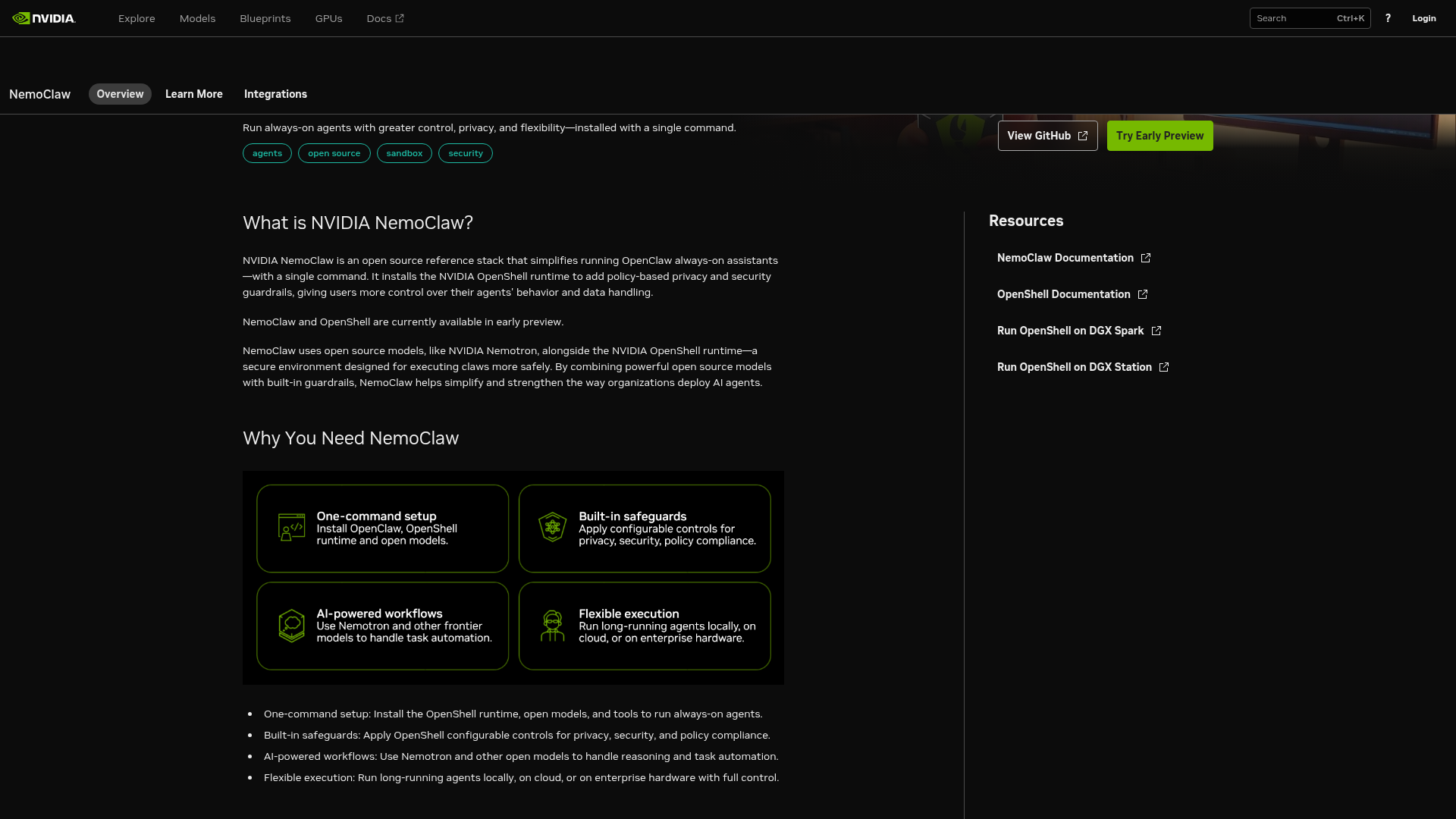
The verdict.
NemoClaw is NVIDIA's answer to the messy reality of deploying persistent AI agents: too many services, too many integration headaches, too little control over where your data lives. If your team needs always-on AI assistants running on your own infrastructure with real privacy guarantees, this is one of the most streamlined paths to get there. It is currently in early preview and free, which makes it low-risk to evaluate, but you should expect rough edges and limited enterprise environment support until it matures.
Pricing, straight.
Current pricing as of May 2026. NemoClaw is open-source.
Open-source. Self-hosted on your infrastructure.
- One-command setup
- Built-in safeguards
- AI-powered workflows
- Flexible execution
- NVIDIA Nemotron model support
- OpenShell runtime integration
Pricing as captured on 2026-05-04. Check the live site before you commit.
No paid tiers announced yet. Infrastructure costs (GPU compute, storage) are your own.
What it actually does.
What NemoClaw actually brings to the table.
One-Command Setup
No stitching together a dozen microservices. A single CLI command bootstraps the entire agent orchestration stack on your hardware. This is the headline feature, and it genuinely reduces the time from "I want an agent" to "I have an agent running" from days to minutes.
Built-in Safeguards
Safety guardrails are baked into the orchestration layer, not bolted on as an afterthought. This includes execution sandboxing and output filtering. For teams in regulated industries, this is a meaningful differentiator over rolling your own agent stack.
Full Data Privacy
Everything runs on your own infrastructure. No data leaves your network. No API calls to third-party cloud endpoints unless you explicitly configure them. This is the core value proposition for enterprises that cannot send sensitive data to external LLM providers.
AI-Powered Workflows
Agents can chain together multi-step workflows, not just answer one-off questions. Think: monitor a data source, trigger analysis, generate a report, and notify a team. The orchestration layer handles state management and retry logic.
Flexible Execution
Supports multiple execution modes and model backends. You are not locked into a single NVIDIA model; the architecture is designed to be swappable. The OpenShell runtime provides the sandboxed execution environment for agent actions.
Nemotron Model Integration
First-class support for NVIDIA's Nemotron family of models, which are optimized for NVIDIA hardware. If you are already running NVIDIA GPUs, this tight coupling translates to better inference performance and lower latency compared to generic model serving.
Always-On Persistence
Agents are designed to run continuously, not just respond to one-shot prompts. The stack handles process management, health checks, and recovery. This is the "always-on" part of the pitch, and it is what separates NemoClaw from simpler agent frameworks.
Open Source
Full source code available on GitHub. You can audit the security model, contribute fixes, and fork it for your own needs. For teams that need to vet every dependency before deploying to production, this is non-negotiable.
Who it is for.
NemoClaw is not for everyone. Here is where it makes the most sense.
Enterprise Teams with Privacy Requirements
If you work in healthcare, finance, defense, or any sector where sending data to external APIs is a non-starter, NemoClaw gives you a production-grade agent stack that stays entirely on-premises. This is the primary audience.
DevOps and Platform Engineers
Teams already managing NVIDIA GPU infrastructure who want to add persistent AI assistants without adopting yet another SaaS platform. The one-command setup and self-hosted model mean it fits into existing infrastructure workflows.
AI Agent Developers
If you are building agents that need to run 24/7, handle multi-step tasks, and recover from failures gracefully, NemoClaw provides the orchestration plumbing so you can focus on agent logic rather than infrastructure.
Research Labs and Evaluators
The early preview status and open-source nature make it ideal for teams evaluating agent frameworks. You can dig into the internals, benchmark against alternatives, and contribute upstream. Zero cost to experiment.
The honest part.
What you should know before committing.
Early Preview, Not Production-Hardened
This is explicitly labeled "Early Preview." Expect breaking changes, incomplete documentation, and gaps in edge case handling. Do not deploy this to production-critical systems without thorough testing and a fallback plan. NVIDIA is iterating fast, but stability guarantees are not there yet.
NVIDIA Hardware Dependency
While the architecture is technically flexible, the tight integration with Nemotron models and the OpenShell runtime means you will get the best experience on NVIDIA GPUs. If your infrastructure runs on AMD or custom silicon, this may not be the right fit. The "vendor-neutral" story is not fully realized.
Limited Enterprise Environment Support
NVIDIA acknowledges that not all enterprise environments are supported. If you are running complex Kubernetes setups, air-gapped networks, or non-standard Linux distributions, you may hit compatibility walls. The documentation does not yet cover these scenarios comprehensively.
Narrow Integration Ecosystem
Right now, the listed integrations are limited to NVIDIA's own OpenShell runtime and Nemotron models. There is no mention of connectors for popular tools like Slack, databases, or third-party APIs out of the box. You will likely need to build custom integrations for anything beyond the core NVIDIA stack.
Community and Support Are Young
As a new open-source project, the community around NemoClaw is still forming. Stack Overflow answers, third-party tutorials, and battle-tested deployment guides are sparse. If you hit a problem, you are largely relying on GitHub issues and NVIDIA's developer forums.
Deploy always-on AI agents on your own terms.
NemoClaw is free, open-source, and designed for teams that take data privacy seriously.