- SPECIMEN
Capacities
- FILED AS
Build an Object-Based Knowledge System
- INTAKE DATE
- 2026-05-07
- CLASS
- Design
- METHOD
- desk research, filed before the Lab logged its counts
No dimension scores were recorded for this specimen, so no Koda Score is published. Read the verdict instead.
A studio for your mind. Structure your knowledge as typed objects, not flat files, and let natural linking surface connections you would otherwise miss.
Open it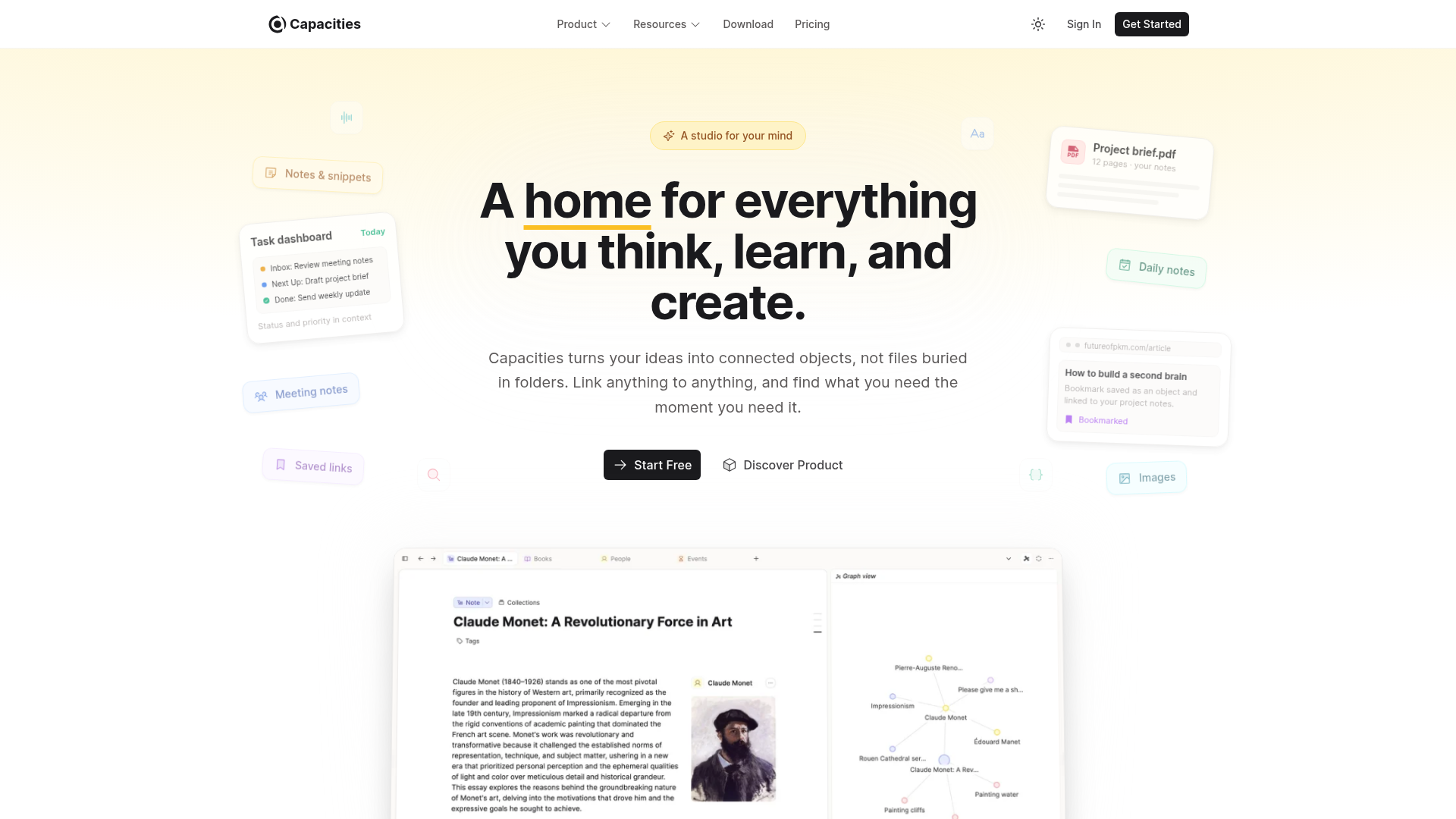
The verdict.
Capacities is the best free option for individuals who want structured, interconnected knowledge without the configuration overhead of Notion or the freeform chaos of plain markdown. If you are a researcher, writer, or founder who thinks in terms of people, projects, and ideas rather than folders and files, this tool will feel immediately natural. The trade-off: no collaboration features and limited customization mean teams and power-tweakers should look elsewhere.
Pricing, straight.
Capacities offers a generous free tier. Paid plans (Believer and Pro) add media storage, AI features, and advanced object types.
Free Forever
$0/month
- No credit card required
- Full export anytime
- Core object types
- Backlinks and daily notes
Believer
~$9/month
- Everything in Free
- Increased media storage
- Custom object types
- Early access to new features
Pro
~$19/month
- Everything in Believer
- AI-powered features
- Expanded storage
- Priority support
Pricing as captured on 2026-05-07. Check the live site before you commit.
Note: Paid tier pricing is approximate based on available information. Check the site for current rates.
What it actually does.
Link Anything to Anything
Create bidirectional connections between any objects. A person links to meetings, projects, and notes without manual upkeep.
Automatic Backlinks
Every connection is surfaced automatically. When you mention an object, it shows up in that object's backlinks panel without extra effort.
Daily Notes
Capture thoughts quickly in a daily journal that automatically links to relevant objects. Low friction entry point for any idea.
Typed Objects
People, books, meetings, projects, and ideas are distinct object types with their own properties. Not just pages with different titles.
Opinionated Design
No endless customization rabbit holes. The app makes sensible decisions so you spend time thinking, not configuring databases.
GDPR Compliant
European-based, privacy-first architecture. Full data export available at any time, even on the free plan.
Who it is for.
Researchers and Students
Track sources, people, concepts, and arguments as distinct objects. When writing a paper, pull up a concept and see every note that references it.
Writers and Content Creators
Build a personal wiki of ideas, drafts, and references. The object model prevents ideas from getting buried in folder hierarchies.
Founders and Managers
Link people to meetings, meetings to decisions, decisions to projects. One click on a person shows every interaction and context.
Developers
Document architecture decisions, link them to the people who made them and the projects they affect. Better than scattered markdown files.
The honest part.
- No collaboration. This is a single-player tool. If your workflow requires shared editing or team spaces, Capacities cannot help you today. Notion or Obsidian with shared vaults are better fits for teams.
- Limited customization. The opinionated design is a feature for some and a constraint for others. You cannot build complex formulas, rollups, or custom views the way you can in Notion. Power users who want full control will feel boxed in.
- No integrations ecosystem. There is no public API or native integrations list. Getting data in from other tools requires manual effort or workarounds. Compare this to Obsidian's plugin ecosystem or Notion's API.
- Smaller community. Fewer templates, guides, and third-party resources compared to Notion or Obsidian. You are somewhat on your own when building complex workflows.
Open object-based thinking
Free tier is genuinely usable. No credit card, full export.