- SPECIMEN
DesignVerse
- FILED AS
Build Enterprise Software From Your Own Documentation
- INTAKE DATE
- 2026-05-13
- CLASS
- Analytics
- METHOD
- desk research, filed before the Lab logged its counts
No dimension scores were recorded for this specimen, so no Koda Score is published. Read the verdict instead.
Ingest your internal docs, rules, and design systems. Generate consistent enterprise software across every team. Founded by ex-Oracle design lead Andrei Manolache, backed by $5.5M in seed funding.
Open DesignVerse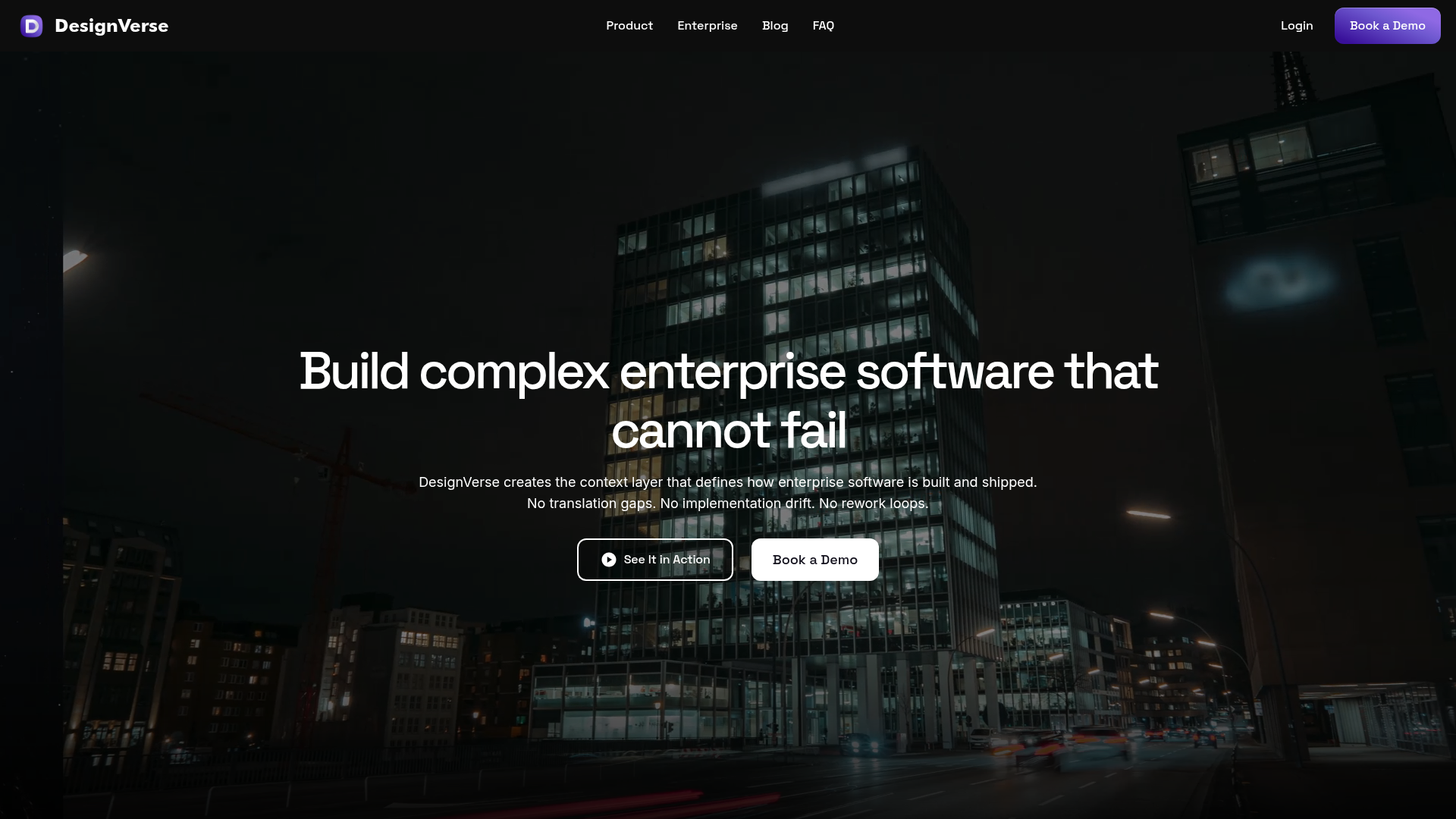
The verdict.
DesignVerse is built for mid-to-large enterprises drowning in fragmented internal tooling, inconsistent design implementations, and the slow drift between what gets designed and what gets shipped. If your organization has existing documentation and design systems but struggles to enforce consistency across multiple teams, this platform directly addresses that pain. The $5.5M seed and the European air traffic management credential suggest real enterprise traction, not just a demo. For small teams or solo developers, the free tier is limited and the real value only opens at scale.
Pricing, straight.
Three tiers. The free plan lets you evaluate core features; the real enterprise capabilities require a conversation.
Basic
Free
Get started, no commitment
- Access to core features
- Limited integrations
Pro
$99/month
For growing teams shipping consistently
- All Basic features
- Advanced analytics
- Priority support
Enterprise
Custom
Contact sales for pricing
- All Pro features
- Custom integrations
- Dedicated account manager
Pricing as captured on 2026-05-13. Check the live site before you commit.
Note: $99/month for Pro is reasonable for a team-level tool, but the real question is what "limited integrations" means on the free tier. If you need Figma + GitHub + your framework of choice, you are likely looking at Pro minimum. Enterprise pricing is opaque, which is standard for this market but worth pressing them on during evaluation.
What it actually does.
What DesignVerse actually does, and why it matters for enterprise teams.
Doc-Driven Generation
Ingests your internal documentation, business rules, and specifications to generate software that actually reflects how your organization works. Not generic templates; your rules, your logic.
Design-to-Production Alignment
Bridges the gap between what designers create in Figma and what developers ship. The platform enforces consistency so the final product matches the design intent, reducing costly rework cycles.
Deep Integration Stack
Connects to Figma, React, Angular, Node.js, GitHub, and REST APIs. This covers the most common enterprise frontend and backend stacks, though notably absent are Vue, .NET, and major cloud CI/CD platforms.
Cross-Team Scalability
Designed for organizations where multiple teams build different parts of the same product. Unified software production means Team A and Team Z ship components that look and behave the same way.
Reduced Rework and Drift
The platform actively prevents the slow divergence between design specs and shipped code that plagues large projects. This is where the real ROI lives for enterprise buyers.
Accelerated Delivery
By generating code from existing documentation rather than starting from scratch, teams can compress delivery timelines significantly. The air traffic management case study suggests this works in high-stakes, regulation-heavy environments.
Who it is for.
DesignVerse is not for everyone. Here is where it makes the most sense.
Large Enterprise Engineering Orgs
If you have 5+ teams building internal tools and customer-facing products, and consistency is a constant battle, DesignVerse directly addresses the coordination problem. The doc ingestion approach means you do not need to retrain teams on a new methodology.
Regulated Industries
Aviation, finance, healthcare. Any sector where software "cannot fail" and must demonstrably comply with documented rules. The European air traffic management work is a strong proof point here. If your compliance team needs traceability from spec to code, this is compelling.
Design System Teams
If you have invested heavily in a design system but adoption across engineering teams is inconsistent, DesignVerse can enforce that system programmatically. It turns your design system from a suggestion into a constraint.
Technical Debt Reduction Initiatives
Organizations actively trying to modernize legacy internal tooling. Rather than rewriting everything from scratch, you can feed existing documentation into DesignVerse and generate consistent replacements incrementally.
The honest part.
What to watch out for before committing.
- Free tier is very limited. "Access to core features" and "limited integrations" is vague. In practice, you will likely hit walls quickly if you are trying to do anything beyond a basic proof of concept. Expect to need Pro or Enterprise for real evaluation.
- Requires existing design systems and documentation. This is not a tool for startups figuring things out. If your organization does not already have well-structured internal docs, business rules, and design systems, DesignVerse will not magically create them. Garbage in, garbage out.
- Integration gaps. The current stack covers Figma, React, Angular, Node.js, and GitHub. That is solid but incomplete. No Vue, no Svelte, no Azure DevOps, no GitLab, no .NET. If your enterprise runs on any of those, you will need to check whether REST API coverage fills the gap or if it is a blocker.
- Early-stage product risk. $5.5M in seed funding is promising, but this is still a young company. Enterprise buyers should evaluate vendor stability carefully. The air traffic management case study is strong social proof, but the broader customer base is still forming.
- Enterprise pricing is opaque. "Contact for pricing" is expected at this level, but it makes it hard to budget or compare against alternatives like Retool, Airplane, or internal platform engineering investments without going through a sales process first.
Evaluate DesignVerse.
If your enterprise has the documentation and design systems to feed it, DesignVerse could meaningfully reduce fragmentation and accelerate delivery. Start with the free tier to test the core workflow.