- SPECIMEN
n8n AI Nodes
- FILED AS
Wire LLM Calls Directly Into Your CI/CD Pipelines
- INTAKE DATE
- 2026-05-14
- CLASS
- Security
- METHOD
- desk research, filed before the Lab logged its counts
No dimension scores were recorded for this specimen, so no Koda Score is published. Read the verdict instead.
Self-hostable workflow automation that now lets you embed GPT, Claude, or open-source model calls as discrete steps in visual pipelines. Your data, your infrastructure, your rules.
Open n8n Free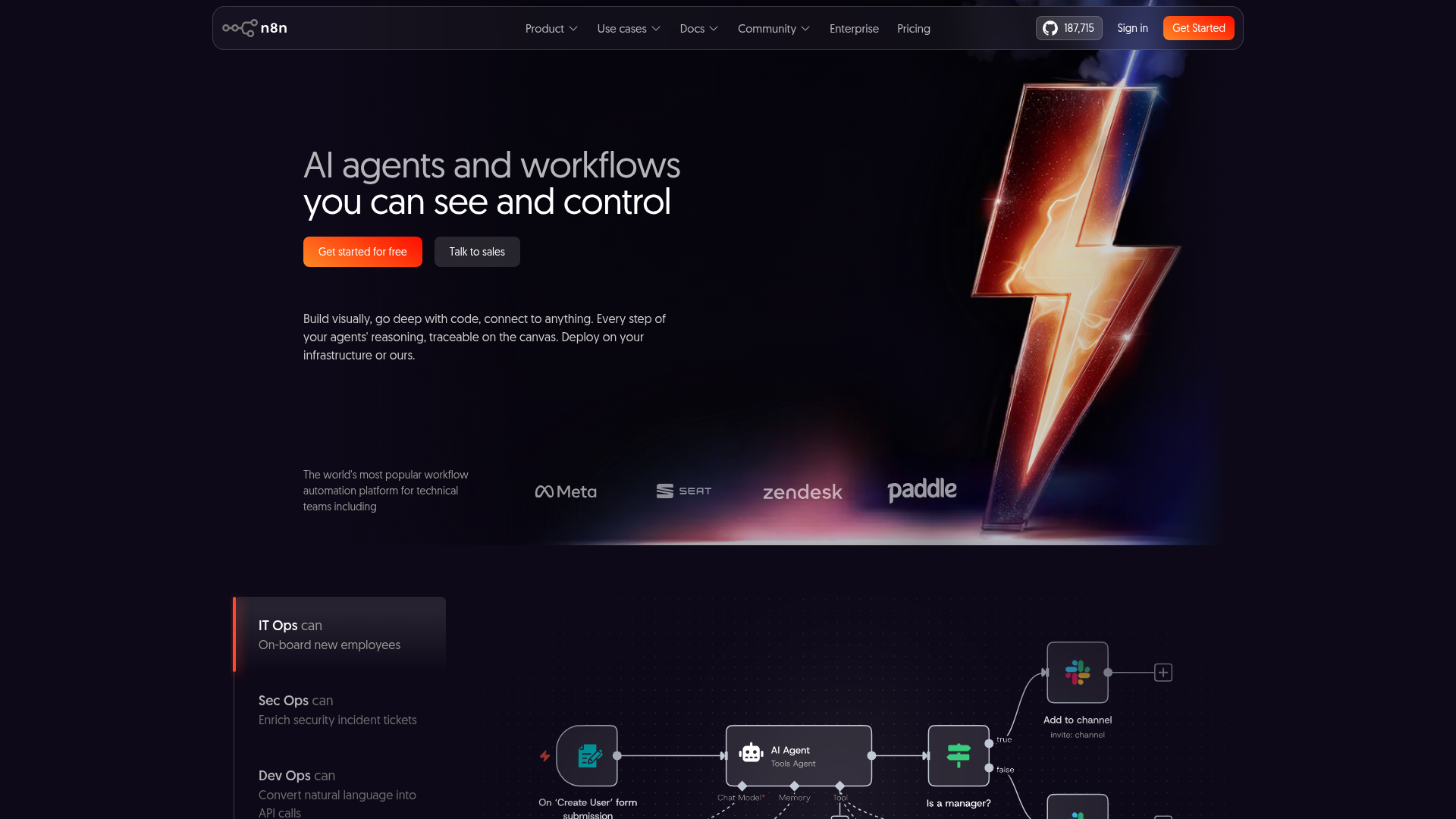
The verdict.
n8n's April 2026 AI nodes release is the strongest argument yet for treating LLM calls as first-class citizens in your automation pipelines. If you are a DevOps engineer, platform team lead, or SRE who wants to bolt intelligent error diagnosis, content generation, or embedding lookups onto existing workflows without leaving your infrastructure, this is the tool. The free tier is genuinely usable for solo operators; the Pro plan at $20/month is a steal compared to building equivalent orchestration from scratch. The main caveat: if your team has zero comfort with workflow-as-code thinking, the learning curve is real.
Pricing, straight.
All plans support the new AI nodes. Self-hosting is free and unlimited.
Free
$0/month
- Basic workflow automation
- Community support
- AI nodes included
- Self-host option
Best for solo devs and experimentation.
Pro
$20/month
- Advanced features
- Priority support
- Premium integrations
- Audit logs and log streaming
- All AI node capabilities
Best for small teams running production workflows.
Enterprise
Custom
- Custom workflows
- Enhanced security
- Dedicated support
- SSO, RBAC, SLA guarantees
Best for orgs with compliance requirements.
Pricing as captured on 2026-05-14. Check the live site before you commit.
What it actually does.
What makes the AI nodes release worth paying attention to.
Visual Workflow Builder with AI Steps
Drag and drop LLM calls alongside HTTP requests, database queries, and script nodes. Each AI node is a discrete, testable step. No black-box abstractions.
Multi-Model Support
GPT-4o, Claude 3.5, Llama 3, Mistral, and any OpenAI-compatible endpoint. Swap models per node. Run cheap models for triage and expensive ones for final output.
Re-run Single Steps
Failed LLM call? Re-run just that node with real data from the previous execution. No need to replay the entire pipeline. This alone saves hours of debugging time.
Self-Hostable, Open Source
Deploy on your own Docker or Kubernetes cluster. API keys, prompts, and data never leave your network. Critical for teams handling PII or operating under SOC 2 constraints.
LLM-Powered Error Handling
Build retry branches that feed error logs into an LLM node for diagnosis before deciding whether to retry, escalate, or reroute. Intelligent failure recovery, not just exponential backoff.
Code and No-Code Hybrid
Chain Python or JavaScript function nodes with AI nodes in the same workflow. Parse LLM output with custom scripts, run embedding lookups, or transform data between steps.
400+ Integrations
GitHub, Salesforce, ServiceNow, Asana, Slack, Docker, and hundreds more. AI nodes slot into existing integration workflows without rebuilding anything.
Audit Logs and Log Streaming
Every execution, every LLM call, every input/output pair is logged. Stream to your SIEM or observability stack. Essential for debugging prompt drift in production.
Who it is for.
Specific teams and scenarios where n8n AI nodes deliver real value.
DevOps / Platform Engineers
Build CI/CD pipelines where a failed deployment triggers an LLM to analyze logs, suggest fixes, and open a Jira ticket with a diagnosis. Automate the triage step that currently eats your on-call hours.
Security Operations Teams
Feed SIEM alerts into an LLM node for initial classification, then route high-confidence threats to PagerDuty and low-confidence ones to a review queue. Reduce alert fatigue without writing custom ML models.
IT Operations
Automate ServiceNow ticket enrichment. When a ticket comes in, an AI node summarizes related past incidents, suggests resolution steps, and pre-fills the knowledge base article draft.
Sales and GTM Teams (Technical)
Pull Salesforce deal data, run it through an LLM to generate personalized follow-up emails, and push drafts to your CRM. Works best when a technical team member sets it up for the broader org.
Data Teams Building RAG Pipelines
Chain embedding generation, vector store lookups, and LLM synthesis in a single visual workflow. Test each step independently with real data. Much faster iteration than writing the same pipeline in Python from scratch, especially when you need to integrate with external APIs between steps.
The honest part.
What to know before committing.
-
Free tier is genuinely limited.
You get basic workflow automation and community support, but no priority support, no audit logs, and limited execution history. Fine for prototyping; not enough for production workloads.
-
Learning curve for complex setups.
The visual canvas is intuitive for simple flows, but multi-branch error handling with conditional LLM routing gets dense fast. Expect a few days of ramp-up for non-trivial pipelines. Documentation is good but not always up to date with the latest AI node features.
-
Some integrations need manual configuration.
While 400+ integrations exist, not all are plug-and-play. OAuth flows for certain services (especially enterprise tools like ServiceNow) can require extra setup steps. The community nodes ecosystem helps, but quality varies.
-
No built-in prompt versioning or A/B testing.
You can version your workflows, but there is no native prompt management layer. If you need prompt versioning, evaluation scoring, or A/B testing across model providers, you will need to pair n8n with a dedicated tool like LangSmith or Braintrust.
-
Self-hosting means self-maintaining.
The data sovereignty story is excellent, but you own the uptime, upgrades, and scaling. For teams without dedicated infrastructure, the cloud-hosted Pro or Enterprise plans are the safer bet.
Wire LLM calls into your pipelines.
Start with the free tier. Self-host or use the cloud. Either way, you will have AI nodes running in under an hour.