- SPECIMEN
n8n
- FILED AS
Wire Up AI Agents and SaaS Tools With Visual Workflow Automation
- INTAKE DATE
- 2026-05-18
- CLASS
- Coding
- METHOD
- desk research, filed before the Lab logged its counts
No dimension scores were recorded for this specimen, so no Koda Score is published. Read the verdict instead.
The open-source workflow automation platform that lets technical teams build agentic AI pipelines connecting LLMs to hundreds of SaaS apps, all from a visual canvas.
Open n8n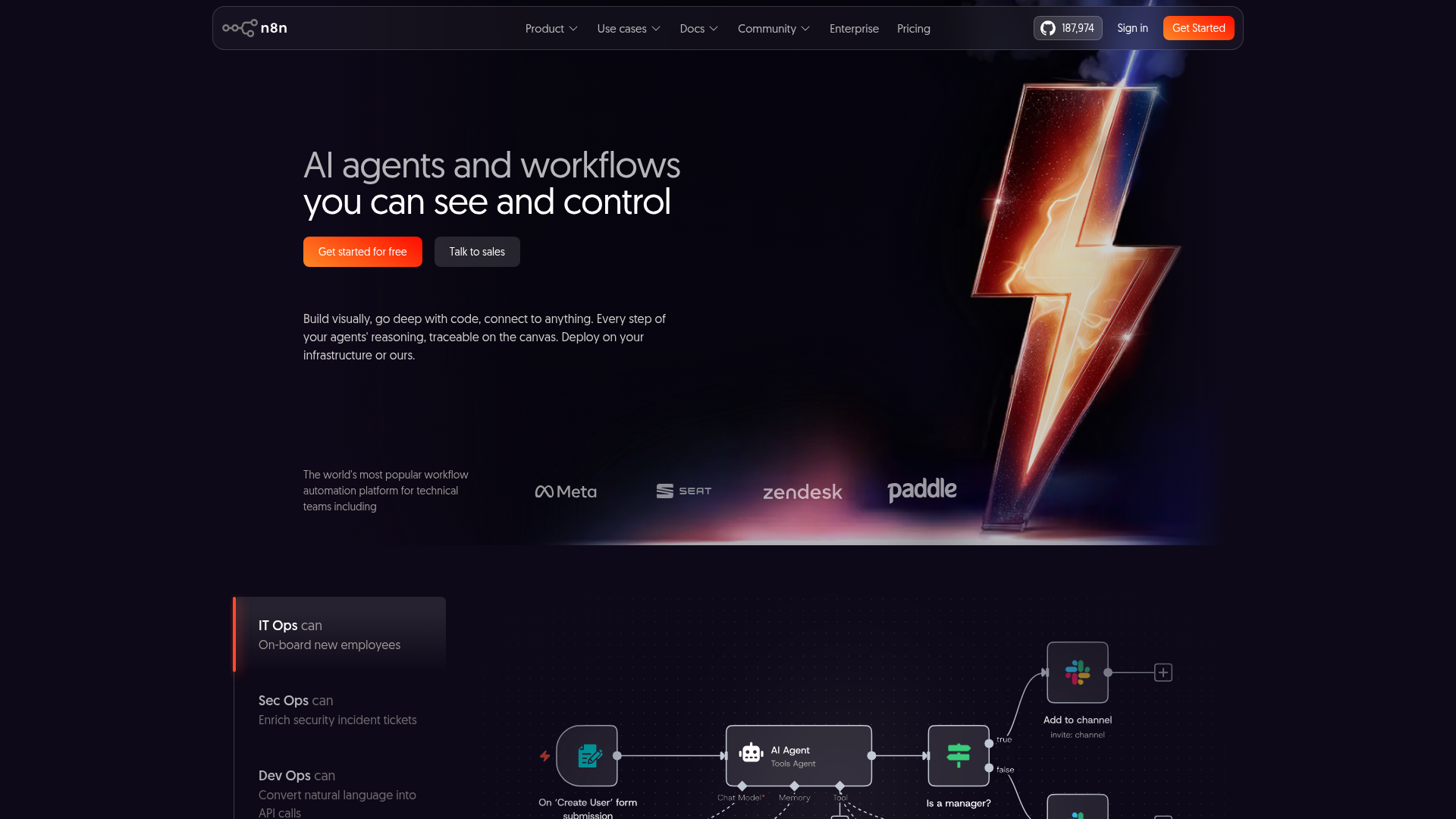
The verdict.
n8n is the strongest option available for technical teams that want to build AI-powered automations without being locked into a proprietary platform. If you are comfortable with JSON, can write a few lines of JavaScript or Python when needed, and want the freedom to self-host, n8n gives you more control per dollar than any competitor. It is not the right pick for non-technical marketers who want a plug-and-play experience; the learning curve is real. But for ops engineers, DevOps teams, and AI builders who need to chain LLM calls with real SaaS integrations, this is the tool to beat in 2026.
Pricing, straight.
Self-hosting is free with no execution limits. Cloud pricing starts at $0 and scales with usage.
- Unlimited workflows
- Access to all integrations
- Community support
Best for solo builders and experimentation. Self-host for zero cost with no execution caps.
- All Free plan features
- Priority support
- Collaboration features
- Advanced workflows
The sweet spot for small teams running production workflows on n8n Cloud.
- All Pro plan features
- Dedicated account manager
- Custom workflows
- Extended integrations
For orgs that need SSO, audit logs, and a dedicated support channel. Contact sales for pricing.
Pricing as captured on 2026-05-18. Check the live site before you commit.
What it actually does.
What makes n8n stand out from Zapier, Make, and other automation platforms.
Inline Code Anywhere
Drop JavaScript or Python directly into any workflow step. No need to leave the canvas to transform data, call APIs, or write custom logic. This is the single biggest differentiator versus no-code-only tools.
Visual + Code Hybrid Canvas
Drag and connect nodes visually while retaining full code access underneath. You get the speed of a visual builder with the precision of a code editor. Great for teams with mixed skill levels.
AI Agent Nodes
Native nodes for OpenAI, Anthropic, and other LLM providers let you build multi-step agentic workflows. Chain tool calls, memory, and retrieval steps into a single pipeline without external orchestration.
Step-Level Re-Runs
Re-run a single node without restarting the entire workflow. This saves enormous time when debugging complex chains, especially when upstream steps involve slow API calls or LLM completions.
Real-Time Execution Logs
Watch data flow through each node in real time. No more clicking through execution histories to figure out what broke. Logs surface input/output payloads at every step, which makes debugging transparent.
Self-Host for Free
Run n8n on your own infrastructure with Docker or Kubernetes. No execution limits, no vendor lock-in, full data sovereignty. This is a major advantage for teams in regulated industries or those with strict data policies.
400+ Integrations
Pre-built nodes for GitHub, Salesforce, Asana, ServiceNow, Slack, Google Sheets, Postgres, and hundreds more. Plus a generic HTTP node and webhook triggers for anything without a dedicated connector.
Test With Real Data
Pin real execution data to nodes and test workflows against actual payloads, not mock data. This closes the gap between development and production behavior, reducing surprises after deployment.
Who it is for.
n8n is built for technical teams. Here is where it delivers the most value.
IT Ops: Employee Onboarding
Trigger a workflow when a new hire appears in your HRIS. Automatically provision accounts in Google Workspace, Slack, GitHub, and Jira. Assign hardware requests in ServiceNow. What used to take a full day of manual ticket creation runs in seconds.
SecOps: Incident Enrichment
When a security alert fires, n8n can pull context from VirusTotal, Shodan, and your SIEM, then use an LLM to summarize the threat and auto-populate the incident ticket. Analysts get a pre-enriched brief instead of starting from scratch.
DevOps: Natural Language to API
Build a Slack bot that takes plain English requests ("scale staging to 3 replicas") and converts them into API calls via an LLM agent. n8n handles the Slack webhook, the LLM call, the API execution, and the confirmation message in one workflow.
Sales: AI-Powered Lead Intelligence
Scrape G2 reviews, run them through an LLM for sentiment analysis, and push structured insights into Salesforce. Sales reps get a pre-built customer profile before the first call. This kind of multi-step data enrichment is where n8n's agent capabilities shine.
The honest part.
No tool is perfect. Here is where n8n falls short.
Steep Learning Curve for Non-Technical Users
n8n markets itself as "low-code," but the reality is that you need to be comfortable with JSON structures, API authentication, and basic scripting to get real value. If your team is mostly marketers or ops people without technical backgrounds, Zapier or Make will be significantly easier to adopt. n8n rewards technical fluency; it does not replace it.
No Built-In Analytics Dashboard
There is no native way to visualize workflow performance over time, track execution success rates, or monitor throughput trends. You can export logs and build dashboards in Grafana or similar tools, but it is extra work. For teams running dozens of production workflows, this gap becomes noticeable fast.
Limited Real-Time Collaboration
You cannot have two people editing the same workflow simultaneously the way you can in Google Docs or Figma. The Pro plan adds collaboration features, but they are closer to shared access than true multiplayer editing. For larger teams, this means you need clear ownership conventions to avoid overwriting each other's work.
Self-Hosting Requires Maintenance
The free self-hosted option is genuinely powerful, but it is not "set and forget." You are responsible for updates, database backups, scaling, and uptime. If your team does not have someone comfortable managing Docker or Kubernetes in production, the $20/month cloud plan is worth it just to avoid the operational overhead.
Build.
Start with the free tier or self-host it today. n8n is one of the few platforms where the free version is genuinely production-capable.