- SPECIMEN
Thunderbit Developer API
- FILED AS
Filed without a one-line summary.
- INTAKE DATE
- 2026-05-28
- CLASS
- Marketing
- METHOD
- desk research, filed before the Lab logged its counts
No dimension scores were recorded for this specimen, so no Koda Score is published. Read the verdict instead.
Turn complex websites into structured data for RAG pipelines, AI agents, and LLM context windows. Web scraping rebuilt for the AI era.
Open it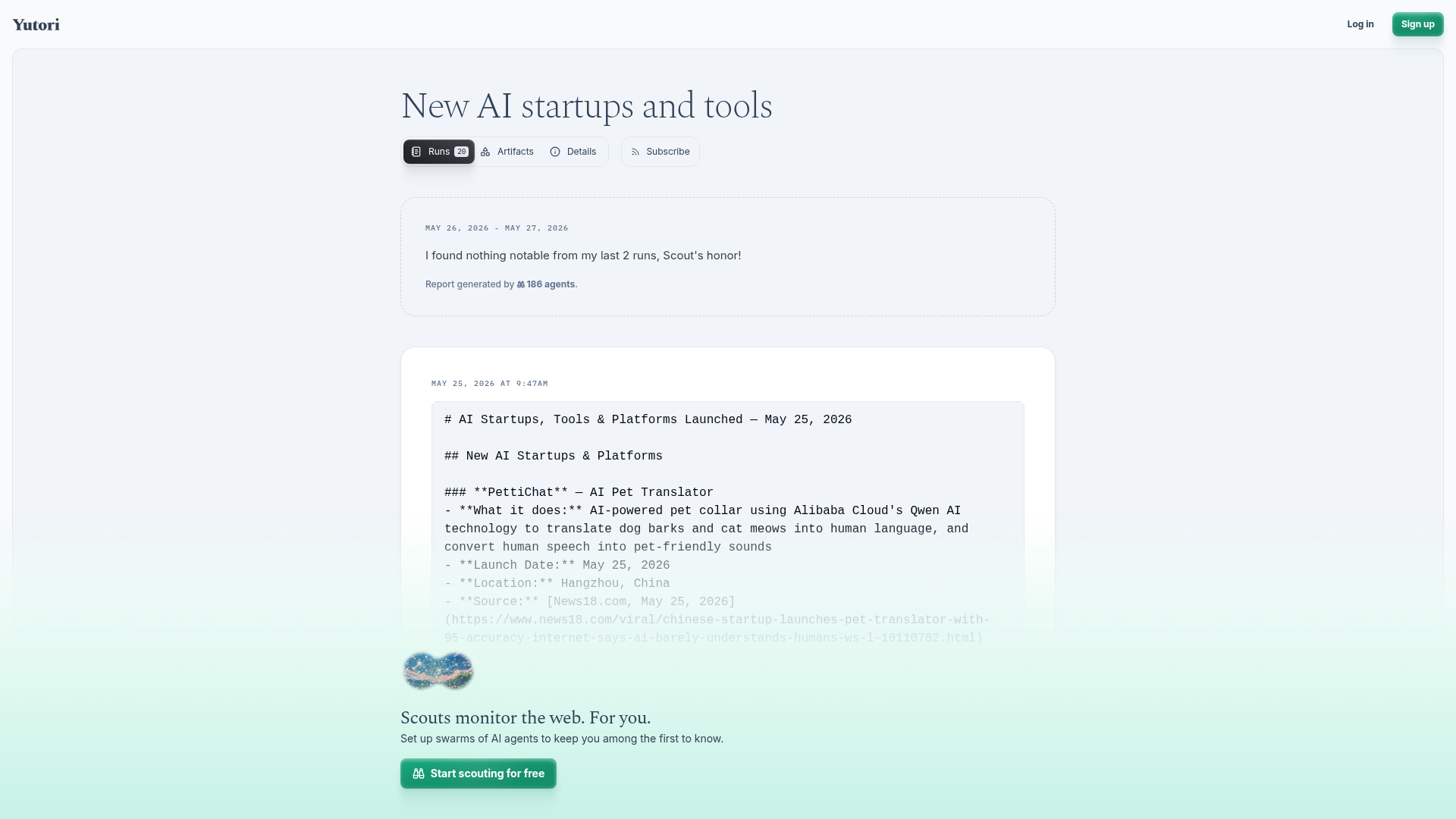
The verdict.
Thunderbit's Developer API is built for engineers who are tired of writing brittle scrapers to feed their RAG pipelines. If you are building AI agents that need to ingest real-world web content, this is a serious contender: it handles the messy extraction layer so you can focus on what happens after the data arrives. The combination of a REST API, MCP server, and CLI gives you flexibility most scraping tools simply do not offer for AI-native workflows.
Pricing, straight.
As of May 2026. Thunderbit has not published detailed public pricing tiers on this page.
Free / Developer
Likely $0
- API access with rate limits
- CLI tool included
- Markdown + JSON output
- Basic MCP server access
- ○ Limited monthly requests
Pro
TBD
- Higher rate limits
- Priority extraction queue
- Full MCP server features
- Structured JSON schemas
- Production-grade SLA
Enterprise
Custom
- Unlimited or custom volume
- Dedicated infrastructure
- Custom output schemas
- SSO and team management
- Priority support
Pricing as captured on 2026-05-28. Check the live site before you commit.
Note: Thunderbit's public documentation does not list explicit pricing tiers at this time. The above is inferred from typical API product structures. Check their site for current details.
What it actually does.
High-Fidelity Web Extraction
Point the API at any URL and get back clean, structured content. It handles JavaScript-heavy SPAs, paywalled layouts, and complex DOM structures that break traditional scrapers.
Markdown + JSON Output
Every extraction returns both clean Markdown (ideal for LLM context windows) and structured JSON (ideal for database ingestion and RAG chunking). No post-processing scripts needed.
MCP Server Integration
Ships with a Model Context Protocol server out of the box. This means AI agents built on Claude, GPT, or open-source models can call Thunderbit as a tool natively, without custom middleware.
CLI for Local Workflows
The command-line tool lets you pipe web content directly into scripts, cron jobs, or CI/CD pipelines. Useful for batch extraction and local development without touching the REST API.
AI-Native Architecture
This is not a traditional scraping tool with AI bolted on. The output formats, chunking strategies, and integration patterns are designed specifically for feeding LLMs and retrieval-augmented generation systems.
REST API for Production
Standard REST endpoints mean you can integrate Thunderbit into any stack. Python, Node, Go, whatever you are running. Authentication is API key-based, and responses are predictable and well-structured.
Noise Removal
Strips navigation, ads, cookie banners, and boilerplate from extracted content. What you get back is the actual content of the page, not the wrapper around it. This matters when every token in your context window counts.
Complex Site Handling
Designed to handle the sites that break other tools: dynamic rendering, infinite scroll, embedded iframes, and multi-page content. The extraction engine renders pages before parsing, catching content that static scrapers miss entirely.
Who it is for.
RAG Pipeline Engineers
If you are building retrieval-augmented generation systems and need a reliable way to ingest web content into your vector store, Thunderbit replaces the fragile scraping layer. The structured JSON output maps cleanly to embedding workflows.
AI Agent Developers
Building agents that need to browse and understand the web? The MCP server integration means your agent can call Thunderbit as a tool, get clean content back, and reason over it. No screen scraping hacks required.
Research and Competitive Intelligence Teams
Need to systematically extract and analyze content from competitor sites, industry publications, or regulatory pages? The CLI makes batch extraction straightforward, and the Markdown output is immediately readable by both humans and LLMs.
LLM Application Builders
If your product needs to summarize web pages, answer questions about URLs, or ground LLM responses in real web content, Thunderbit handles the extraction so you can focus on the intelligence layer above it.
The honest part.
- Pricing opacity. As of this writing, Thunderbit has not published clear pricing tiers on their developer API page. If you are evaluating this for a production workload, you will need to contact them directly. That is a friction point for developers who want to estimate costs before committing.
- New product, unproven at scale. The API shipped on May 25, 2026. That is three days ago. There is no public track record for uptime, reliability under heavy load, or how extraction quality holds up across thousands of diverse domains. Early adopters should plan for some rough edges.
- Limited public documentation on edge cases. How does it handle login-gated content? CAPTCHAs? Sites that aggressively block bots? These are the questions that matter in production, and the current documentation does not address them in depth.
- MCP is still an emerging standard. The MCP server integration is a strong differentiator, but MCP itself is not universally adopted yet. If your agent framework does not support MCP, this feature is irrelevant to you, and you will be using the REST API like any other scraping service.
- No visible integrations ecosystem. There are no listed integrations with popular vector databases (Pinecone, Weaviate, Qdrant), orchestration tools (LangChain, LlamaIndex), or workflow platforms. You will be writing the glue code yourself for now.
Pipe the web into your AI.
Thunderbit's Developer API is purpose-built for the extraction layer your RAG pipeline has been missing.
Open Thunderbit Developer API