- SPECIMEN
Architect.new
- FILED AS
Go From Idea to Deployed AI Agent in One Session
- INTAKE DATE
- 2026-06-08
- CLASS
- Design
- METHOD
- desk research, filed before the Lab logged its counts
No dimension scores were recorded for this specimen, so no Koda Score is published. Read the verdict instead.
Built by Lyzr, Architect.new promises to let business executives and consultants design, build, and deploy AI agents without writing a single line of code. We tested both its guided flow and One Shot mode to see if the promise holds up.
Open Architect.new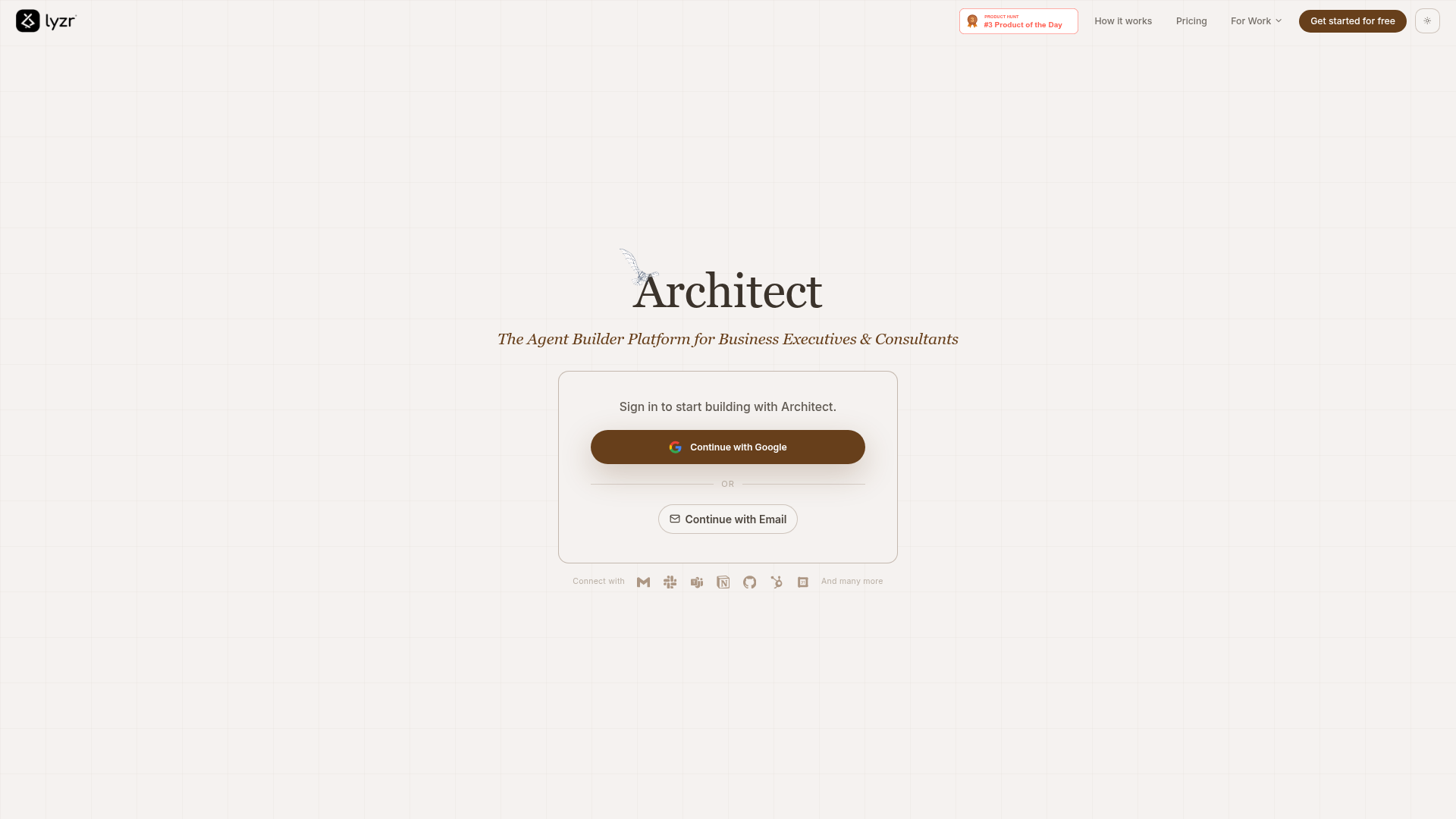
The verdict.
Architect.new is genuinely useful for consultants and ops leads who need a working AI agent prototype in hours, not weeks. The free tier gives you enough runway to validate whether an agent concept is viable before committing $29/month. If you are a developer who already knows LangChain or CrewAI, you will find the abstraction layer limiting. But if you are a non-technical decision-maker who needs to ship a customer support bot, internal data retrieval agent, or process automation workflow without hiring an engineer, this is one of the fastest paths from idea to deployment available right now.
Pricing, straight.
All plans billed monthly. Enterprise pricing requires a sales conversation.
- Basic agent building features
- Guided flow and One Shot mode
- Limited community support
- No custom integrations
- All Free features
- Advanced agent features
- Custom integrations (Slack, Zapier, etc.)
- Priority support
- All Pro features
- Dedicated account manager
- Tailored solutions and SLAs
- Custom deployment options
Pricing as captured on 2026-06-08. Check the live site before you commit.
Note: Our earlier estimate of ~$35/month was based on pre-launch pricing. The confirmed Pro tier is $29/month.
What it actually does.
What Architect.new actually does well, and what sets it apart from manual agent frameworks.
AI-Driven Requirements Analysis
Describe what you want your agent to do in plain English. Architect.new interprets your intent, identifies required capabilities, and maps out the agent architecture before any building begins. This is where the "guided flow" shines for non-technical users.
One Shot Mode
Feed it a single prompt and get a complete agent scaffold: tools, memory configuration, prompt templates, and deployment config. Useful when you already know exactly what you want and do not need the step-by-step walkthrough.
Workflow Orchestration
Chain multiple agent steps together visually. Define conditional logic, handoffs between sub-agents, and fallback behaviors. This is the core differentiator over simpler chatbot builders that only handle linear conversations.
Responsive UI Generation
Architect.new generates a front-end interface for your agent automatically. It is not going to win design awards, but it produces functional, mobile-friendly UIs that you can embed or share immediately.
Native Integrations
Pre-built connectors for Google Workspace, Slack, Microsoft Teams, Asana, and Zapier. The Zapier integration effectively gives you access to thousands of additional apps, though the depth of each connection varies.
Real-Time Building and Deployment
Agents build and deploy in the same session. No separate CI/CD pipeline, no Docker configuration, no server provisioning. You go from prompt to live agent URL in minutes. Lyzr handles the hosting infrastructure.
Who it is for.
Architect.new is not for everyone. Here is where it makes the most sense.
Customer Support Teams
Build a support agent that pulls from your knowledge base, handles tier-1 queries, and escalates to humans when needed. The Slack and Teams integrations mean you can deploy it where your team already works.
Management Consultants
Prototype AI solutions for clients in a single working session. Show a live demo instead of a slide deck. This is clearly Lyzr's primary target audience, and the guided flow is designed to make consultants look competent with AI tooling fast.
Data Retrieval and Internal Tools
Connect to Google Workspace or internal databases and build agents that answer questions about your data. Think "ask your spreadsheets" or "query your project management tool in natural language."
Business Process Automation
Automate repetitive workflows like task assignment, status updates, and report generation. The Zapier connector extends this to virtually any SaaS tool. Best for structured, repeatable processes rather than open-ended creative tasks.
The honest part.
No tool is perfect. Here is what you should know before committing.
Free Tier Is Genuinely Limited
You can prototype and test, but support is minimal and custom integrations are locked behind the Pro plan. If your agent needs Slack or Zapier connectivity, you are paying $29/month from day one.
Not for Developers Who Want Control
If you are comfortable with LangChain, LlamaIndex, or CrewAI, Architect.new will feel like a black box. You cannot easily inspect the underlying agent code, swap out LLM providers at a granular level, or implement custom tool functions beyond what the platform exposes.
Vendor Lock-In Risk
Your agents live on Lyzr's infrastructure. There is no obvious "export to code" option that lets you take your agent and self-host it. If Lyzr changes pricing, deprecates features, or shuts down, your agents go with it.
Not Built for Personal or Casual Use
The platform is explicitly designed for business executives and consultants. If you want a personal assistant agent or a hobby project, the onboarding flow and pricing structure are overkill. Look at something like Poe or a simple GPT wrapper instead.
Generated UIs Are Functional, Not Beautiful
The auto-generated front-end works and is responsive, but it looks generic. If you need a polished, branded experience for external customers, plan on building a custom front-end that calls the agent via API.
Build Your First Agent.
The free tier is enough to validate your idea. Start there, and upgrade to Pro only if you need integrations or priority support.