- SPECIMEN
Glean
- FILED AS
Make Your Company's Scattered Knowledge Instantly Searchable
- INTAKE DATE
- 2026-06-09
- CLASS
- Analytics
- METHOD
- desk research, filed before the Lab logged its counts
No dimension scores were recorded for this specimen, so no Koda Score is published. Read the verdict instead.
Connects your company's knowledge, systems, and context so AI can actually work at enterprise scale. One search bar to rule every app your team touches.
Open Glean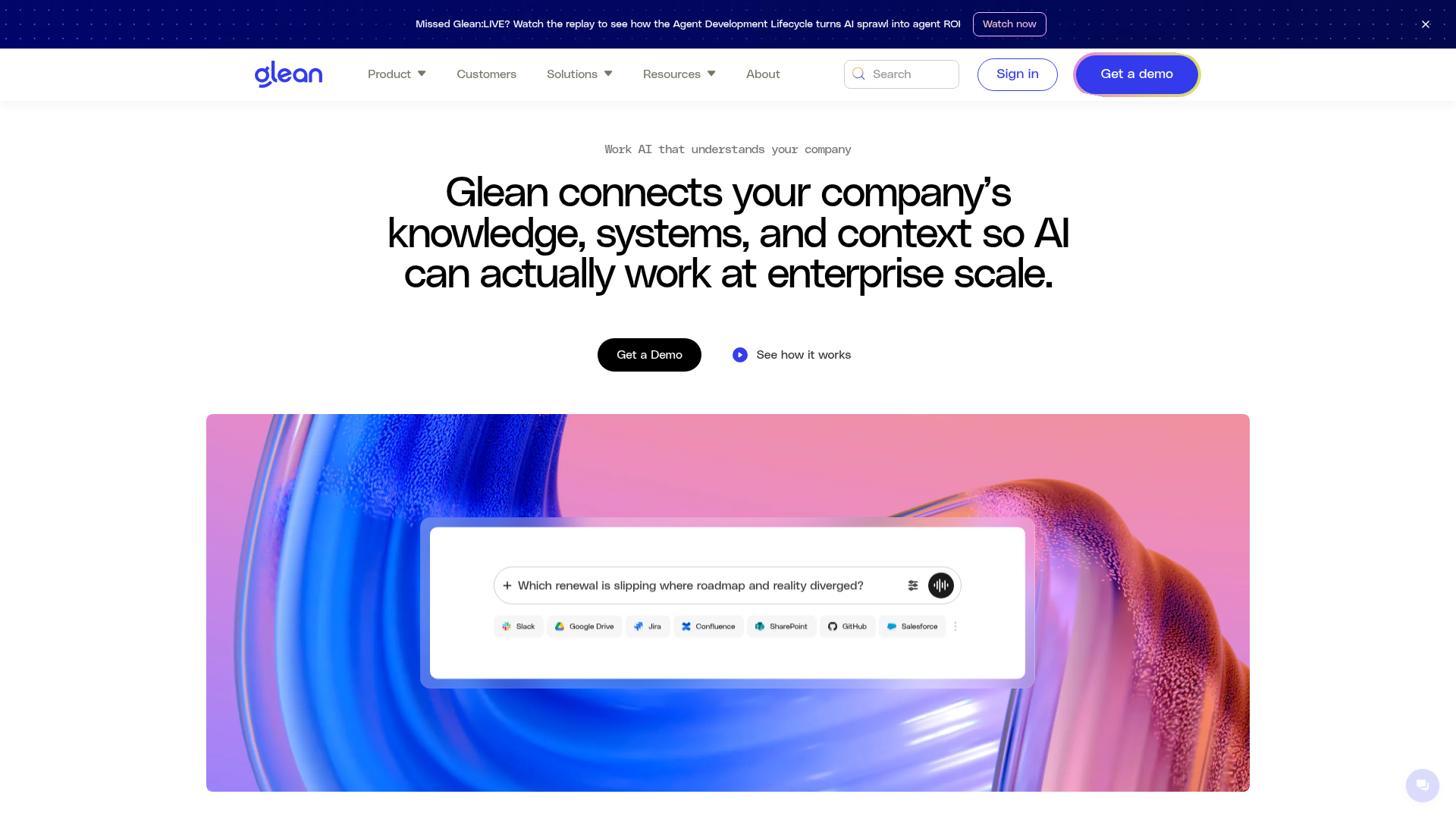
The verdict.
Glean is the strongest enterprise knowledge search product on the market right now, and it is built for mid-to-large companies (200+ employees) drowning in fragmented information across Slack, Drive, Confluence, and a dozen other tools. If your new hires spend their first two weeks asking "where do I find X?" in Slack channels, Glean pays for itself quickly. The catch: pricing is opaque, the sales process is enterprise-grade slow, and smaller teams may find the cost hard to justify when a well-organized Notion workspace could do 80% of the job.
Pricing, straight.
Glean does not publish pricing publicly. All plans require contacting sales. Based on market reports, expect $15 to $30+ per user per month depending on scale and features.
Standard
Contact for pricing
- AI-driven enterprise search
- Integration with existing tools
- Secure access controls (respects source permissions)
- Token usage optimization
Enterprise
Contact for pricing
- Everything in Standard
- Advanced analytics and query observability
- Dedicated support and onboarding
- Custom agent builder and workflows
- Scalability for large teams (1,000+)
Pricing as captured on 2026-06-09. Check the live site before you commit.
Glean typically requires annual contracts. Free trials are not publicly available; you will need to request a demo.
What it actually does.
What makes Glean worth evaluating over simpler alternatives.
100+ Native Integrations
Connects to Slack, Google Drive, Jira, Confluence, SharePoint, GitHub, Salesforce, Zendesk, and many more. Permissions from each source are respected automatically, so users only see what they should.
AI-Powered Unified Search
Natural language queries across all connected apps. Ask "what's our refund policy for enterprise clients?" and get a synthesized answer with source links, not just a list of documents.
Custom Agent Builder
Build lightweight AI agents for ticket triage, onboarding checklists, policy lookups, and internal Q&A. No code required for basic agents; more complex workflows need some configuration.
Enterprise-Grade Security
SOC 2 Type II certified. Data governance controls let admins restrict which content gets indexed. Full query observability means you can audit what people are searching for and what the AI returns.
Knowledge Graph
Glean builds a company-specific knowledge graph that understands relationships between people, teams, projects, and documents. This is what makes search results contextually relevant rather than keyword-matched.
Token Efficiency
Glean claims fewer tokens used per query compared to generic RAG setups. For companies running thousands of queries daily, this translates to meaningful cost savings on the AI compute side.
Who Should Use Glean
Glean is not for everyone. Here is where it genuinely shines.
Mid-to-Large Enterprises (200+ employees)
The more apps and people you have, the more valuable Glean becomes. If your company uses 10+ SaaS tools and employees regularly cannot find the right document, this is the core use case.
Onboarding-Heavy Organizations
Companies hiring frequently or with high turnover. New hires can self-serve answers instead of waiting for someone on Slack to respond. This alone can cut onboarding time by 30-50% according to Glean's case studies.
Support and Customer Success Teams
Agents can handle ticket triage and surface relevant knowledge base articles, past tickets, and internal docs. Reduces time-to-resolution when support reps do not have to hunt across five different systems.
IT and Operations Leaders
If you are responsible for reducing internal tool sprawl or improving cross-team collaboration, Glean gives you analytics on what people search for, what they cannot find, and where knowledge gaps exist.
Not ideal for: Solo founders, small teams under 50 people, or companies that primarily use a single tool like Notion for everything. The ROI does not justify the cost at that scale.
The honest part.
Where Glean falls short or may frustrate you.
Completely Opaque Pricing
No public pricing page. No self-serve signup. You must go through a sales demo to get a quote. This is frustrating for teams that want to evaluate quickly. Industry estimates suggest $15 to $30+ per user per month, but your mileage will vary based on company size and negotiation.
Slow Time-to-Value
Connecting all your apps, indexing content, and building the knowledge graph takes time. Expect 2 to 4 weeks before search results feel genuinely useful. The initial setup requires IT involvement for permissions and connector configuration.
Learning Curve for Agent Builder
While basic search works immediately, the custom agent builder requires understanding of workflows and prompt design. Non-technical users may struggle to build anything beyond simple Q&A bots without support.
No Public User Dashboard
Individual users do not get much control over their experience. There is no public-facing account dashboard for managing preferences, saved searches, or personal settings. Admin controls are robust, but end-user customization is limited.
Competitive Pressure
Microsoft Copilot, Google Vertex AI Search, and Notion AI are all moving into this space. If your company is already deep in the Microsoft or Google ecosystem, their native AI search tools may be "good enough" at a lower cost, even if Glean's cross-platform search is technically superior.
Unify your company's knowledge.
Connect your three most-used apps and see how fast your team stops asking "where is that doc?" in Slack.