- SPECIMEN
SciSummary
- FILED AS
Filed without a one-line summary.
- INTAKE DATE
- 2026-07-02
- CLASS
- Design
- METHOD
- desk research, filed before the Lab logged its counts
No dimension scores were recorded for this specimen, so no Koda Score is published. Read the verdict instead.
Improving academic comprehension through domain-specific AI that turns dense papers into fast, structured summaries.
Open it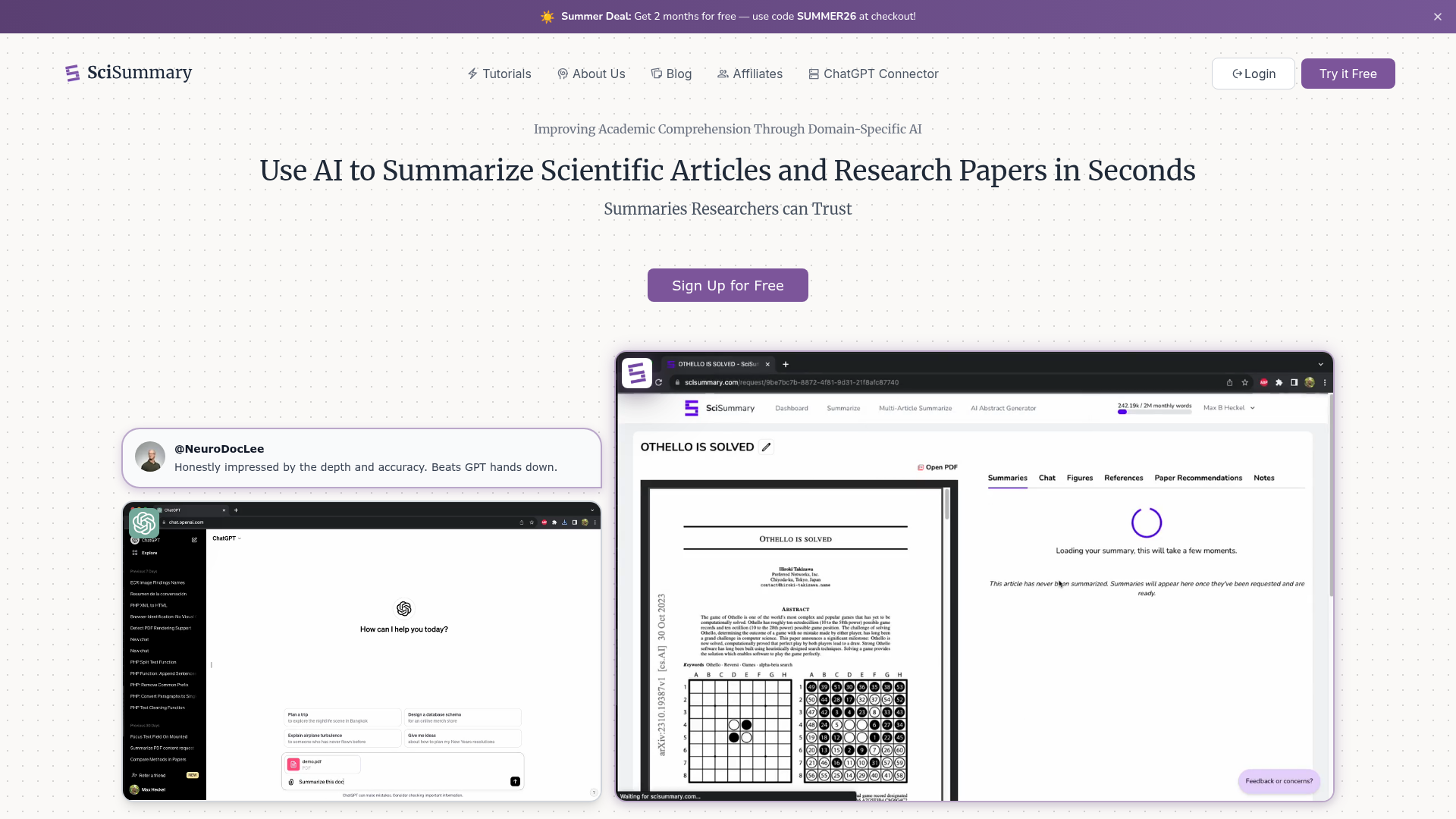
The verdict.
SciSummary is a well-priced triage tool for anyone drowning in literature. It will not read a paper for you, but it does an honest job of extracting core findings, interpreting figures, and letting you decide what actually deserves your full attention. For students and researchers screening dozens of papers a week, the low cost and email-in workflow make it easy to justify. Treat it as a first pass, not a substitute for reading the studies that matter.
Pricing, straight.
SciSummary keeps its plans simple. The digest that flagged it mentioned paid tiers from $6.99/month, but the site now lists an annual Pro plan that works out to roughly $4/month. Worth confirming the current rate before you commit.
Free Trial
$0
- Unlimited summaries for 1 month
- Unlimited figures analyzed (AI)
- Unlimited chat messages
- Unlimited article searches
- Unlimited quick click import
Student
$0
- Unlimited summaries for 1 month
- Unlimited figures analyzed (AI)
- Unlimited chat messages
- Unlimited article searches
- 50 papers quick click import
Pro Plan
$4/mo
billed as $48/yr
- Unlimited summaries
- Unlimited figures analyzed (AI)
- Unlimited chat messages
- Unlimited article searches
- 1,000 documents indexed
Pricing as captured on 2026-07-02. Check the live site before you commit.
What it actually does.
Structured summaries
Breaks dense academic papers into readable sections so you get the argument, method, and findings without wading through jargon.
Email-in submission
Forward a paper to SciSummary and get a summary back. Useful when a PDF lands in your inbox and you do not want to leave your workflow.
Bulk summarization
Process many papers at once, which is where the tool earns its keep during a literature review sprint.
Figure interpretation
Reads charts and reports statistics like p-values and effect sizes, giving you a sense of whether a result is meaningful.
Folders and tags
Organize your research library so summaries stay retrievable across projects instead of piling up in a chat history.
Chat with papers
Ask follow-up questions against a paper to clarify a method or dig into a result the summary glossed over.
Who it is for.
Researchers
Screen new literature quickly to decide which papers deserve a close read and which can be filed away.
Students
Get oriented in an unfamiliar field fast, then use the free student access to keep costs near zero.
Academics managing libraries
Use folders and tags to keep a growing research collection organized and searchable across projects.
Professors running lit reviews
Speed up the early filtering stage of a review before committing time to detailed synthesis.
The honest part.
SciSummary does not replace understanding a complex paper. For methodologically dense work, subtle assumptions and limitations in the study design can get lost in a summary, and you will still need to read the original to cite it responsibly.
The free trial gives generous access but only for one month, and quick click import is capped on the free student tier. Anyone summarizing at scale will need the Pro plan, and the 1,000 document indexing limit there is worth keeping in mind for very large libraries.
There are no listed third-party integrations, so it lives mostly as a standalone workspace plus the email workflow rather than plugging into a reference manager you may already use.