- SPECIMEN
MARS5 TTS
- FILED AS
Filed without a one-line summary.
- INTAKE DATE
- 2026-07-14
- CLASS
- Voice
- METHOD
- desk research, filed before the Lab logged its counts
No dimension scores were recorded for this specimen, so no Koda Score is published. Read the verdict instead.
The verdict.
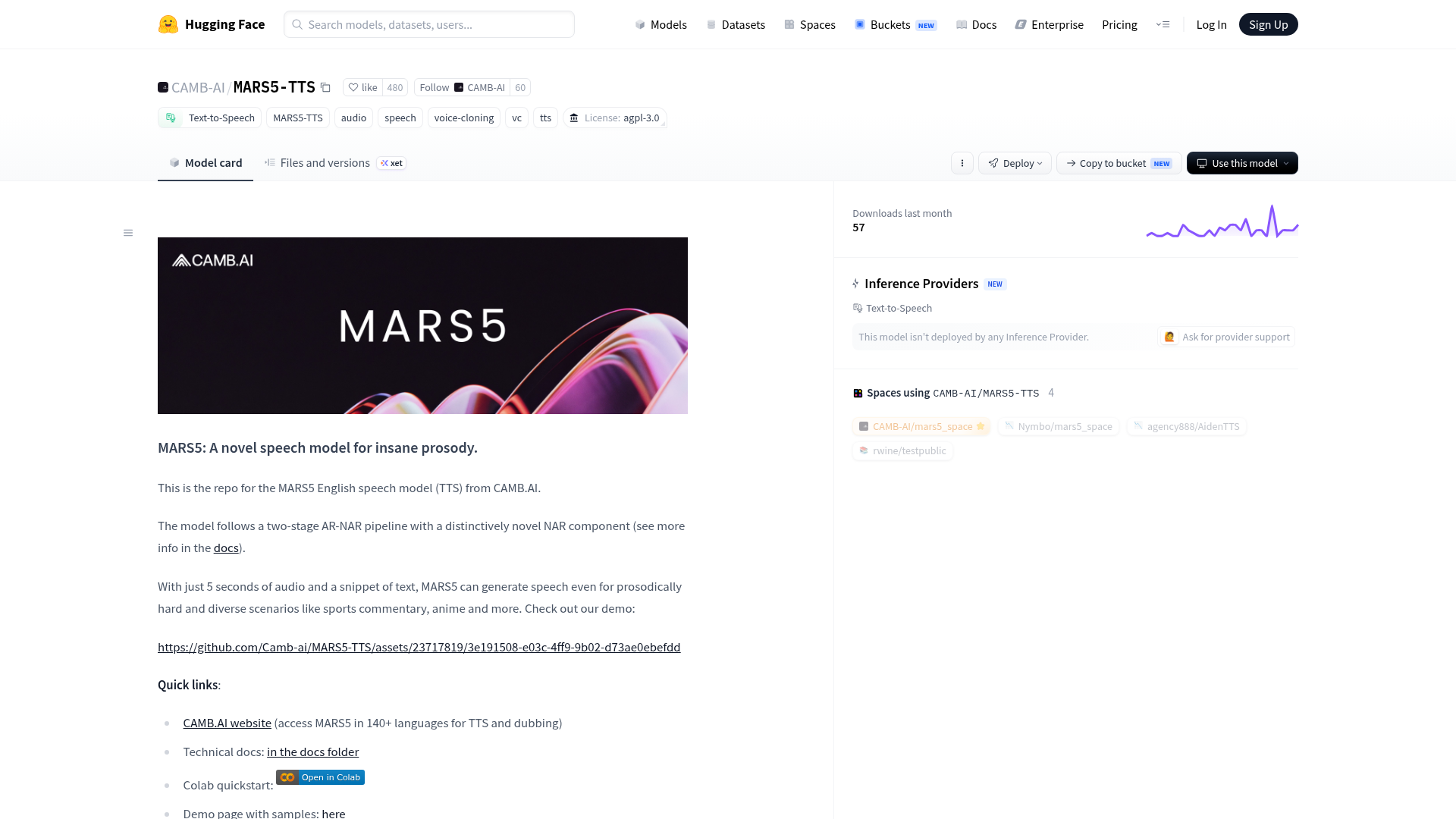
MARS5 is one of the better open-weight voice cloning models you can run without touching a credit card, and the prosody is genuinely a cut above most free alternatives. It is aimed squarely at developers with a capable GPU who want to build TTS, dubbing, or narration pipelines free of licensing constraints. If you do not have around 20GB of VRAM or a comfort level with Python and Colab, this is not a plug-and-play consumer product; it is a research model you assemble yourself.
Pricing, straight.
Free and Open Source
$0
AGPL-friendly release, commercially usable weights
- Access MARS5 in 140+ languages for TTS and dubbing
- API usage for applications
- Community support
- Run locally or on your own cloud GPU
Pricing as captured on 2026-07-14. Check the live site before you commit.
There is no metered tier, no per-character billing, and no seat cost. The real price is compute. You pay for the GPU time, whether that is your own hardware or a rented instance.
What it actually does.
Two-stage AR-NAR pipeline
An autoregressive stage handles the acoustics while a non-autoregressive stage refines quality. This split is what gives MARS5 its noticeably more natural cadence.
Clone from seconds of audio
A short reference clip of roughly 2 to 5 seconds is enough to capture a speaker. Longer, cleaner samples improve the result.
Deep clone mode
Feeding a transcript alongside the reference audio produces markedly higher fidelity output. It is slower, but the accuracy jump is real.
Prosody via punctuation
You can steer emphasis and pacing through punctuation and capitalization rather than fighting a rigid SSML syntax.
140+ languages
Broad language coverage makes it a candidate for multilingual dubbing pipelines, though quality varies by language.
Handles hard scenarios
CAMB.AI demonstrates it on sports commentary and anime, cases where flat TTS models usually fall apart.
Who it is for.
MARS5 fits developers and small studios building products where voice quality matters but per-minute API bills do not scale. Because the weights are commercially usable, you can bake it into a shipping product without negotiating licenses.
- Storytelling and narration apps that need expressive delivery rather than robotic reads.
- Video dubbing pipelines across many languages, especially where a consistent cloned voice is required.
- Media and audio production where you want to iterate quickly on takes without studio time.
- Language learning tools that benefit from natural pronunciation samples.
- Voice cloning research and prototypes where full local control beats a black-box API.
The honest part.
- Heavy GPU requirement. Around 20GB of VRAM is expected for comfortable inference. That rules out most consumer laptops and cheaper cloud tiers.
- Quality depends on clean input. Noisy or reverberant reference audio degrades the clone noticeably. Garbage in, garbage out applies here.
- Deep clone is slow. The higher-quality path takes real time to run, which complicates any low-latency or realtime use case.
- No polished UI. This is a Hugging Face model, not a product. Expect to work through Python, Colab, and dependency management yourself.
- Uneven language quality. The 140+ figure is impressive, but not every language performs equally. Test your specific targets before committing.