- SPECIMEN
Ollama
- FILED AS
Local runtime for open-weight LLMs, with an optional cloud tier for bigger models
- INTAKE DATE
- 2026-07-25
- CLASS
- AI Platform
- METHOD
- 1 page scraped, 3 search passes, 23 community sources
Koda Score = weighted blend: capability 35, ease 20, value 25, momentum 20.
One curl command puts a real model on your own hardware, and everything you draft, summarize, or explain there costs you exactly zero API dollars.
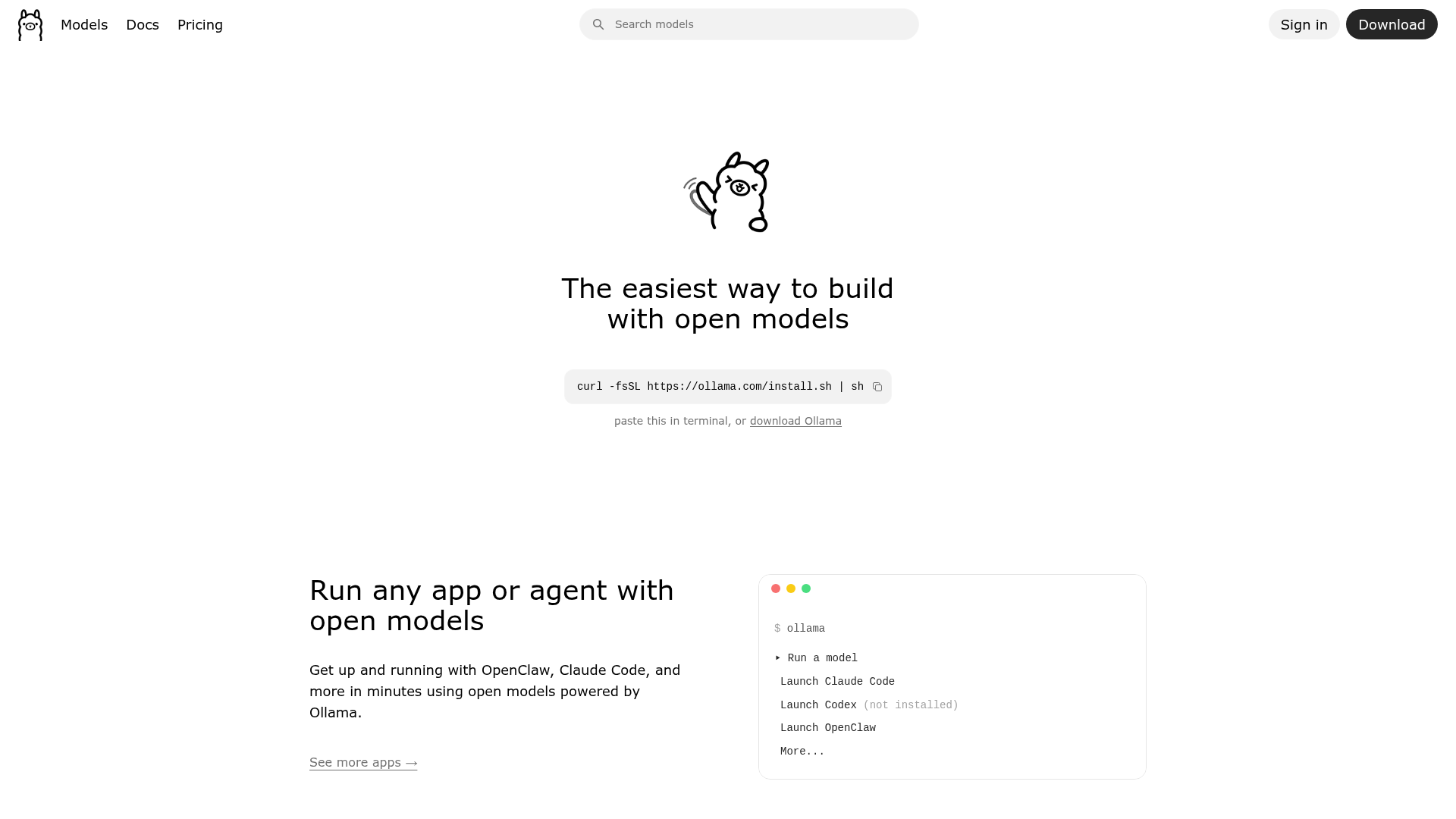
Captured: ollama.com on 2026-07-25.
Ollama is not a replacement for a frontier model on your hardest work, and it does not do image generation. But if you already pay per token for low-stakes drafting, summarizing, and code explanation, it is worth installing today. It is for developers who want open-weight models running on their own machine with minimal ceremony, then want the same CLI and API to reach datacenter hardware when a task outgrows local RAM.
What it actually does.
One-line install
A single curl script or a platform download gets the runtime on macOS, Windows, or Linux.
Local model library
Pull open-weight models and switch between them from the CLI without re-plumbing your setup.
Cloud escalation
The same interface reaches larger models on datacenter-grade hardware when local memory runs out.
Agent integrations
Launch OpenClaw, Claude Code, or Codex against open models straight from the Ollama CLI menu.
Parallel requests
Cloud usage supports many requests in parallel, which matters for batch jobs and agent loops.
Offline operation
Local models run entirely offline, which the site positions for mission critical work.
Regional cloud and data policy
Cloud models are available in the United States, Europe, and Singapore, and Ollama states your data is never trained on.
How you would actually use it.
Concrete setups pulled from the research, not feature-list hand-waving.
Move the boring prompts off the meter
Solo builder paying per token
Install Ollama, pull a mid-size open model, and route drafting, summarizing, and code-explaining requests to the local endpoint while keeping your paid model for hard reasoning.
The high-volume, low-stakes half of your usage stops generating invoices.
Open-model backend for your agent
Developer already using Claude Code, Codex, or OpenClaw
Use the Ollama CLI launcher to start your existing agent front end against a local open model, then flip to a cloud model for tasks that need more headroom.
Same workflow, swappable backend, no vendor lock on the model layer.
Confidential text processing
Team handling data that cannot leave the building
Run entirely offline with a local model for translation or summarization of sensitive documents; researchers benchmarking confidential translation used exactly this setup on Ubuntu 24.04 with v0.14.2.
Useful output with no third-party network hop to explain to legal.
Model bake-off before you commit
Tech lead evaluating open weights
Pull several open models locally, run your real prompts through each, and compare quality against your current API before writing an integration.
An evidence-based model choice instead of a leaderboard guess.
Pricing, straight.
Access to open models, run models locally, cloud access included with an Ollama account
3 cloud models at a time, 50x more cloud usage, larger models on datacenter hardware, parallel requests, real-time web information; $200/year option
The free local tier is the real product and it costs nothing but hardware, which makes $20/mo for cloud overflow an easy call rather than a required one.
Pricing as captured on 2026-07-25. Check the live site before you commit.
What people online are saying.
Real reactions surfaced during research. Paraphrased faithfully, linked to source.
Small-sample but consistently positive: reviewers call it the easiest way to run local models and praise privacy and model switching, with the recurring gripes being no image generation and the usual squeamishness about piping an install script into a shell.
Reviewers describe it as the easiest way to run large language models locally, with easy installation, easy switching between models, and simple integration into other tools.
Users keep coming back to the same three wins: privacy, offline use, and a terminal workflow that manages several local models without much setup.
The main drawback called out in the review summary is that image generation is not available yet.
A commenter points out that on Linux the install is essentially just curling a script into a shell, which is minimal but also the sort of thing that raises eyebrows.
Very easy to get started installing local LLMs, with only minor hiccups along the way.
The field.
Desktop app for downloading and chatting with local open-weight models.
PICK IT WHENYou want a polished GUI workflow rather than a terminal and API-oriented runtime.
Chat and workflow front end that sits on top of a local model backend.
PICK IT WHENYou need a browser chat interface for teammates; it complements Ollama more than it replaces it.
Consumer-friendly AI assistant with productivity features layered on top.
PICK IT WHENYou care more about a friendly interface and daily productivity than raw local model flexibility.
The honest part.
- No image generation, which is the most consistent complaint in the review summaries.
- Output quality is capped by your hardware; the digest note is right that plenty of unified memory or a discrete GPU is where this pays off.
- The default install path pipes a remote script into a shell, which some Linux users flag as a friction point.
- Cloud models require internet access and the bigger allowances sit behind the Pro plan.
- Public sentiment data is thin, roughly a handful of ratings across G2 and other directories, so treat the positive reception as small-sample.
Getting started.
Time to first value: about 15 minutes, plus model download time
Run the install script from the homepage or grab the macOS, Windows, or Linux download.
Pull and run a model from the CLI, sized to the memory you actually have.
Point your existing agent front end, OpenClaw, Claude Code, or Codex, at the local endpoint and create a free account if you want cloud overflow.
Quick answers.
Do I need the Pro plan to get anything useful?
No. Local model access is free, and Ollama says cloud access is included with a free account. Pro at $20/mo or $200/year raises the ceiling to 3 concurrent cloud models with 50x more cloud usage and parallel requests.
Can it run fully offline for sensitive data?
Yes, the site positions offline local operation for mission critical work and states your data is never trained on. Researchers benchmarking confidential translation ran v0.14.2 on Ubuntu 24.04 for exactly that reason. Cloud models are the exception since they require internet access.
What hardware do I actually need?
Enough memory to hold the model you want, which in practice means a machine with plenty of unified memory or a discrete GPU. Users on consumer AMD setups report tinkering to get local coding assistants working well, so budget some setup time if you are not on a mainstream configuration.
Is the project still moving quickly?
Yes. Release coverage shows v0.14.2 adding the TranslateGemma model with 55-language support plus CLI improvements and MLX build guidance, with subsequent releases layering on cloud model controls and web search. The cadence is fast enough that pinning a version for reproducibility is a reasonable habit.
Install it, move your cheap-and-boring prompts off the meter, and keep your paid frontier subscription for the work that actually needs it.
Field research: 1 pages scraped · 3 search passes · 23 community sources. Reviewed by the Koda desk on 2026-07-25.