- SPECIMEN
OfficeCLI
- FILED AS
Open-source CLI that lets AI agents create and edit .docx, .xlsx and .pptx files
- INTAKE DATE
- 2026-08-01
- CLASS
- Productivity
- METHOD
- 1 page scraped, 3 search passes, 13 community sources
Koda Score = weighted blend: capability 35, ease 20, value 25, momentum 20.
Your agent can write code all day but still cannot fill in the quarterly workbook; OfficeCLI is a single binary that closes that gap without a Microsoft Office install anywhere in the pipeline.
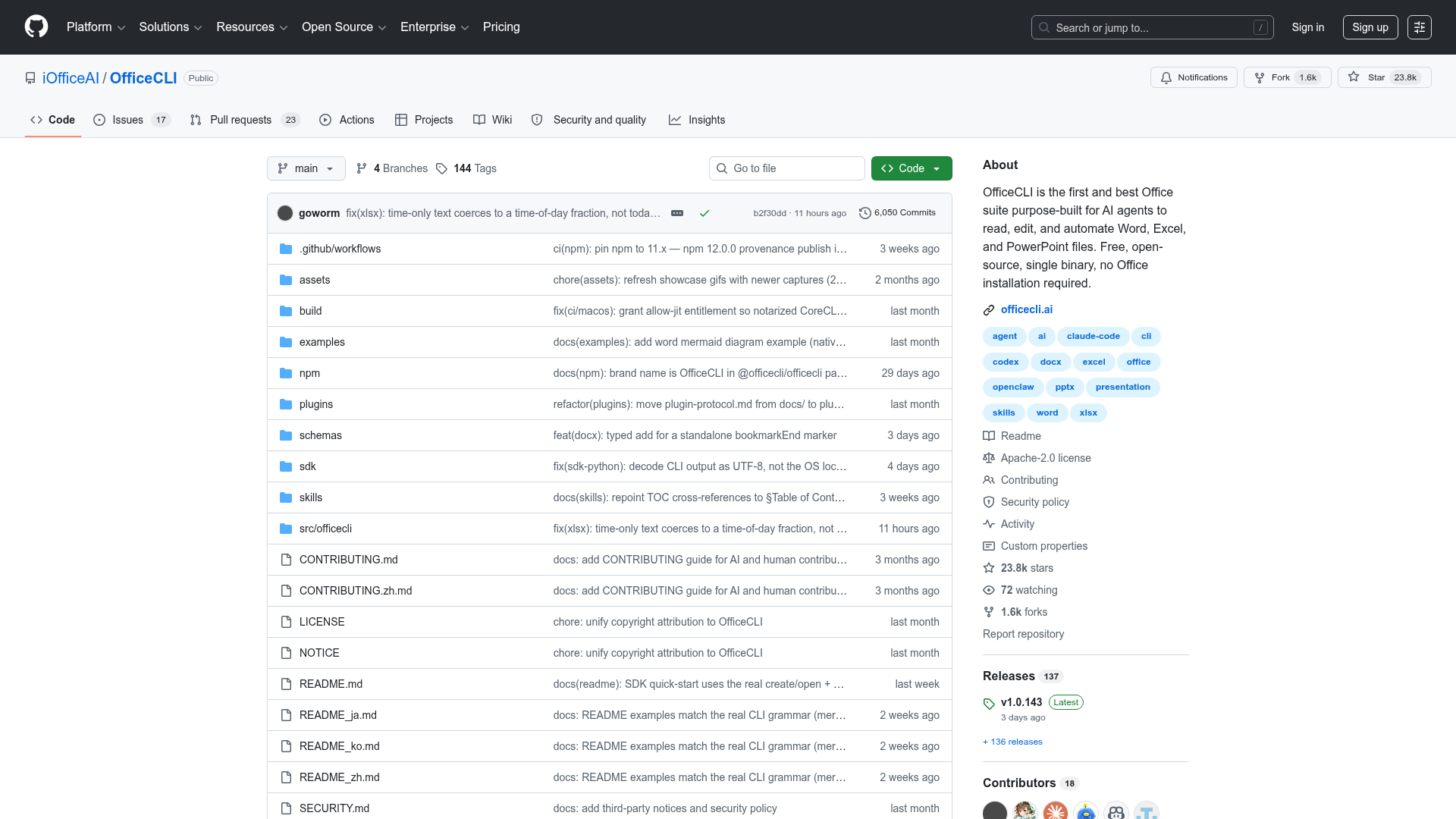
Captured: github.com/iOfficeAI/OfficeCLI, the project's home, not a product screen.
This is for teams whose agents already touch the filesystem and now need to produce real Office artifacts: reports, workbooks, decks, generated headlessly in CI or a container. It is free, Apache 2.0, actively committed to, and wired for Claude Code, Cursor, VS Code and Copilot, which makes it an easy yes if your deliverables end in .docx or .xlsx. Treat write access as the risky part, not the install.
What it actually does.
Single binary, zero dependencies
Drop one executable on macOS, Linux or Windows and skip the usual Office automation stack entirely.
Formula and pivot engine
Built-in calculation means spreadsheet edits recompute instead of leaving dead cells behind.
Round-trip dump
Dump an existing document to a readable structure so an agent can learn its layout before writing changes.
Template merge across formats
Merge data into Word, Excel and PowerPoint templates with one consistent workflow.
HTML rendering engine
High-fidelity HTML rendering gives you a way to preview or publish output without opening Office.
Agent and editor integrations
Documented use with Claude Code, Cursor, Visual Studio Code and GitHub Copilot rather than a bespoke SDK.
Auto-update
The binary can update itself, which matters given the project is shipping tags at a rapid clip.
How you would actually use it.
Concrete setups pulled from the research, not feature-list hand-waving.
Nightly report build
Data engineer on a reporting team
Add OfficeCLI to the CI container, pull the numbers from your warehouse or API, and merge them into an approved .docx template on a schedule.
The monthly report stops being someone's Friday afternoon and becomes a build artifact.
Agent-driven workbook edits
Agent tooling engineer
Expose OfficeCLI to Claude Code or Cursor on a scratch copy of a real workbook, first read-only via round-trip dump, then with write access on a narrow set of sheets.
The agent updates formulas and tables with recalculated values instead of handing back a CSV you have to paste in.
Deck from a prompt
Solutions or sales engineer
Wire a prompt-to-pptx step that fills a branded template with the customer's specifics before a call.
A first-draft deck in the house format that only needs editing, not building.
Batch extraction from a document pile
Ops lead sitting on a shared drive
Point the binary at a directory of contracts or spreadsheets and extract structured fields into your own store.
Searchable structured data out of files nobody has opened in two years.
Pricing, straight.
Open source, single binary, no dependencies beyond the .NET runtime it ships against
Free and open source for capability that usually means either a licensed Office install or a hand-rolled openpyxl script, so the value question is your engineering time, not the invoice.
Pricing as captured on 2026-08-01. Check the live site before you commit.
What people online are saying.
Real reactions surfaced during research. Paraphrased faithfully, linked to source.
Too new for a real street reaction: the launch posts and writeups are warm, but the research surfaced no substantial independent user threads, no HN comment content, and no verified complaints.
A post on X reacts with straight astonishment and frames it as the first Office suite built for AI agents.
A LinkedIn post frames it as someone open sourcing an entire Office suite, which captures the launch-day tone more than any measured evaluation.
A hands-on writeup notes the scope is strictly .docx, .xlsx and .pptx, with no support for HWP or HWPX documents.
The field.
Lower-level Python libraries for reading and writing the three OOXML formats.
PICK IT WHENYou want maximum control inside an existing Python codebase and do not need a single-command, agent-facing interface.
Microsoft's own enterprise APIs for programmatic document and tenant access.
PICK IT WHENYour documents live in Microsoft 365 and you need tenant identity, permissions and audit trails rather than local offline edits.
Broader document parsing and transformation tooling across many file types.
PICK IT WHENYour job is ingesting and normalizing mixed documents, not writing back native Office files.
The honest part.
- Scope stops at .docx, .xlsx and .pptx; formats like HWP and HWPX are explicitly out.
- Depends on the .NET runtime, which is one more thing to keep straight in slim containers.
- Complex or unusual document types beyond the standard formats may not round-trip cleanly.
- Almost no independent public evaluation yet, so you are the QA team on your own file corpus.
- Recent commit history shows platform sharp edges such as macOS hardened runtime and notarization fixes, worth checking before you standardize on the Mac build.
Getting started.
Time to first value: about 15 minutes
Download the single binary for macOS, Linux or Windows from the GitHub releases and confirm it runs.
Copy a real workbook or report to a scratch directory and use the round-trip dump to inspect its structure read-only.
Wire the binary into your agent of choice (Claude Code, Cursor, VS Code or Copilot) and grant write access only on the scratch copy first.
Quick answers.
Do I need Microsoft Office installed?
No. The whole point is a single binary that reads and writes the standard Office formats without an Office install, which is what makes it viable in Docker and on build servers. It does rely on the .NET runtime.
Will spreadsheet formulas still work after an agent edits a file?
There is a built-in formula and pivot engine, so calculations are handled rather than left stale. Verify against a copy of your own workbook before trusting it on anything financial.
Is it really free, and what is the catch?
It is open source at $0 with no paid tier published, and writeups note the Apache 2.0 license. The cost is ownership: you integrate it, you test it, and there is no vendor support line.
Is the project actively maintained?
The repository shows over 6,000 commits, 144 tags and commits landing within the last day, alongside 23.8k stars and 1.6k forks. Shipping pace looks strong; long-term stability is still unproven.
Install it, run a read-only pass against a copy of a workbook you actually care about, and only then let an agent write. The download costs nothing; a mangled financial model costs plenty.
Field research: 1 pages scraped · 3 search passes · 13 community sources. Reviewed by the Koda desk on 2026-08-01.