- SPECIMEN
Checksum
- FILED AS
Agentic Playwright test generation and healing that runs on every pull request
- INTAKE DATE
- 2026-08-21
- CLASS
- Coding
- METHOD
- 2 pages scraped, 3 search passes, 12 community sources
Koda Score = weighted blend: capability 35, ease 20, value 25, momentum 20.
Your coding agent writes the diff in four minutes and the regression in four weeks; Checksum's pitch is to generate and execute 50 to 200 Playwright tests against that exact diff before you hit merge.
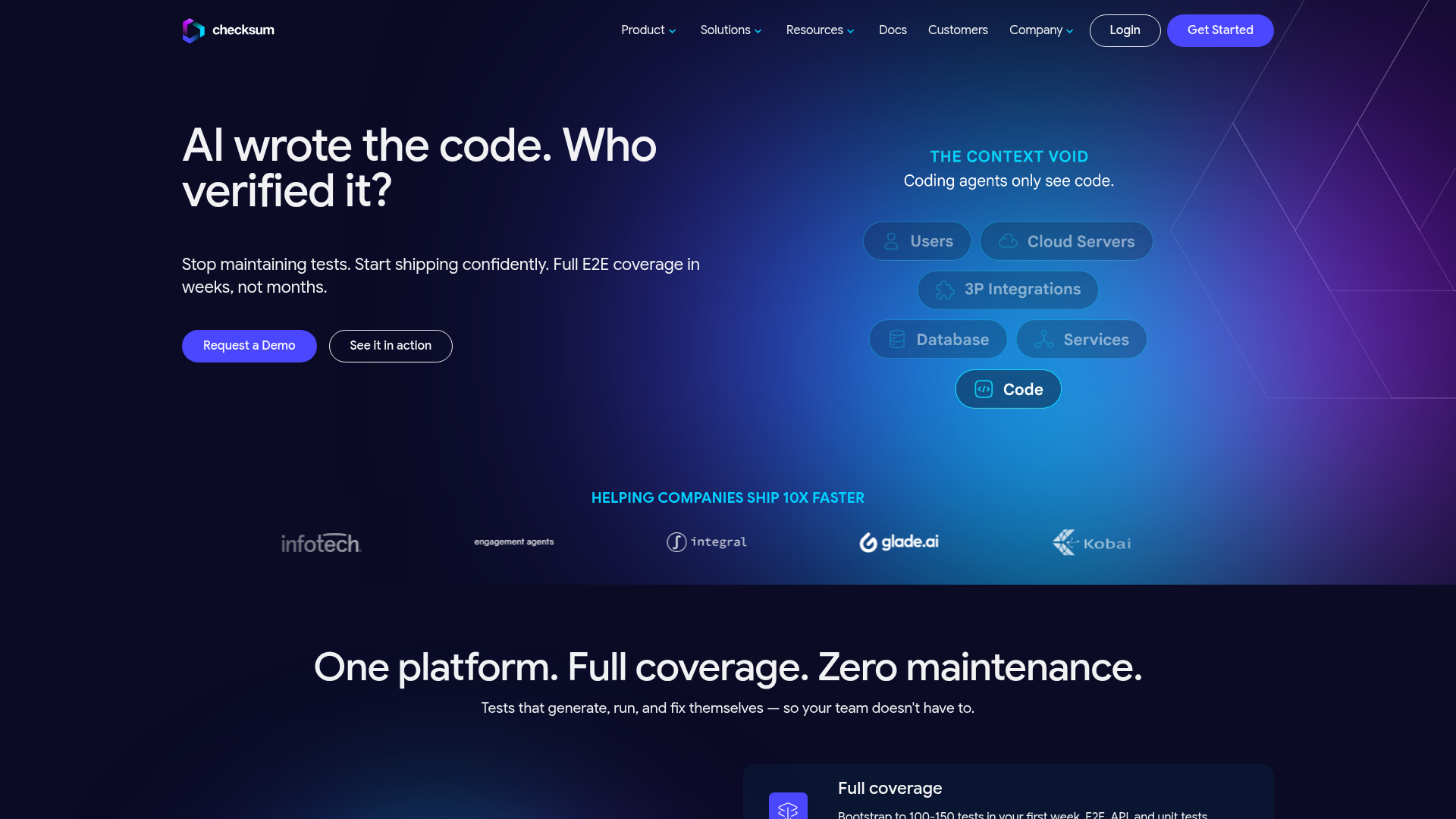
Captured: checksum.ai on 2026-08-21.
Worth a demo, but treat week one as an experiment with a hard metric attached. This is for engineering teams already shipping agent-authored code who have no real E2E suite and no appetite to build one. If you have a mature Playwright stack and a QA team who owns it, Checksum is an expensive way to outsource something you already do; if your coverage is a folder of three smoke tests and a prayer, the Results as a Service model with human verification is a genuinely different offer than the usual self-serve AI test tool.
What it actually does.
CI Agent per-PR testing
Generates 50 to 200 tests scoped to the exact code a pull request changed and runs them before human review.
End-to-end Agent with self-healing
Produces production-ready Playwright tests and automatically repairs them when the app's UI evolves underneath.
API Agent at endpoint scale
Covers thousands of endpoints in days with tests that span multiple calls and verify behavior rather than status codes.
Human engineer verification
A Checksum engineer signs off on generated tests so what lands in your repo is claimed to be 100% working Playwright code.
Real bug versus stale test triage
The agent decides whether a failure is a genuine regression or a test that drifted, then fixes the false failures.
Production error feedback loop
Monitors production errors and converts observed bugs into new tests, so the suite grows from real incidents.
First-week coverage bootstrap
Aims for 100 to 150 tests across E2E, API, and unit layers in the first week rather than a slow ramp.
How you would actually use it.
Concrete setups pulled from the research, not feature-list hand-waving.
The agent-commit gate
Eng lead running Codex or Claude on real branches
Point Checksum's CI Agent at one active repository and require its run to pass before merge on agent-authored PRs only.
A hard count of how many AI-generated diffs fail verification in week one, which is the number that tells you whether the gate is load-bearing.
Retiring the manual release checklist
QA lead at a team that still hand-tests before every deploy
Hand Checksum your critical release workflows and let the E2E Agent build and maintain the Playwright equivalents, keeping manual passes in parallel for the first few releases.
Söderberg & Partners reports 90 hours of manual testing saved per month and zero issues missed after moving to a fully automated E2E suite.
Endpoint coverage sprint
Platform team with a large, undertested API surface
Turn the API Agent loose on your endpoint inventory and prioritize multi-call flows over single-endpoint status checks.
Coverage across thousands of endpoints in days instead of a quarter-long test-writing project nobody wants to staff.
Killing the flaky suite tax
Team whose CI reds out weekly on stale selectors
Move your most brittle workflows under Checksum's maintained set and let the healing agent absorb UI churn while you watch which failures it classifies as real.
Fewer hours spent debugging tests instead of code, and a signal you can trust enough to block merges on.
Pricing, straight.
No per-seat fees, no per-run charges; includes human engineer final verification and delivery of ready-to-go Playwright tests.
For teams building their first real test suite: 50 CI/CD-ready E2E workflows maintained, autonomous test healing, dedicated customer engineer.
Workflow-based pricing with no per-run charges is the right shape for teams whose agents open dozens of PRs a day, but with no published numbers and no free tier you are negotiating blind until the demo.
Pricing as captured on 2026-08-21. Check the live site before you commit.
What people online are saying.
Real reactions surfaced during research. Paraphrased faithfully, linked to source.
Too new for a real street verdict: the public trail is a Product Hunt launch and a couple of Reddit threads where QA people ask if anyone has actually tried it, with no firsthand reviews either way.
The launch framing positions it as your coding agent's testing buddy, an agent that generates, runs, and auto-heals Playwright E2E and API tests on every pull request.
The founder's angle is that the agent decides whether a failing test is a real bug or just a stale test, then repairs the false failures so suites keep up with coding agents.
A QA practitioner asks whether anyone has actually used Checksum.ai or Katalon TruTest, noting their team currently runs its own Playwright-based framework; no verdict follows.
A tools roundup post describes it as end-to-end automation testing that turns user sessions into a testing pipeline, without praise or complaint attached.
The field.
Established test automation platform with AI-assisted test generation, the comparison point QA teams raise alongside Checksum.
PICK IT WHENYou want a vendor with a longer public track record and a body of user reviews you can actually read.
The open source browser automation framework Checksum itself generates tests for.
PICK IT WHENYou already have engineers who own a Playwright stack and would rather spend the budget on headcount than on maintained workflows.
The honest part.
- Complex scenarios still need human oversight, which the vendor acknowledges; the human-verification layer is the tell.
- No free tier and no self-serve signup visible; the pricing page gates tiers behind a team-size form and a demo request.
- Every dollar figure and hours-saved number in the research comes from vendor case studies, not independent reviews.
- Essentially no public user sentiment yet, so you cannot triangulate reliability from the community before you buy.
- Playwright-centric and web/API focused; if your critical surface is mobile native or desktop, this is not the tool.
Getting started.
Time to first value: first-week coverage bootstrap of 100 to 150 tests, per the vendor; expect a demo call before day one
Request a demo and pick the team-size tier on the pricing page, since there is no self-serve path in.
Connect one repository and your CI pipeline so the CI Agent can generate and execute tests against real PRs.
Gate agent-authored pull requests on the Checksum run and count how many fail verification in the first week.
Quick answers.
How is this different from asking my coding agent to write its own tests?
Checksum's claim is separation of concerns plus execution: the CI Agent generates tests scoped to the changed code and actually runs them before review, rather than proposing tests the same model already believes are passing. It also triages failures into real bugs versus stale tests and heals the stale ones, with a human engineer verifying what ships.
What does it actually cost?
No public number. Pricing is per maintained workflow with no per-seat or per-run fees, and the Emerging tier is described as 50 CI/CD-ready E2E workflows with a dedicated customer engineer. You have to run the team-size form and take a demo to get a figure.
Do I own the tests, or are they locked in a platform?
The stated deliverable is ready-to-go Playwright tests, which is real code in a standard open source framework rather than a proprietary recorder format. That is the strongest lock-in hedge here, though the healing and per-PR generation are the parts you would lose if you left.
Should I trust the savings numbers on the homepage?
Treat them as vendor case studies, because that is what they are: 90 hours a month for Söderberg & Partners, zero production outages for Counterpart, and six-figure annual savings claims elsewhere. There is no independent review body yet, so run a single-repo pilot and measure agent commits caught rather than inheriting someone else's ROI math.
Wire it into one noisy repo, count how many agent commits it actually blocks in the first week, and let that number decide the contract. There is no free tier to hide behind, so the pilot is the evaluation.
Field research: 2 pages scraped · 3 search passes · 12 community sources. Reviewed by the Koda desk on 2026-08-21.