- SPECIMEN
Otto by Workato
- FILED AS
An enterprise superagent that runs multi-step projects from Slack, web, or SMS
- INTAKE DATE
- 2026-08-27
- CLASS
- AI Platform
- METHOD
- 1 page scraped, 3 search passes, 12 community sources
Koda Score = weighted blend: capability 35, ease 20, value 25, momentum 20.
Workato built an agent that does not stop at one task; the hard part is deciding how much of your business you are willing to hand it on day one.
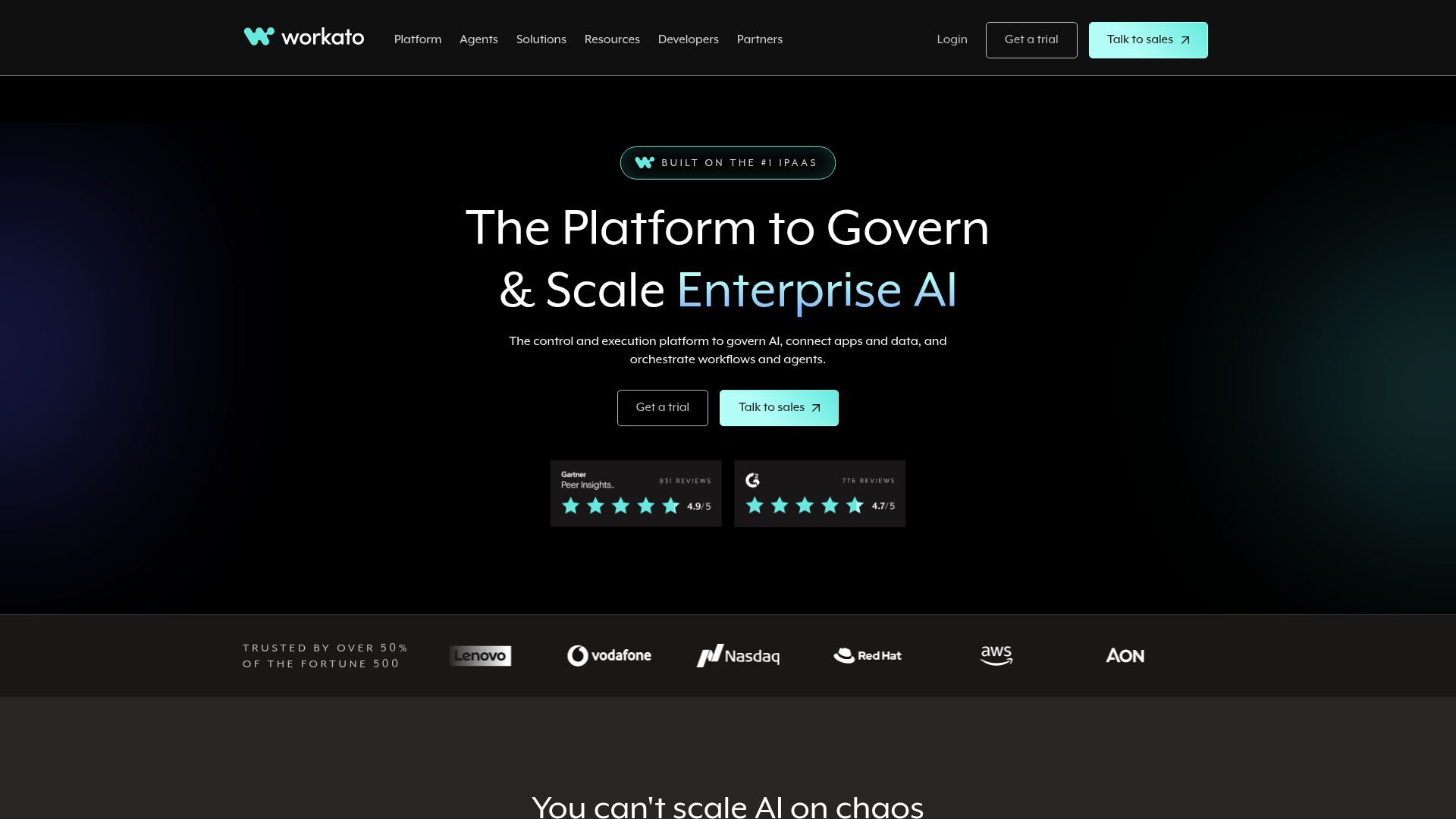
Captured: workato.com on 2026-08-27.
Otto is worth a scoped pilot if you have a documented, repeatable process and an existing automation to benchmark against; it is not worth a broad rollout while pricing is quote-only and public evidence of real-world results is still thin. It is for automation and IT ops teams who already run Workato recipes and want an agent that carries a whole process instead of a single step, with RBAC, audit logs, data masking, and approvals sitting on top.
What it actually does.
End-to-end project execution
Workato positions Otto to keep working toward a goal across multiple steps rather than firing a single task and stopping.
Three entry points
Users can reach Otto from Slack, the web, or SMS, which lowers the cost of asking it to do something.
Acts as the authorized user
Verified user access and RBAC mean the agent operates within a real identity's permissions, not a shared superuser.
One audit trail
Every decision and action lands in a single control surface so you can prove agent behavior to an auditor.
Guardrails and approvals
Policy covers what the agent does, not just what it can reach, with approval gates and permission escalation controls.
Multi-agent orchestration
Otto is described as collaborating with teammates and other Ottos, coordinated on the same platform.
Deep connector estate
Runs on Workato's execution plane with access to 1,200+ applications plus ERP, databases, files, APIs, and legacy systems.
Unified observability
Agent actions and the workflows underneath them are monitored together instead of two disconnected systems.
How you would actually use it.
Concrete setups pulled from the research, not feature-list hand-waving.
Vendor onboarding, start to finish
Procurement ops lead with an existing Workato recipe
Hand Otto the one onboarding flow you already document, wire it to the ERP, contract store, and finance systems it needs, and require an approval gate before any record is created.
A single completion rate number you can compare against the recipe it replaced, with an audit trail for every step.
Governed ticket triage
Service desk manager
Let Otto pick up tickets from Slack, classify them, gather context from connected systems, and either resolve or route with a note on what it tried.
Fewer human touches on repetitive tickets, measured against the resolution rate your current triage already delivers.
SMS-triggered field request
Ops team supporting non-desk staff
Expose a narrow request type over SMS, such as a status lookup or a standard form submission, with data masking on anything sensitive.
Coverage for people who never open the automation UI, without opening the whole permission surface.
Agent-versus-agent bake-off
Platform owner evaluating agent vendors
Run Otto against your current agent or copilot on the same process, same inputs, same week, and score completion, escalation, and rework.
A defensible procurement decision now that the baseline is other agents rather than manual work.
Pricing, straight.
Integration and process automation with access to 1,200+ applications
Advanced automation, AI integration capabilities, performance analytics
Custom SLAs, dedicated support, scalable architecture
Value is unassessable from the outside: Workato publishes no numbers, so the only honest move is to price a single-process pilot and judge it on completion rate.
Pricing as captured on 2026-08-27. Check the live site before you commit.
What people online are saying.
Real reactions surfaced during research. Paraphrased faithfully, linked to source.
Too new for a street read: research turned up no independent Reddit, Hacker News, G2, or Product Hunt reaction to Otto, only Workato's own launch messaging and a LinkedIn post from a Workato employee, so we are reporting zero community quotes rather than dressing up marketing copy as sentiment.
The field.
Lightweight agents that run multi-step business workflows across connected apps.
PICK IT WHENYou want to test agentic automation this afternoon without an enterprise procurement cycle.
Enterprise tooling for building governed internal copilots and automations.
PICK IT WHENYour stack is Microsoft-centric and you want internal copilots more than a cross-system project runner.
An agent that performs tasks across websites and apps on a user's behalf.
PICK IT WHENThe work is task-shaped and browser-bound rather than a governed enterprise process.
The honest part.
- No public pricing anywhere, so evaluation starts with a sales call rather than a trial.
- Broad autonomy across Slack, web, SMS, and connected systems is the headline risk; Workato's own launch material leans on permission escalation and audit controls to address it.
- Some features require advanced configuration, which means real setup effort for teams new to the platform.
- Limited offline capabilities, so anything air-gapped or intermittent stays out of scope.
- No independent user reviews or third-party benchmarks for Otto specifically yet; the performance claims on the site are Workato's own.
Getting started.
Time to first value: days, not minutes, once access is granted
Choose one process you already document end to end, and note its current completion rate.
Contact Workato for access, then scope Otto to only the connections and identities that process needs, with approvals on write actions.
Run it alongside your existing automation for a week and compare completion, escalations, and rework.
Quick answers.
How is Otto different from a normal Workato recipe?
A recipe executes a defined path you built; Otto is pitched as pursuing a goal across multiple steps and systems until it is complete. It still runs on the same execution plane and connectors, so your existing integration work is the foundation rather than wasted effort.
What should I benchmark it against?
Other agents, not manual work. Anthropic's 2026 State of AI Agents Report surveyed over 500 technical leaders and found agents moving into production, so the fair comparison is your current automation or copilot on the same process.
How risky is giving an agent SMS and Slack access to business systems?
That breadth is the main concern, and Workato's own launch material points to permission escalation and audit controls as the answer. Practically, act as if the agent inherits a real user's rights, keep approvals on writes, turn on data masking, and expand scope only after you have logs you trust.
Is there any independent evidence it works?
Not yet in public. The research found no meaningful Reddit, Hacker News, G2, or Product Hunt commentary on Otto, only Workato's launch messaging and an employee LinkedIn post, so treat every performance figure as vendor-supplied until your own pilot says otherwise.
Pick one process you can already draw on a whiteboard, give Otto exactly the permissions that process needs, and let completion rate decide whether it earns more.
Field research: 1 pages scraped · 3 search passes · 12 community sources. Reviewed by the Koda desk on 2026-08-27.