- SPECIMEN
Qoder
- FILED AS
Alibaba's agentic coding platform: desktop, JetBrains plugin, CLI, and mobile agent control
- INTAKE DATE
- 2026-09-01
- CLASS
- Coding
- METHOD
- 2 pages scraped, 3 search passes, 12 community sources
Koda Score = weighted blend: capability 35, ease 20, value 25, momentum 20.
Broad surface area across IDE, CLI, desktop and mobile with a real verification pitch, easy trial onboarding, but credit-metered pricing with unclear burn rates and a public community too thin to confirm the claims.
8 MIN READAlibaba stopped selling Qoder as an AI IDE and started selling it as an agent that plans, executes, then grades its own work; that last step is the only part worth your afternoon.
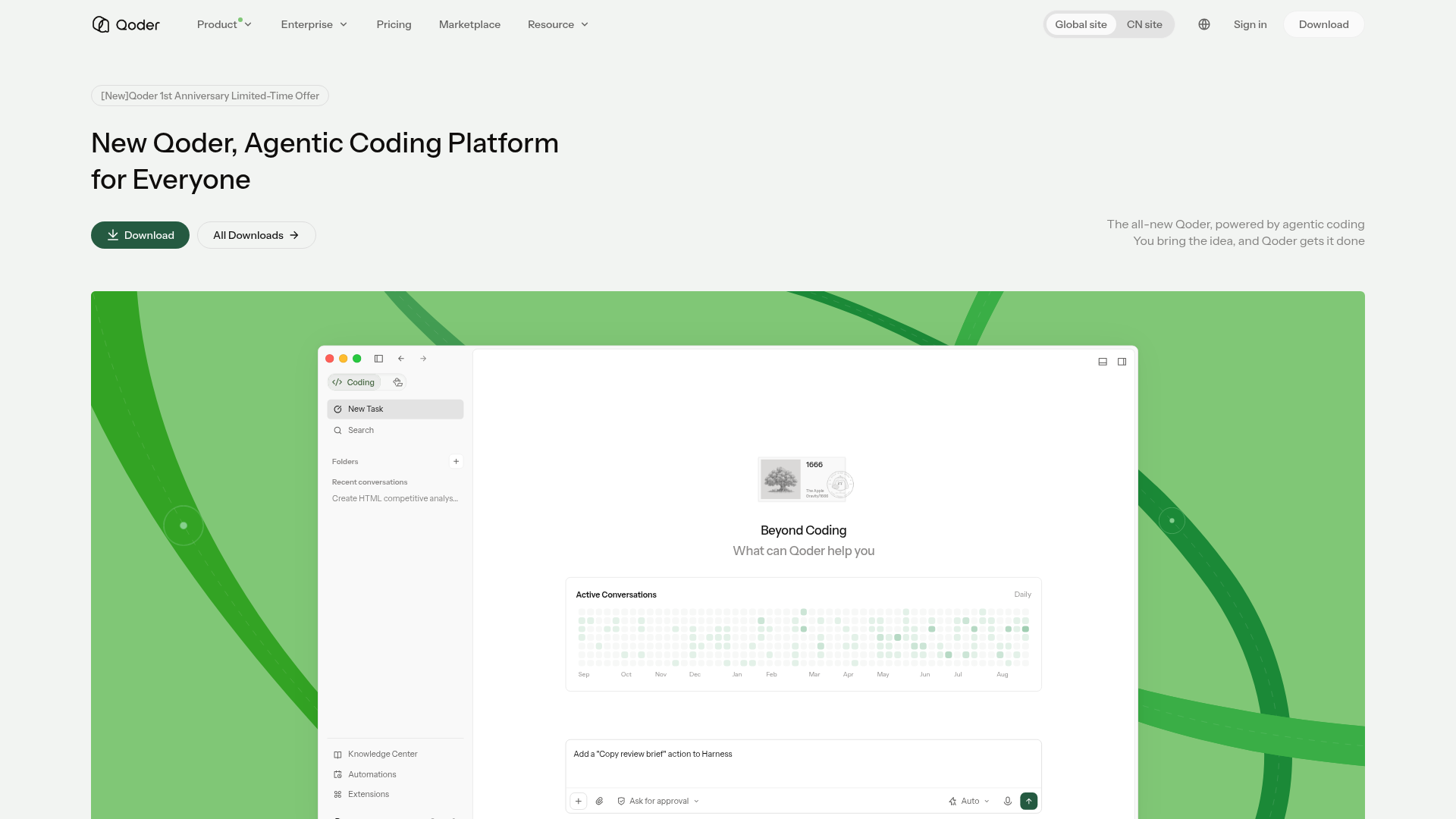
Captured: qoder.com on 2026-09-01.
The differentiator is not autocomplete, it is the closed loop: you hand over a goal, Qoder plans steps, calls tools, and then verifies what it produced, with Quest Mode and RepoWiki gated behind the $20 Pro tier. Credits are metered, so the real question is not whether the agent works but how many credits a single supervised task burns before you trust it unattended. Worth a two-week trial for backend and JetBrains-heavy teams; treat the self-verification claim as a hypothesis you test on a dependency upgrade with a test suite, not a feature you buy.
What it actually does.
Goal to verified output loop
You give a natural-language goal; the agent plans steps, calls tools, executes, then checks its own result before handing it back.
Quest Mode
Hand off a complete task rather than line-by-line suggestions, with planning up front; it is a Pro-tier feature.
RepoWiki repo awareness
Builds repo-wide context so the agent works against your architecture and patterns instead of a single open file.
JetBrains plugin
Deep JetBrains integration aimed at backend work, with refactoring, database awareness and framework support.
Terminal-native CLI
Runs the same agentic workflow from the shell for building, debugging and shipping without leaving the terminal.
Mobile agent control
Monitor agent progress, approve critical actions and review deliverables from an iOS app while a task runs.
Approval gating
Tasks can run on auto or pause to ask for approval, which is how you keep an autonomous agent out of trouble.
Enterprise controls
Higher tiers add SSO via SAML or OIDC, role and group management, pooled credits, model policy control and operation audit.
How you would actually use it.
Concrete setups pulled from the research, not feature-list hand-waving.
The dependency upgrade audition
A backend dev with a healthy test suite
Point Qoder at one outdated dependency, ask it to upgrade and fix the fallout, and require the existing tests to pass as the success condition.
A binary read on whether the verification loop actually catches its own mistakes, plus a credit-burn number for one contained task.
Scoped auth review
Senior engineer owning login and session code
Use the pattern Qoder ships on its own homepage: a tightly scoped prompt covering token expiry, refresh rotation and reuse, with explicit instructions to avoid unrelated refactors and to add focused tests.
Edge-case findings and narrow test coverage in an area where broad AI refactors are usually too risky to accept.
Long task, short leash
Solo founder juggling shipping and meetings
Kick off a Quest Mode task on desktop with approval mode set to ask, then approve steps and review the deliverable from the iOS app while away from the machine.
Progress on a multi-step task without leaving an unsupervised agent alone with the repo.
JetBrains team pilot
Tech lead on a Java or Kotlin service
Install the JetBrains plugin across two or three volunteers, let RepoWiki index the service, and compare agent output on the same ticket against your usual assistant.
A concrete comparison against Cursor or Claude Code on your own codebase before a team-wide purchase.
Pricing, straight.
One-time 2-week Pro trial with 300 credits, then limited completions and next edits plus bring your own API key
2,000 credits, extended chat and agent limits, Quest Mode and RepoWiki
6,000 credits total plus priority access to upcoming features
20,000 credits total plus early access to new features
The $20 entry point matches the category, but credits are the real currency and Qoder does not publish how much a typical agent task consumes, so budget with a trial run rather than the price sheet.
Pricing as captured on 2026-09-01. Check the live site before you commit.
What people online are saying.
Real reactions surfaced during research. Paraphrased faithfully, linked to source.
Too new for a real street verdict: the visible discussion is a few Reddit threads and an AMA, with no independent criticism surfacing in the research at all.
One poster called Qoder the shape agentic coding is heading toward and liked the free preview enough to wish it would never start charging.
A community thread framed it as more than line-by-line help, pointing at handing off whole tasks in Quest Mode, repo-wide awareness, and code that arrives verified.
Another post argued it beats Cursor, crediting the planning and TDD-style behavior of Quest mode.
The field.
The incumbent AI-first code editor with a large user base and mature agent features.
PICK IT WHENYou want the option with the deepest public track record and do not need JetBrains-native integration.
Anthropic's terminal-based agent for delegating coding tasks.
PICK IT WHENYou live in the shell and prefer a single strong model over a multi-surface workspace.
Agentic IDE competing on autonomous multi-file edits.
PICK IT WHENYou want an agentic editor without Qoder's separate workspace and delegation split.
The honest part.
- The self-verification loop is the headline claim and there is no independent public evidence yet that it catches its own errors reliably.
- Credit metering with no published per-task consumption makes monthly cost hard to forecast before you run real work.
- The Pro trial is one account per user, requires the latest client, and is explicitly unavailable on virtual machines, which rules out some CI and remote dev setups.
- Unused trial credits are wiped at expiry unless you upgrade first, and purchased credit packs expire one month after purchase.
- The Free plan drops to limited completions plus bring-your-own-key, and Quest Mode and RepoWiki are Pro-only, so there is no long-term free path to the interesting features.
- Team and enterprise controls like SSO, audit and pooled billing sit on higher tiers whose pricing is not listed on the individual page.
Getting started.
Time to first value: about 20 minutes
Download the desktop app, JetBrains plugin or CLI and sign in on the latest client version to trigger the one-time 14-day Pro trial with 300 credits.
Open a real repo, let RepoWiki build context, and set approval mode to ask rather than auto for the first run.
Give it one contained task with an objective pass/fail check, such as a dependency upgrade validated by your test suite, and note how many credits it consumed.
Quick answers.
What actually changed with the agentic workspace upgrade?
Instead of positioning Qoder as an AI programming IDE, Alibaba now pitches it as a workspace that takes a natural-language goal, plans the steps, calls tools, executes, and then verifies its own output. Quest Mode is the delegation surface for that, and RepoWiki supplies the repo-wide context. Both are Pro features.
How much will it cost me per month in practice?
Pro is $20/mo for 2,000 credits, Pro+ is $60 for 6,000 and Ultra is $200 for 20,000, with add-on packs at $20 per 1,500 credits that expire in a month. Qoder does not publish credit cost per agent task, so run the 300 trial credits against a representative job and extrapolate from that.
Is it safe to point at a production repo?
Not on day one. Use the ask-for-approval mode rather than auto, keep the scope narrow the way Qoder's own example auth prompt does, and require a test suite or another hard check to confirm the output. Enterprise tiers add privacy mode control, model policy control and operation audit if you need governance.
Should I switch from Cursor or Claude Code?
Only after a side-by-side on your own codebase. The one comparison in the public research is a Reddit poster who preferred Qoder's planning and TDD-style Quest mode to Cursor, which is a single data point, not a trend. JetBrains-centric backend teams have the strongest reason to pilot it, since that plugin is a real gap in some competitors.
Download it, spend the 300 trial credits on one task that has a hard pass/fail check, and let the credit meter decide whether Pro is a line item or a curiosity.
Field research: 2 pages scraped · 3 search passes · 12 community sources. Reviewed by the Koda desk on 2026-09-01.