- SPECIMEN
Questo
- FILED AS
Buy a single quest and your city walk becomes a two-hour story game
- INTAKE DATE
- 2026-09-03
- CLASS
- Productivity
- METHOD
- 1 page scraped, 3 search passes, 24 community sources
Koda Score = weighted blend: capability 35, ease 20, value 25, momentum 20.
The format is well built and near frictionless to start, coverage and traction are real at 1,075 cities and 1M+ claimed explorers, but per-quest writing quality is uneven enough that a 7.99 to 9.99 euro purchase is a small gamble.
8 MIN READOne payment from 7.99 euros turns the street you are standing on into a murder mystery, and the only real question is whether the clues match the pavement.
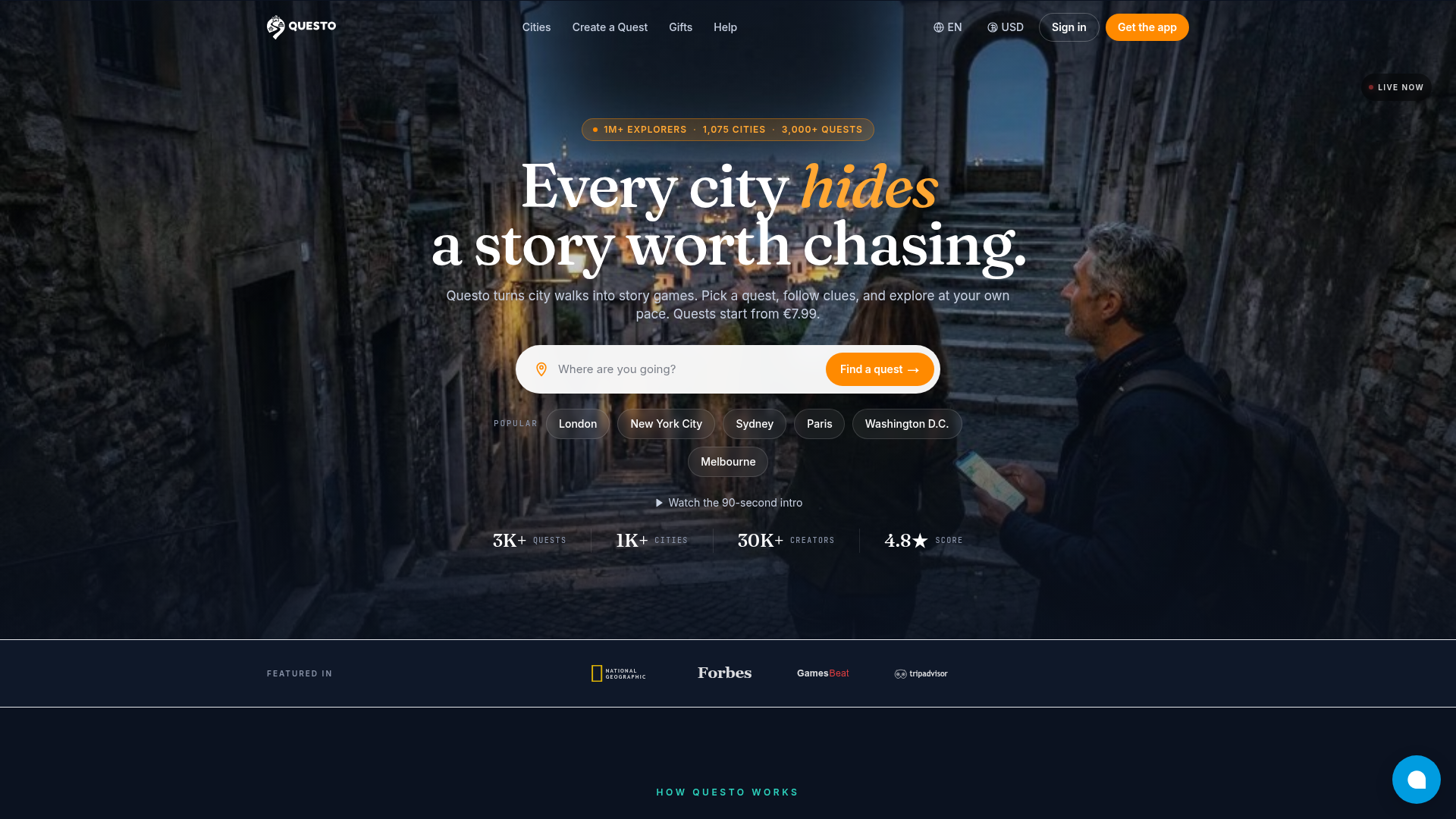
Captured: questoapp.com on 2026-09-03.
The mechanic is simple and it mostly works: pay once for a single quest, walk between real landmarks, solve a puzzle at each stop for 1.5 to 3 hours, no guide and no reservation. That makes it a genuinely good default for a spare afternoon in a new city or a date night you do not want to schedule, especially since the quest is yours forever and runs offline. The catch is quality variance across 3,000+ quests written by 30,000+ creators, and the loudest public complaints are exactly about that: clues that feel bolted onto locations rather than drawn from them.
What it actually does.
Self-guided quests
The app routes you between real landmarks and drops a puzzle at each stop, no guide, group or reservation involved.
One-time purchase per quest
Quests start at 7.99 euros, are yours permanently, and can be played now or on a trip next year.
Offline play
Once a quest is downloaded it runs without data, which matters when you are roaming abroad.
Theme picker
Quests are sorted by vibe rather than by neighborhood: true crime, romance, family friendly, ghost hunts, fairytales.
City coverage at scale
1,075 cities and 3,000+ quests, including small markets where the nearest quest may still be a drive away.
Creator marketplace
30,000+ creators write the quests, which is why the catalog is enormous and why quality swings hard between them.
Pause anytime pacing
Quests run 1.5 to 3 hours and can be stopped for lunch or a tantrum without losing progress.
How you would actually use it.
Concrete setups pulled from the research, not feature-list hand-waving.
The unplanned afternoon
A traveler with half a day and no booking
Search your current city in the app, buy the highest-rated quest in a theme you like, and start walking within minutes of landing.
A structured route through real landmarks for roughly the price of two coffees, with no tour schedule to hit.
Date night without a reservation
Couples who hate booking things
Pick a romance or true crime quest in your own city, download it in advance, and start whenever you both actually get out the door.
Two hours of shared problem solving that ends wherever you want dinner to be.
Kid-proof sightseeing
Parents on a city trip
Choose a family-friendly or fairytale quest and hand the phone to the oldest kid so they run the clue-solving between stops.
Landmarks get visited without the standard museum-hallway meltdown.
Offsite team-building on a budget
Ops or people leads planning an offsite
Buy the same quest for two or three small teams, stagger the start times, and compare finish times over drinks afterward.
A competitive outdoor activity at single-digit cost per head, with zero facilitator to hire.
Pricing, straight.
iOS and Android, browse quests and cities before buying.
One-time purchase, no subscription, yours forever, works offline. US quests we saw were listed at 9.99 dollars.
For 1.5 to 3 hours of activity with no guide fee and no expiry the price is fair, but since quality varies by creator you are effectively paying per lottery ticket rather than per guaranteed experience.
Pricing as captured on 2026-09-03. Check the live site before you commit.
What people online are saying.
Real reactions surfaced during research. Paraphrased faithfully, linked to source.
Public discussion is thin outside app-store and travel-review channels, and what exists splits cleanly: the concept gets praise, the clue-to-location authenticity gets the complaints.
A TripAdvisor reviewer called a trivia-style outing quite disappointing, saying there were no real clues actually tied to the places you visit and it felt like just an app.
A Google Play reviewer said they had no idea why the app rates so highly, finding the interactivity lacking and the story and puzzles poorly matched to the actual environment.
A Reddit commenter described the format as a fairly involved backstory where you walk to locations, find clues and open up the next steps, which read as appealing to people who like structured exploration.
A Redditor asking about the app said the reviews they had read suggested it was not particularly impressive, so they were skeptical before trying.
A Scranton thread asking whether it was a scam got a straight answer from the company itself confirming Questo is a real platform for quests and escape events.
The field.
Self-guided puzzle trails through cities, the closest conceptual match for clue-based urban discovery.
PICK IT WHENYou want the same walk-and-solve format and your city is covered there with better local reviews.
General interactive scavenger hunt and trail builder rather than a travel catalog.
PICK IT WHENYou need to write your own clues for a team event or classroom instead of buying someone else's story.
Broad travel marketplace that includes self-guided options alongside conventional tours.
PICK IT WHENYou care more about reliable curation and refund policy than about the game layer.
The honest part.
- Quality is creator-dependent across 3,000+ quests, and the most consistent complaint is that puzzles are not genuinely tied to the locations you are standing in.
- Rating claims do not reconcile: 4.8 stars from 140,000+ reviews on the site versus 4.4 from 4,254 on Google Play and 3.3 from 31 on one TripAdvisor listing.
- Coverage is uneven outside major cities. In Wichita the nearest quest was 27 miles away, so 1,075 cities does not mean quests near you.
- No guide and no group interaction by design, so if a puzzle is broken or ambiguous there is no one on site to unstick you.
- Every quest requires sustained walking, which rules out anyone with mobility limits and makes bad weather a full refund conversation.
Getting started.
Time to first value: about 10 minutes
Install the app on iOS or Android and search your city or destination.
Filter by theme, then read the star count and review total on the specific quest page, not the platform average.
Buy the quest, download it while you still have wifi, and start walking from the first landmark.
Quick answers.
Is it a subscription?
No. Quests are one-time purchases starting at 7.99 euros, and the company states the quest stays yours permanently. You can buy one now and play it on a trip next year.
Does it need mobile data while I am playing?
Not once the quest is downloaded. Questo states quests work offline after they are activated, which is the practical case for buying before you land somewhere with roaming charges.
Why do the ratings look so different depending on where I check?
The site advertises 4.8 stars from 140,000+ reviews, Google Play currently shows 4.4 from 4,254 ratings, and one TripAdvisor listing sits at 3.3 from 31 reviews. Because each quest is a separate creator-written product, the per-quest rating is the only number worth acting on.
How is this different from an audio guide or a walking tour?
Questo frames it as playing the story rather than listening to one, with no guide, no fixed schedule and roughly half the price of a guided walk. The tradeoff is that nobody is there to explain a confusing clue, and the reviews that go badly usually go badly on exactly that point.
Pick a quest with visible reviews attached to it, treat the marketing average as marketing, and you get a cheap, self-paced afternoon that beats trailing a guide with an umbrella.
Field research: 1 page scraped · 3 search passes · 24 community sources. Reviewed by the Koda desk on 2026-09-03.