- SPECIMEN
Basedash
- FILED AS
AI analyst that answers business questions from your database and shows the SQL
- INTAKE DATE
- 2026-09-07
- CLASS
- Analytics
- METHOD
- 1 page scraped, 3 search passes, 24 community sources
Koda Score = weighted blend: capability 35, ease 20, value 25, momentum 20.
Capability earns credit for SQL transparency, governed metrics, self-hosting and SOC 2, GDPR and HIPAA readiness; ease is strong thanks to a no-card trial but governed definitions take setup; value drops because flat-rate plans start near $1,000 a month and reviewers call pricing high; momentum reflects a claimed 5000+ teams and frequent updates against a thin public review footprint.
8 MIN READThe visible SQL and governed metric layer are the whole pitch: an answer you can trace beats a prettier dashboard you cannot. The catch is price, with published plans starting around $1,000 a month plus AI usage, and a Product Hunt review base that praises the product while flagging that cost. Adopt it if a data team is tired of fielding one-off questions and a warehouse already exists; skip it if the job is a few internal tables and a founder who just wants to peek at rows.
Every answer Basedash gives comes with the SQL that produced it, which is the one feature that separates an AI analyst you can audit from one you have to trust.
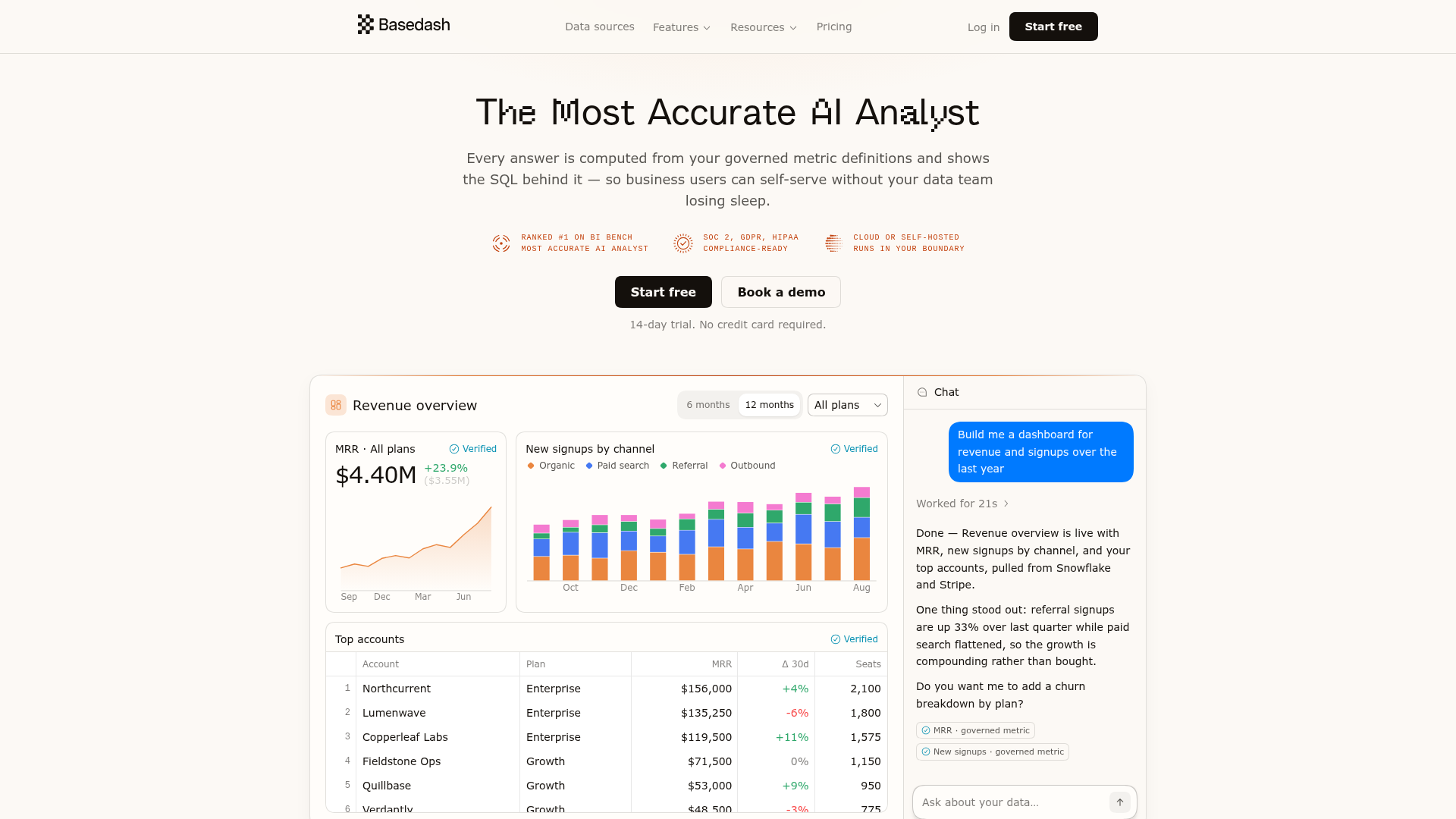
Captured: www.basedash.com on 2026-09-07.
The short version.
4 LINESNatural-language questions become dashboards and answers, and every result exposes the SQL and the governed metric definition behind it.
Published pricing starts around $1,000 a month flat rate plus AI usage, so this is a team purchase, not a side-project tool.
The 14-day trial needs no credit card; connect a warehouse and ask a question whose answer you already know before you trust anything.
Public sentiment is small but positive on Product Hunt and G2, with the recurring complaint being price and missing connectors such as Firestore.
What it actually does.
7 CAPABILITIES- Answers with SQL attached
- Each response shows the query that computed it so business users can self-serve while the data team can audit.
- Governed metric definitions
- Answers are computed from centrally defined metrics rather than whatever the model improvises, which is the accuracy claim in a sentence.
- Dashboard generation from a prompt
- Describe the report you want and Basedash builds the dashboard instead of making you assemble widgets.
- 750+ data sources
- Warehouses like Snowflake and BigQuery sit alongside Postgres, MySQL, Salesforce, HubSpot and ad platforms such as Reddit Ads.
- Cloud or self-hosted
- The product can run inside your own boundary, which matters when the data is patient records or customer PII.
- Compliance-ready posture
- The site advertises SOC 2, GDPR and HIPAA readiness, a checklist most small AI BI tools cannot tick.
- API access
- Beyond the web app there is an API, so answers and charts can be pulled into other internal tools.
How you would actually use it.
4 PLAYS- The trust test
- Connect the warehouse, define two or three governed metrics such as MRR, then ask Basedash for a number the finance team already reports and open the generated SQL.WHOHead of dataPAYOFFA yes or no on whether the AI analyst matches your source of truth before anyone in sales quotes it.
- Kill the request queue
- Publish governed definitions for the ten metrics that generate most Slack questions, then hand the conversational interface to ops and marketing.WHOAnalytics engineerPAYOFFBusiness users self-serve on defined metrics while the team keeps control of what the numbers mean.
- One conversation instead of three tabs
- Point Basedash at product analytics, CRM and billing sources and ask cross-source questions like signups by channel against MRR.WHOGrowth or RevOps leadPAYOFFReviewers describe replacing a Metabase, PostHog and Claude copy-paste loop with a single query surface.
- Regulated self-host
- Run the self-hosted deployment inside your own boundary and lean on the SOC 2, GDPR and HIPAA readiness during vendor review.WHOEngineering lead at a healthcare or fintech companyPAYOFFAI-assisted BI that clears security review rather than getting parked in procurement.
Pricing, straight.
2 TIERS- Verdict on the price
- Fair for a company replacing a Looker-class tool and a backlog of analyst hours, expensive for anyone who mainly wants a friendly window into a small database, which is exactly the complaint that spawned a cheaper Reddit clone.
What people online are saying.
5 QUOTEDPublic reaction is thin but warm: nine Product Hunt reviewers and two G2 reviewers rate it 5.0, praising speed and support, while the persistent gripes are price and missing connectors.
Reviewers say Basedash speeds up analytics work, makes data access conversational, and comes with responsive support; teams report daily use and a UI with low latency.
PraiseThe main drawbacks reviewers raise are high pricing and requests for broader integrations, Firestore among them, plus more proactive insight suggestions.
CritiqueA user says the product replaced a workflow of copying between Metabase, PostHog and Claude with one conversation.
PraiseA developer says Basedash makes visualizing and editing data easy, their team uses it daily, and creating segments from filtered data is a favorite feature.
PraiseA founder who used Basedash loved the idea but found it overkill and expensive for simple internal tools, so they built a cheaper alternative and reached their first $1K in subscriptions.
CritiqueThe honest part.
5 LIMITATIONSPricing starts around $1,000 a month flat rate plus AI usage, and reviewers on Product Hunt call it high; the landing page itself does not list plans, so expect a sales conversation for anything beyond the trial.
No mobile app; the product is web and API only.
Connector gaps still exist despite the 750+ sources claim, with Firestore named specifically by reviewers.
Accuracy depends on governed metric definitions being in place, which is real setup work the marketing glosses over.
The number one ranking on BI Bench is published on Basedash's own site, so treat it as a vendor benchmark rather than an independent one; the public review base is also small at nine Product Hunt and two G2 reviews.
The field.
3 ALTERNATIVES- Metabase
- Self-serve BI with open-source hosting and SQL-first workflows; Basedash publishes its own comparison page against it.PICK IT WHENYou want open-source hosting and a mature dashboard tool and can live without a conversational AI layer.
- Dot
- AI-powered data analyst that GetDot.AI lists first among Basedash alternatives.PICK IT WHENYou want a chat-style analyst and want to compare accuracy and price head to head before committing four figures a month.
- Draxlr
- BI tool pitching dashboards, alerts, embedding and flexible pricing as its edge.PICK IT WHENEmbedded analytics and alerting matter more than natural-language querying and your budget is tighter.
Getting started.
3 STEPSStart the 14-day trial at charts.basedash.com; no credit card is required.
Connect a source such as PostgreSQL, MySQL, Snowflake or BigQuery, and add a CRM like Salesforce or HubSpot if you want cross-source questions.
Ask a question whose answer you already know, open the SQL behind the result, and check it against your existing report before building any dashboards.
Quick answers.
4 ANSWERS- How much does Basedash actually cost?
- The homepage does not list prices, but Basedash's pricing page describes flat-rate AI BI plans from $1,000 a month, a Startup plan with a 14-day free trial, and a team tier billed as flat rate plus AI usage. G2 also shows a $1,000 figure. Anything beyond that will come out of a demo call.
- Are the Starter, Growth and Enterprise figures on the homepage the price list?
- No. Those plan names and dollar amounts appear inside the sample revenue dashboard on the homepage as demo data for fictional accounts. They are not Basedash's plans, so do not budget from them.
- Can I verify what the AI tells me?
- Yes, and that is the reason to test it first. Every answer shows the SQL behind it and is computed from your governed metric definitions, so you can trace a number back to the query and the definition rather than taking the model's word for it.
- Is it the same Basedash that launched as a database GUI?
- It is the same company. Basedash launched on Hacker News in 2020 as a YC S20 collaborative database editor for non-technical teammates, and the current product is a pivot toward AI-native BI, which explains why some older Reddit and G2 comments talk about editing rows and filtering segments.
The bottom line.
SPECIMEN 0215 CLOSEDRun the trial against a number you can already verify, read the generated SQL, and let that one test decide whether four figures a month is a bargain or a tax.
Field research: 1 page scraped · 3 search passes · 24 community sources. Reviewed by the Koda desk on 2026-09-07.