- SPECIMEN
Revolte
- FILED AS
Governed AI agents that plan, code, test, deploy and monitor across the full SDLC
- INTAKE DATE
- 2026-09-09
- CLASS
- Coding
- METHOD
- 1 page scraped, 3 search passes, 24 community sources
Koda Score = weighted blend: capability 35, ease 20, value 25, momentum 20.
Capability is strong on paper because few tools cover intent through runtime with approval gates, ease drops because the loop needs tracker and cloud integrations before it does anything useful, value is held back by unpublished Pro pricing, and momentum reflects a #3 Product of the Day launch with almost no independent user discussion yet.
8 MIN READThe governance wrapper is the whole product here: plan approval before execution, inline diffs, cost caps, audit logs, and a rule that anything above a risk threshold routes to a human first. That makes it a different animal from Cursor or Devin, and it also means the value only shows up once you have wired in a tracker, a cloud target and a monitoring source. Worth a pilot on one low-risk service for engineering teams with a compliance function breathing on them; not worth the setup tax for a solo developer who just wants faster commits.
Revolte's bet is that the audit trail, not the code generation, is the part your team will actually pay for.
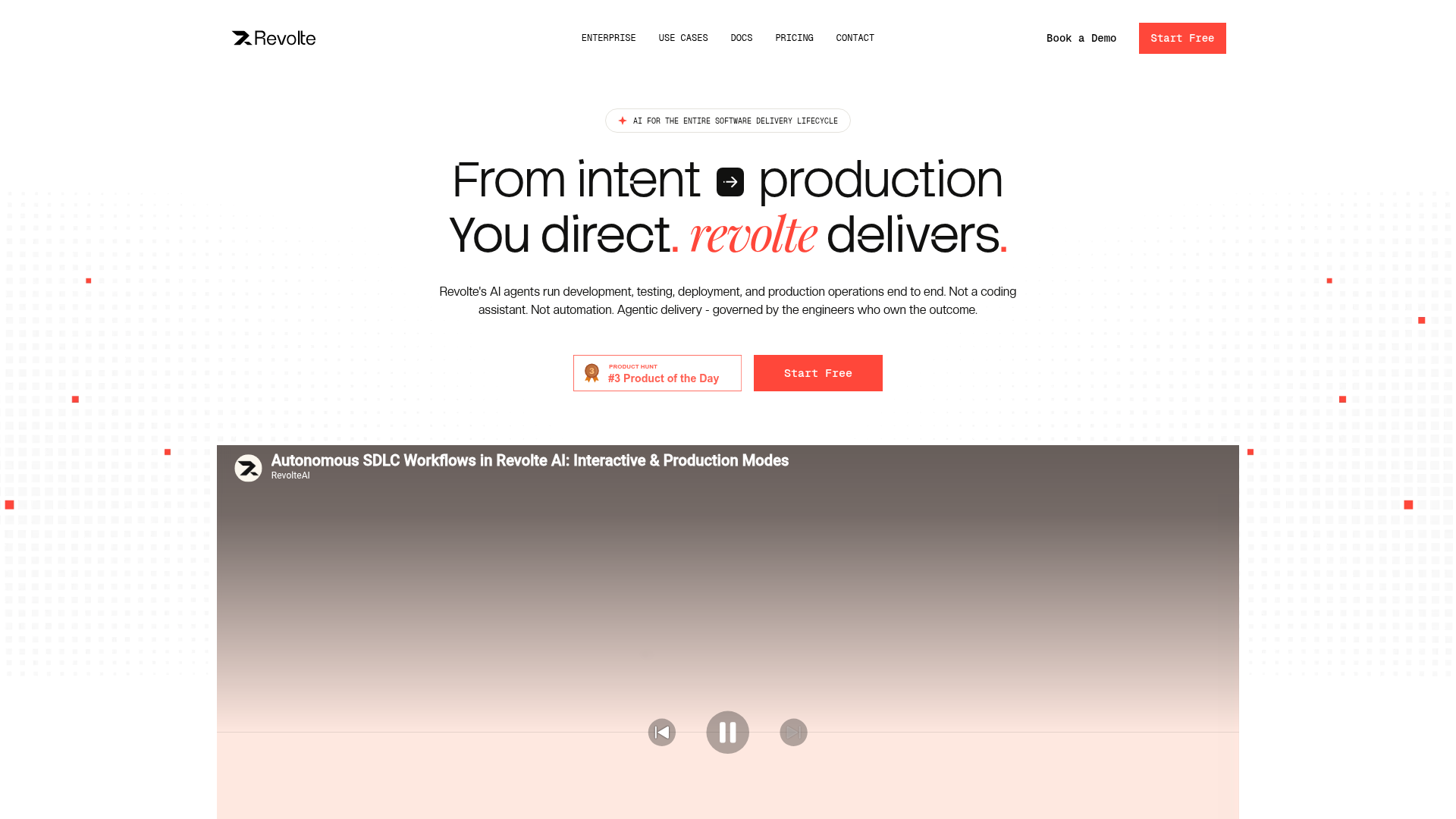
Captured: revolte.ai on 2026-09-09.
The short version.
4 LINESRevolte runs the whole delivery loop, planning, coding, testing, deploying and watching production, with a human approval gate at each step.
Interactive Sessions give you one tabbed session per task with plan approval, inline diffs, cost caps and audit trails; that is the differentiator over a bare coding agent.
A Free tier exists with basic agent access and limited project support; Pro and Enterprise pricing is on request, so ask before scoping a rollout.
There is essentially no independent user feedback yet, so treat the 6x and 95% figures on the homepage as vendor claims until your own pilot confirms them.
What it actually does.
8 CAPABILITIES- Interactive Sessions
- A tabbed workspace with one session per task where you drive architecture, coding, tests and staging step by step with approval at each stage.
- Plan approval before execution
- Agents propose a plan you sign off on before any code is written, so intent is visible before anything is committed.
- Inline diffs
- Every generated change is shown as a diff you review inside the session rather than a finished PR you discover later.
- Quality and security checks
- After code generation the pipeline runs quality and security checks whose output you can audit line by line before deploy.
- Cost caps
- Sessions carry spend limits so an agent loop cannot quietly run up a bill while you are away.
- Audit trails and risk routing
- Every agent action is logged, and decisions above a risk threshold are routed to a human first.
- Deploy and runtime monitoring
- Production mode extends the loop to deployment and watching runtime behaviour, with Datadog among the integrations.
- Agentic test automation
- Testing is run by agents as part of the loop, with the company citing 95% test automation coverage as a headline outcome.
How you would actually use it.
4 PLAYS- Low-risk service pilot
- Pick one internal service, open an Interactive Session with a small feature intent, approve the plan, and read every quality and security check before allowing the staging step.WHOEngineering lead evaluating agentic deliveryPAYOFFA concrete read on whether the checks catch what your reviewers catch, before any production exposure.
- Compliance-visible feature work
- Connect Jira or Linear as the intent source and let the session log each agent action and human approval against the ticket.WHOTeam with an audit or compliance functionPAYOFFTraceability from spec to shipped change that a compliance reviewer can follow without asking engineers to reconstruct it.
- QA bottleneck relief
- Route a release branch through the agentic testing stage and compare coverage and cycle time against your current QA pass.WHOTeam whose releases stall in manual testingPAYOFFEvidence for or against the vendor's claim that agentic testing removes the QA bottleneck.
- Data migration with validation
- Use a session for the migration scripts and let the validation stage run against a staging copy, with the human gate before anything touches production data.WHOBackend engineer running a schema or data movePAYOFFA migration where the rollback plan and validation output are recorded alongside the change.
Pricing, straight.
3 TIERS- Verdict on the price
- The Free tier is enough to run a pilot session, but with Pro unpriced you cannot judge value for a team rollout until you get on a sales call, which is a real friction point for a tool pitching engineer control.
What people online are saying.
3 QUOTEDToo new for a real street read: the only public signal is the Product Hunt launch and launch-roundup coverage, and no attributable user reviews were found on Reddit, Hacker News, X, G2 or YouTube.
Interactive Sessions wraps SDLC agents in plan approval, inline diffs, cost caps and audit trails.
PraiseRevolte is an early-stage platform with a limited public track record, so there is little verified community feedback to evaluate.
CritiqueNo substantive verified customer reviews were found on major review or community sites.
CritiqueThe honest part.
5 LIMITATIONSNo independent user reviews exist yet, so the 6x release acceleration and 95% test coverage figures are unverified vendor claims.
Pro pricing is on request and Enterprise is custom, which blocks self-serve budgeting for a team.
Integrations are limited to major platforms (AWS, Google Cloud, Datadog, Jira, Linear, ClickUp); other stacks are not covered.
Advanced features sit behind paid plans and the Free tier carries usage caps and limited project support.
The full loop only pays off once cloud and monitoring are connected, so a quick trial shows you the coding stage but not the deploy and runtime governance.
The field.
3 ALTERNATIVES- Cursor
- AI-first code editor with an approve-each-step interactive coding workflow.PICK IT WHENYou want tight, supervised control inside the editor and do not need deploy or runtime governance.
- Devin
- Autonomous software engineering agent in a run-it-and-check-back style.PICK IT WHENYou prefer to hand off whole tasks and review at the end rather than approve each stage.
- CodeRabbit
- AI code review that sits on pull requests.PICK IT WHENReview is your bottleneck and you want to keep your existing pipeline untouched.
Getting started.
3 STEPSSign up free at console.revolte.ai and connect Jira, Linear or ClickUp as your intent source.
Open an Interactive Session on a low-risk service, describe the change, and approve or edit the proposed plan.
Review the inline diffs and the quality and security check output, then decide whether to let it proceed to staging.
Quick answers.
4 ANSWERS- How is this different from a coding agent like Devin or an editor like Cursor?
- Revolte covers the whole lifecycle, from plan through deploy and runtime operations, and wraps every stage in approval gates, cost caps and audit logs. Cursor is closer on the approve-each-step workflow but stays in the editor; Devin is more autonomous with less supervision along the way.
- What does it cost?
- There is a Free tier with basic agent access and limited project support. Pro is priced on request and Enterprise is custom, so you will need to talk to the company before you can budget a team rollout.
- Can I trust it to deploy to production?
- The design intent is that decisions above a risk threshold route to a human first and every action is logged. Since there is no independent user track record yet, pilot it on a low-risk service and read the security check output line by line before you let the deploy step run unattended.
- What do I need connected for it to be useful?
- At minimum a tracker such as Jira, Linear or ClickUp for intent, and for the full loop a cloud target on AWS or Google Cloud plus Datadog for runtime visibility. Without those you only see the coding and testing stages.
The bottom line.
SPECIMEN 0217 CLOSEDRun one Interactive Session against a service you could afford to break, read every security check it prints, and only then decide if the deploy step earns your trust.
Field research: 1 page scraped · 3 search passes · 24 community sources. Reviewed by the Koda desk on 2026-09-09.