- SPECIMEN
Appwrite
- FILED AS
Open-source backend cloud with built-in MCP so coding agents can run your project
- INTAKE DATE
- 2026-09-29
- CLASS
- Coding
- METHOD
- 2 pages scraped, 3 search passes, 12 community sources
The feature set runs from auth through hosting and adds vector and relational databases, held back by beta database engines and reviewer reports of cloud stability trouble. THE RUNDOWN
Quick starts exist for the major frameworks and agent tools, though some Product Hunt reviewers describe the developer experience as rigid at times. ZERO TO RUNNING
Every tier gets the full platform plus a monthly database credit, so a small app can run a long way before costs climb. THE DAMAGE
The GitHub repo now pitches an MCP and agent-first 2.0 release, which shows the project shipping toward where builders are heading. github.com
Koda Score = weighted blend: capability 35, ease 20, value 25, momentum 20.
One console covers the backend chores a small app needs, and because the code is open source you keep an exit door to self-hosting if the cloud bill or a compliance review ever pushes you out. It is the right default for Flutter and small web teams building MVPs with AI coding tools. Hold off if your schema leans on advanced relational features today.
Appwrite 2.0 ships an MCP server with the platform, so the coding agent in your editor can operate on a live backend project while you watch.
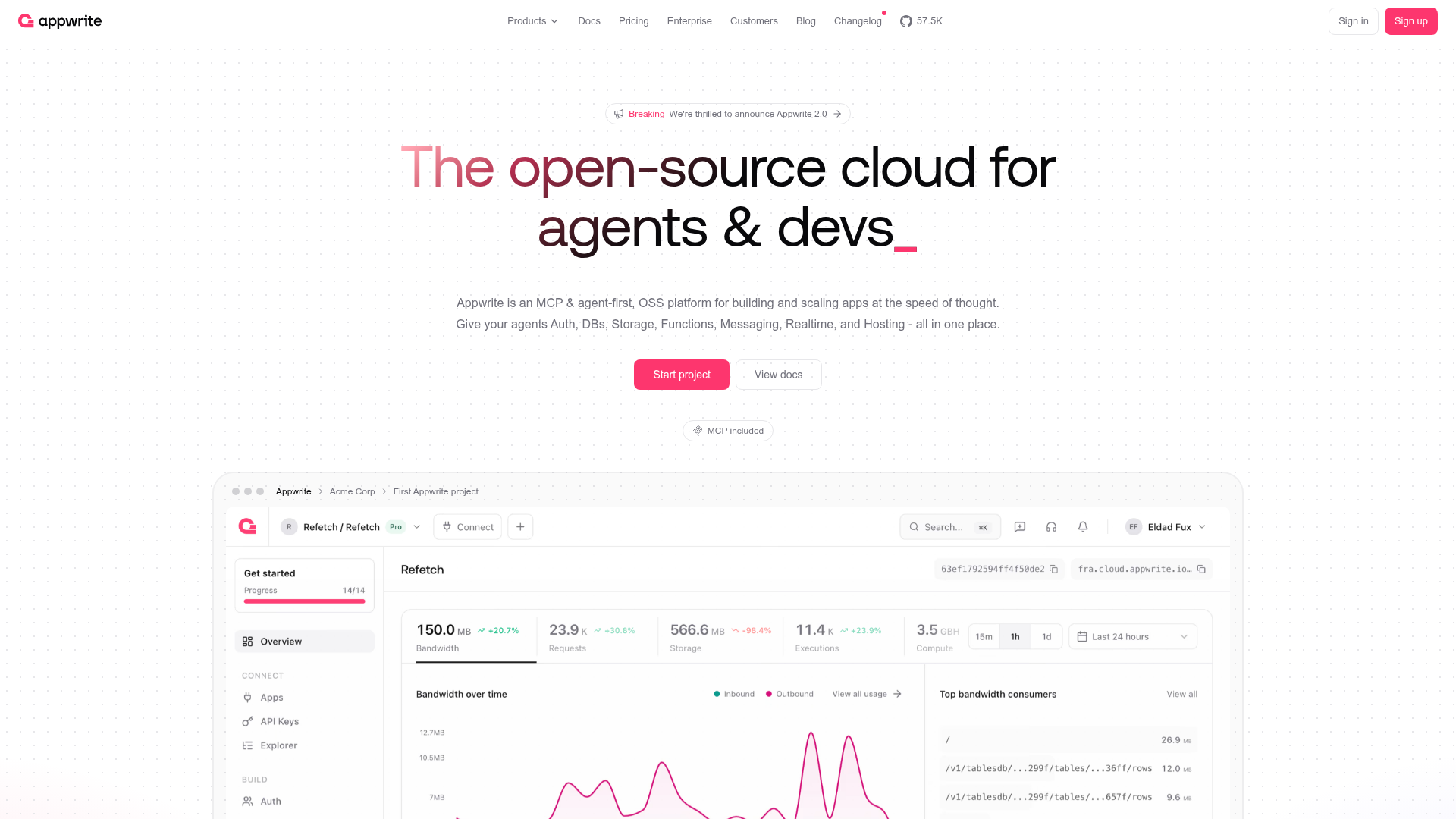
Captured: appwrite.io on 2026-09-29.
Read this first.
4 LINESHook Claude Code or Cursor up to a project over MCP and let the agent do backend grunt work on live infrastructure.
Database compute is the line item to watch; read the dedicated tier table before committing to a paid setup.
Treat the relational database options as preview software for now.
Open source means you can move off Appwrite Cloud later, but budget real ops time if you do.
What it can do.
8 CAPABILITIES- MCP included
- Agents such as Claude Code, ChatGPT, OpenCode and Lovable get documented setups to work directly against a live Appwrite project.
- Auth
- Offers five sign-in methods, from OAuth providers like Google and GitHub to anonymous sessions and magic URLs.
- Databases
- Pick TablesDB, DocumentsDB or VectorsDB, or run managed PostgreSQL and MySQL inside the same project.
- Storage
- Uploaded files get compression and encryption, plus image transformations such as AVIF conversion and access control.
- Functions
- Serverless code runs in isolated runtimes and fires on events or cron schedules, auto-scaling with demand.
- Sites hosting
- Web front ends deploy next to the backend they call, from one console.
- Messaging and Realtime
- A built-in messaging service and Realtime subscriptions push updates to users without bolting on another vendor.
- Firewall
- Automated DDoS protection and a firewall product guard every project by default.
Three ways to run it.
3 PLAYS- The MCP smoke test
- Connect your agent to a fresh Free project through the included MCP and ask it to add sign-in and one table. If it finishes without you opening the console, the agent workflow holds up for your stack.WHOSolo dev pairing with an AI coding agentPAYOFFA yes-or-no answer on agent-driven backend work before spending a dollar.
- Serverless until it hurts
- Keep each database on serverless while traffic is unpredictable. Promote one to a dedicated tier only once its monthly overage costs more than that tier's fixed price.WHOStartup CTO watching burnPAYOFFReserved compute shows up only where it pays for itself.
- One-console Flutter launch
- Build login from the Flutter quick start and add a cron-scheduled Function for nightly cleanup. Ship the landing page through Sites on that same project.WHOTwo-person Flutter MVP teamPAYOFFFewer vendors to wire together before launch day.
What it costs.
4 TIERS- Verdict on the price
- Fair for small production apps, since all plans include the whole toolkit and $10 of database compute credit each month, but replica and recovery surcharges on dedicated tiers stack up quickly.
The street's view.
5 QUOTEDProduct Hunt reviewers are broadly warm about speed, docs and the free tier, while Reddit threads argue over self-hosting in production and a newer pricing model, and Trustpilot sits at 3.1 from just 4 reviews.
Reviewers say Appwrite cuts setup time and lets them ship faster with fewer moving parts.
PraiseOne user calls the self-hosted option a blessing and says the platform is very developer-friendly.
PraiseA long-time user says Appwrite has powered their projects since version 1.6.0 and calls it a great stack.
PraiseSome reviewers mention cloud stability issues, limited database features and slow function development.
CritiqueThe author would not run a self-hosted instance in production unless you are genuinely willing to handle the operational burden yourself.
CritiqueWhere it breaks.
5 LIMITATIONSThe PostgreSQL and MySQL options carry Beta labels, and reviewers still ask for row-level security and more database power.
Only credit and debit cards are accepted, and accounts may face a payment verification hold of up to $150.
Enterprise pricing is quote-only, so large buyers cannot compare costs without a sales conversation.
Serverless read and write quotas and overage rates live in a separate plan comparison table, which makes early cost forecasts fiddly.
Reviewers want better filtering in the dashboard and faster functions.
What else to weigh.
3 ALTERNATIVES- Firebase
- Google's proprietary backend-as-a-service with two NoSQL databases, auth, hosting and cloud functions.PICK IT WHENYou want Google to run everything and will never need to self-host.
- Supabase
- A focused open-source backend stack built around Postgres and Deno.PICK IT WHENYour app lives or dies on mature Postgres features today.
- PocketBase
- A lightweight open-source backend shipped as a single executable on SQLite.PICK IT WHENYou want the smallest possible self-hosted backend for a simple app.
First hour.
3 STEPSClick Start project at appwrite.io and create a Free organization.
Open the quick start for your framework or agent tool, such as Next.js, Flutter or Cursor.
Add sign-in or a table from your code or through the MCP connection, then check it in the console.
The questions people ask.
3 ANSWERS- Can I self-host Appwrite?
- Yes. The full platform is open source on GitHub, and the project invites you to run all of it or just a part. Community opinion on production self-hosting is split, so weigh the Reddit reactions in the community section first.
- Which database should I start on?
- TablesDB on serverless compute is the default and carries no fixed monthly fee. DocumentsDB, VectorsDB, PostgreSQL and MySQL all require dedicated compute, so choosing one of those means paying for a tier from day one.
- Will Appwrite sign a BAA for health data?
- The pricing page lists BAA requests as a frequently asked question, but the answer is not shown publicly. Confirm with Appwrite sales before putting sensitive health data on the platform.
The call.
SPECIMEN 0236 CLOSEDStart on the Free plan, let your agent do the scaffolding, and pay for Pro the day real users arrive.
Field research: 2 pages scraped · 3 search passes · 12 community sources. Reviewed by the Koda desk on 2026-09-29.