- SPECIMEN
Iris.ai
- FILED AS
Enterprise knowledge layer for grounded, traceable AI answers over research and documents
- INTAKE DATE
- 2026-10-01
- CLASS
- AI Platform
- METHOD
- 1 page scraped, 3 search passes, 9 community sources
The pipeline on show runs from extraction through SME validation to LLM evaluation, a serious design, but none of it carries an independent benchmark. THE RUNDOWN
Getting started means a sales demo and a scoping conversation, so time to a first answer is out of your hands. ZERO TO RUNNING
With no published price, output per dollar cannot be estimated, which hurts anyone trying to compare quotes. THE DAMAGE
No dated release or funding figure is on record and the AWS partnership on the homepage carries no date, so traction stays unproven. THE STREET
Koda Score = weighted blend: capability 35, ease 20, value 25, momentum 20.
Iris.ai's pitch is control over what a model reads, backed by expert review loops that keep every answer traceable to a source, and none of it can be inspected without a sales call. Regulated R&D groups with a defined corpus and a procurement budget should pilot it; individual researchers will get further, faster, with a self-serve tool.
Iris.ai promises AI answers that hold up where a wrong one is unacceptable, and it keeps the product behind a demo request until you look like a buyer.
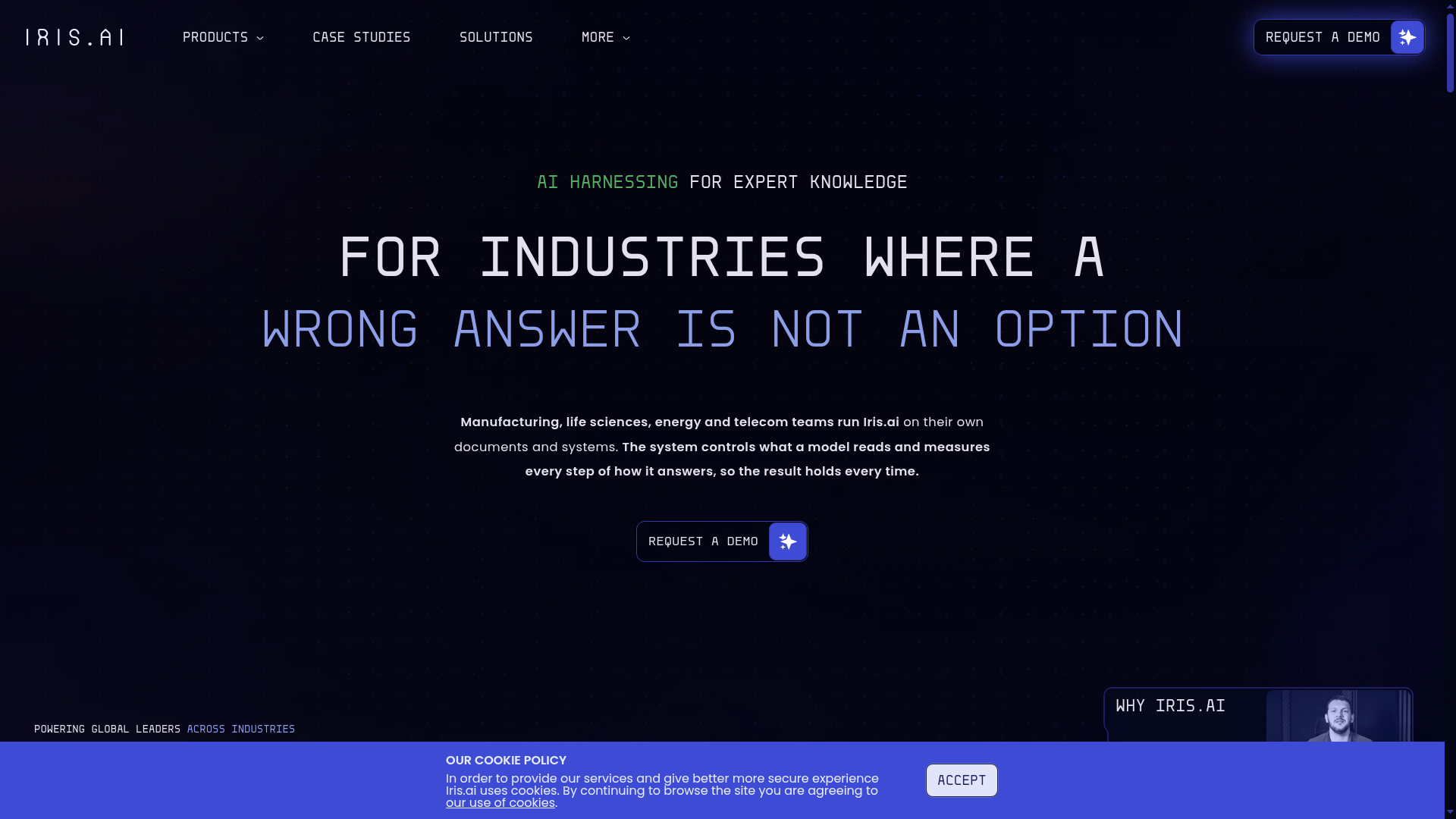
Captured: iris.ai on 2026-10-01.
Read this first.
4 LINESExpect a sales conversation before you touch the product; there is no self-serve signup.
The core idea is a governed knowledge layer that limits what the model reads and logs how it answers.
Treat the homepage performance figures as marketing until a pilot on your own documents reproduces something similar.
Budget time from subject-matter experts, because the workflow relies on them to validate and refine the knowledge.
What it can do.
7 CAPABILITIES- Knowledge Synthesis
- Structures data from across enterprise systems into one coherent knowledge graph.
- Contextual Grounding
- Anchors model answers in trusted sources and domain semantics.
- Governance and Trust
- Keeps full source traceability and explainable reasoning paths aimed at regulated deployment.
- Expert Validation
- SMEs and architects feed corrections back, and the resulting knowledge is versioned and auditable.
- LLM Evaluation
- Tests outputs against accuracy and compliance criteria, with guardrails drawn from expert benchmarks.
- Paper and patent review
- Its Product Hunt listing describes sifting large collections of research papers or patents and pulling out data.
- AWS partnership
- A strategic partnership with AWS targets regulated industries globally.
Three ways to run it.
3 PLAYS- Known-list accuracy test
- Load only the sources behind one review your team already published, then grade each Iris.ai summary line by line against what you know sits in those papers.WHOLiterature review leadPAYOFFA hard accuracy read before any wider rollout.
- Weekly expert feedback loop
- Assign two subject-matter experts to flag wrong or incomplete answers each week and push those corrections into the validation step, tracking whether repeat questions improve across knowledge versions.WHOR&D knowledge managerPAYOFFEvidence that the versioned knowledge actually gets better over time.
- Expansion gate
- Widen ingestion to the full corpus only after the pilot set clears an error threshold you write down before the demo, and halt if any citation fails to point back to a real source passage.WHOResearch operations leadPAYOFFA go or no-go call grounded in your own documents.
What it costs.
NO TIERS PUBLISHED- Verdict on the price
- Value cannot be judged until a quote arrives; the only cost signal on the site is a vendor claim of 35%+ savings on LLM usage costs.
The street's view.
2 QUOTEDIndependent chatter about this product is thin: one Product Hunt review is the clearest signal, while the detailed Iris-branded reviews on G2 describe HeyIris.ai, an RFP tool, and the Gartner page compares against RFP software.
With far fewer public reviews than Elicit or Consensus, Iris.ai's claims are hard to check independently.
MixedWhere it breaks.
4 LIMITATIONSThe vendor says grounding eliminates hallucination, an absolute claim with no public test behind it.
AWS is the only integration named; connectors to reference managers or lab systems go unmentioned.
The homepage names two products, Axion and Neuralith, with little detail on how they divide the work, so scope is hard to judge before a call.
Web is the only listed platform.
What else to weigh.
3 ALTERNATIVES- Elicit
- Research assistant built around finding and synthesizing academic papers.PICK IT WHENYou want to start today without a sales call and can lean on a larger base of public user feedback.
- Consensus
- Search engine that answers research questions from academic literature.PICK IT WHENYour question is about what published studies conclude and no private corpus is involved.
- SciSpace
- Paper reader for interacting with uploads and extracting explanations from them.PICK IT WHENYou mainly need to understand individual papers you upload yourself.
First hour.
3 STEPSRequest a demo on iris.ai
Agree pilot scope and the document set with the Iris.ai team
Ingest the pilot documents and review the first answers with your experts
The questions people ask.
3 ANSWERS- Can I try Iris.ai without talking to sales?
- No. The site offers a single route in, a demo request, and lists no free tier.
- How much should I trust the homepage numbers?
- Iris.ai cites 330 million+ documents securely ingested, 200,000+ answers evaluated on 50+ use cases and 80%+ acceleration on AI go-to-market. These are its own figures with no outside audit attached, so ask how they were measured during the demo.
- Is it built for academic literature reviews?
- The Product Hunt description fits paper analysis, but the current homepage pitches an enterprise knowledge layer for sectors like manufacturing and telecom. Ask to see the paper-analysis workflow specifically before committing.
The call.
SPECIMEN 0237 CLOSEDBook the demo only if you can bring a reading list your team knows cold and someone who signs contracts. Everyone else can learn more from an afternoon with Elicit.
Field research: 1 page scraped · 3 search passes · 9 community sources. Reviewed by the Koda desk on 2026-10-01.