- SPECIMEN
Pi
- FILED AS
A minimal, MIT-licensed coding agent harness for the terminal
- INTAKE DATE
- 2026-10-03
- CLASS
- Coding
- METHOD
- 1 page scraped, 3 search passes, 4 community sources
The extension API and TypeScript SDK make it a genuine platform, held back by missing permissions and thin sub-agent support. THE RUNDOWN
Getting it running is a Node.js install plus a provider key, but the bare default means you assemble your own workflow before it feels complete. ZERO TO RUNNING
An MIT-licensed core at $0 covers everyday use, and the only running cost is the model provider you connect. THE DAMAGE
The pi-mono repository showed 111.8k stars with a fresh commit on Oct 2, 2026, backed by 294 contributors and 6,703 commits. github.com
Koda Score = weighted blend: capability 35, ease 20, value 25, momentum 20.
Pi's 1.0 core wins by staying small: a tiny system prompt, any provider you like, and an extension API for building whatever it lacks. That minimalism has a real cost, since there is no built-in permission system and the default workflow is bare. Solo builders and tinkerers who enjoy wiring up their own guardrails should adopt it now; teams that need policy controls out of the box will spend their first week filling gaps.
Pi 1.0 ships a coding agent with a system prompt small enough that a modest laptop running a local model can keep up with it.
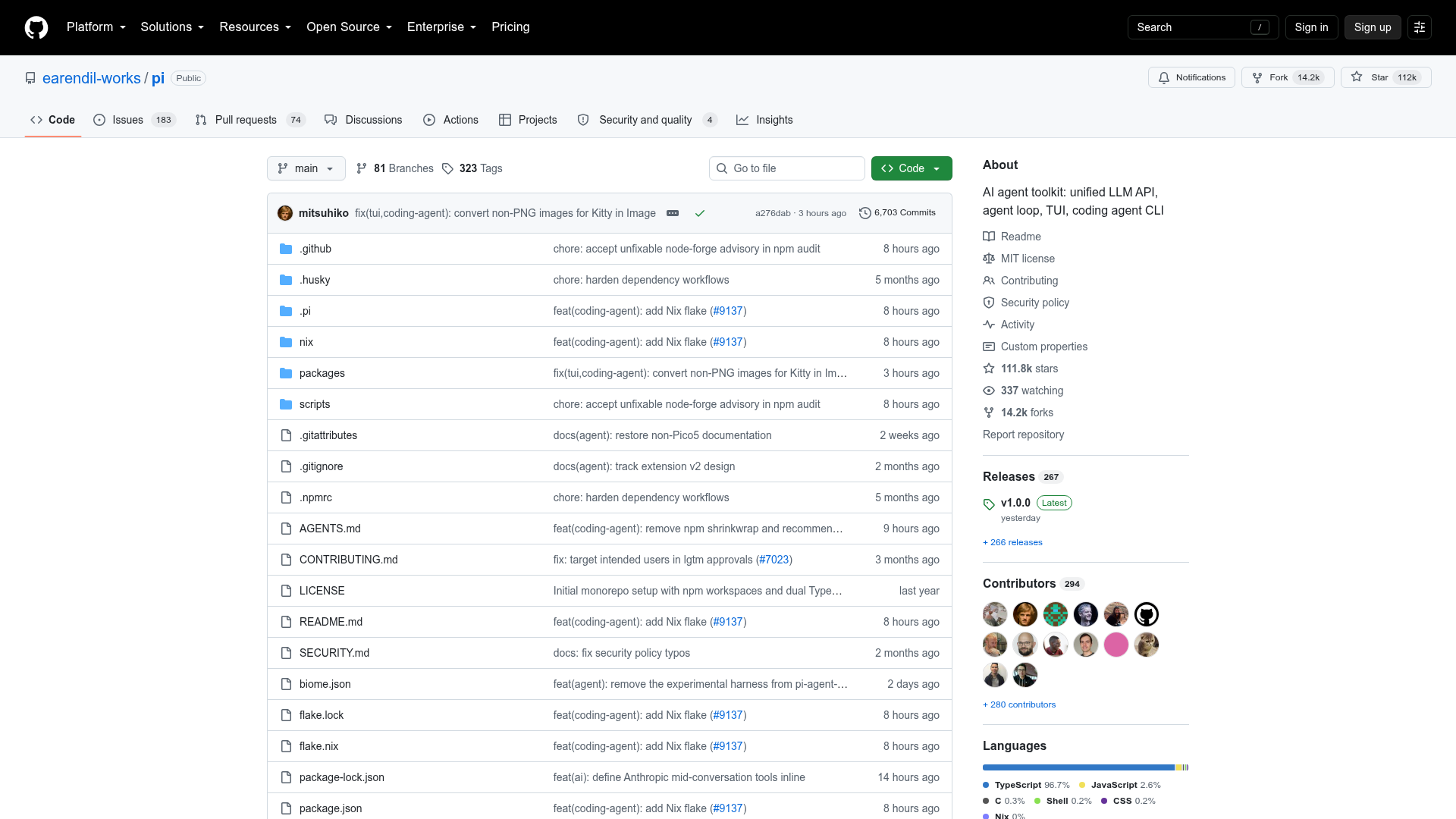
Captured: github.com/badlogic/pi-mono, the project's home, not a product screen.
In one breath.
2 LINESInstall it for long or local coding sessions where prompt overhead and token cost actually matter.
Put your own guardrails around it before pointing it at anything you care about.
The working parts.
7 CAPABILITIES- Full-screen terminal UI
- Runs as a full-screen TUI and renders images inline in Kitty-compatible terminals.
- Small system prompt
- Keeps prompt overhead low, which cuts prefill time and token use on long sessions.
- Provider connections
- Built-in connections to the major hosted model vendors, and users report it working well against local models.
- Custom extensions
- Extensions add tools and workflows on top of the minimal core.
- RPC and JSON modes
- Other programs can drive the agent over RPC or consume its JSON output.
- TypeScript SDK
- An SDK for embedding the agent inside your own applications.
- Durable-agent package
- An experimental package for long-running agents, shipped alongside the stable core.
Where it earns its keep.
2 PLAYS- Local-model laptop rig
- Point Pi at a local model and time the first response against your current agent on the same task.WHODevelopers on low-powered hardwarePAYOFFA usable agent loop that does not stall for minutes chewing through a giant prompt.
- Slack on-call harness
- Build a support and on-call bot on the TypeScript SDK and RPC mode, wired into Slack, so the model vendor can change without a rewrite.WHOPlatform and support engineersPAYOFFA vendor-agnostic support bot you own end to end.
The price, as listed.
1 TIER- Verdict on the price
- The free MIT core carries nearly all the value, model spend goes to whichever provider you connect, and the project lists no paid plan.
What users report.
5 QUOTEDEarly reactions on X and Hacker News are warm about speed and lean prompts, though they are too few and too recent to call representative.
Pi was the only agent I tried that ran decently on local models, because it skips the enormous system prompt that took minutes to prefill on my low-powered laptop.
PraiseBest agent harness thanks to high cache hits, low latency and a tiny prompt, though you will probably end up on Oh My Pi anyway.
MixedThe plugin ecosystem is way ahead, but it lives or dies on attracting contributors in a crowded agent market.
MixedA weak fit for teams that want built-in permissions and enterprise policy controls without customizing it first.
CritiqueWhat it will not do.
4 LIMITATIONSNo built-in permission system, so the agent acts with whatever access your user account has.
Sub-agent support is limited in the core.
Requires Node.js 22.19 or newer.
No polished beginner path; expect to install extensions and tune config before it feels finished.
The other options.
2 ALTERNATIVES- Claude Code
- Anthropic's mainstream terminal coding agent, less customizable.PICK IT WHENYou want a ready-made CLI and can live with one vendor and fewer knobs.
- OpenAI Codex
- OpenAI's coding-agent harness.PICK IT WHENYou are committed to OpenAI models and never plan to switch vendors.
How to begin.
4 STEPSInstall Node.js 22.19 or newer.
Install Pi from the pi-mono repository, or build it with the Nix flake on Linux or macOS.
Connect a hosted provider key or a local model.
Launch it in your project directory to open the full-screen terminal interface.
Straight answers.
2 ANSWERS- Is it worth trying with a local model?
- Yes, that is where users describe the biggest gap versus heavier agents. Its short prompt avoids the long wait before the first token on modest hardware.
- How do I sandbox it?
- Pi ships no sandbox of its own. One X user moved agent tooling into a Docker-isolated harness over supply-chain worries, and Docker is among Pi's listed integrations, so a container is the obvious place to start.
Where this lands.
SPECIMEN 0239 CLOSEDRun the stable core for daily local work today, and treat the experimental durable-agent package as a weekend toy until it graduates.
Field research: 1 page scraped · 3 search passes · 4 community sources. Reviewed by the Koda desk on 2026-10-03.