- SPECIMEN
SuperLocalMemory
- FILED AS
Local-first shared memory for AI agents that grades its own recall
- INTAKE DATE
- 2026-10-18
- CLASS
- Coding
- METHOD
- 4 pages scraped, 3 search passes, 9 community sources
Graded recall, a kept history of superseded facts and a log of which agent wrote each memory make a broad feature set, though the headline benchmark is self-reported. THE RUNDOWN
Getting started is a global npm install plus slm setup on any of the three desktop OSes, with a model warm-up pause before recall answers. ZERO TO RUNNING
The local core costs $0, and its main published restriction is a monthly cap on API integration downloads. THE DAMAGE
GitHub shows, as of 2026-10-18, 250 stars; 44 releases in the last 90 days; last release v4.2.9 on 2026-10-17, a fast shipping pace on a still-small following. github.com
Read by Koda: qualixar/superlocalmemory on GitHub, read 2026-10-18: 250 stars; 44 releases in the last 90 days; last release v4.2.9 on 2026-10-17. github.com
Koda Score = weighted blend: capability 35, ease 20, value 25, momentum 20.
SuperLocalMemory grades each recall and keeps replaced facts on an undoable record, which targets the costliest failure in multi-agent coding: an agent acting confidently on stale context. The free local core means a trial costs one install, and developers running two or more coding agents on one repo should take it this week. Keep it a personal tool until the paid plans carry real numbers.
Every recall from SuperLocalMemory comes back graded, so a coding agent about to bluff about your staging port gets caught before it acts.
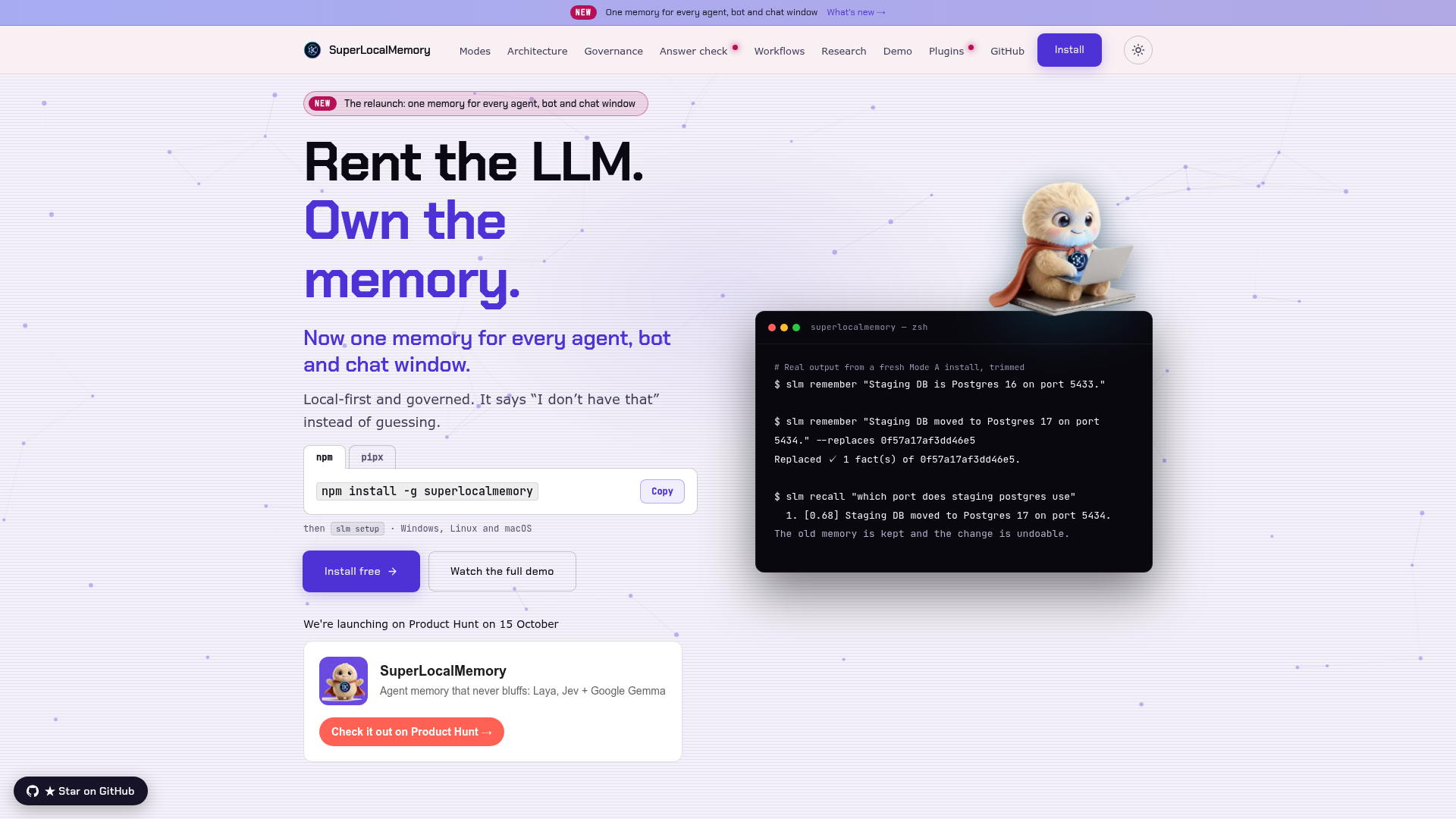
Captured: www.superlocalmemory.com on 2026-10-18.
Read this first.
3 LINESThe three-tier recall is the reason to try it, because an agent can see when a memory only loosely matches the question.
Run the trial with two coding agents sharing one store; success means you never re-brief the second one.
Hold off on a team rollout, since governance sits in the Enterprise plan and that plan has no price yet.
What it can do.
7 CAPABILITIES- Graded recall
- Each recall ends as a supported answer, a set of closest related memories, or a plain statement that the fact is not stored.
- Time-aware facts
- Facts record when they were true, and the --replaces flag supersedes an old fact while keeping it on file for undo.
- Writer provenance
- Every stored fact logs which agent wrote it and at what time.
- One store for many agents
- A single memory serves coding agents such as Claude Code and Cursor alongside chat tools like ChatGPT.
- Pictures and PDFs
- Images and PDF documents live in the same store and are found through hybrid document search.
- Governed access
- Auditing and rules on who may see a memory are part of the governed design.
- Answer check
- Recall can be checked by Laya running on your Mac or by Jev online.
Ways to run it.
3 PLAYS- Two-agent handoff test
- Point both agents at the same store, brief only the first on the project, then open a fresh session in the second and count how often it asks you to restate context.WHODevelopers using Claude Code and Codex on one repoPAYOFFA concrete yes or no on whether shared memory saves you re-explaining, measured on your own codebase.
- Environment change log
- Run slm remember with --replaces and the old fact's ID whenever a port or database version changes, then ask a different agent for that detail.WHOEngineers who keep staging details currentPAYOFFEvery agent reads the current value, and a bad correction can be rolled back because the prior fact is retained.
- Supported-only gate
- Gate any automated action on a supported-tier recall; send related-tier results to a human and treat a no-answer result as a cue to write the missing fact down.WHOBuilders wiring agents into automated scriptsPAYOFFAutomation stops acting on guesses, and gaps in project memory surface as visible to-dos.
What it costs.
3 TIERS- Verdict on the price
- Free is generous for one developer, but nobody can budget past it while both upper tiers read TBD.
The street's view.
0 QUOTEDSuperLocalMemory relaunched on Product Hunt in mid-October and no public user reviews or comments have surfaced yet, so there is no street reaction to report.
Where it breaks.
4 LIMITATIONSHow much you can store depends on the local disk space your machine gives the memory store.
Free-tier management options are limited, by the vendor's own account.
Nobody outside the project has yet shown how it holds up over months of real multi-agent use.
The release cadence is very fast, so expect to update often and recheck your agent hookups.
What else to weigh.
3 ALTERNATIVES- Mem0
- General-purpose memory layer that extracts and retrieves user and conversation facts.PICK IT WHENYou want a more established, easier-to-integrate layer and do not need local storage of pictures and PDFs.
- Zep / Graphiti
- Temporal knowledge graph that tracks when facts were valid and reasons about change.PICK IT WHENReasoning over how facts changed through time is your core requirement and a graph model suits your stack.
- Letta
- Agent runtime with editable, persistent memory blocks.PICK IT WHENYou want each agent to own its memory inside a single runtime.
First hour.
4 STEPSInstall with npm install -g superlocalmemory, or use pipx.
Run slm setup.
Connect each agent through the plugins listed on the SuperLocalMemory site.
Store a fact with slm remember and query it with slm recall.
The questions people ask.
4 ANSWERS- Does my memory stay on my machine?
- The core is local-first and installs on Windows, Linux and macOS. The vendor lists no offline support for advanced features, so expect some functions to need a connection.
- What license covers the free core?
- The local core is AGPL v3. Teams that plan to embed it in a hosted product should check what the copyleft terms require of them before shipping.
- What happens right after setup?
- While its models load, recall reports that it is still warming up and asks you to try again in a few minutes. Plan your first test around that pause.
- Is there evidence the recall is accurate?
- Qualixar reports 74.8% on the LoCoMo benchmark for Mode A with retrieval, and the project has four arXiv preprints describing the design. A comparison post on varunpratap.com repeats that figure and puts Mem0 at roughly 58 to 66 percent, noting it varies across reports.
The call.
SPECIMEN 0254 CLOSEDInstall it, wire up two agents, and judge it on one question: does the second agent already know what you told the first?
Field research: 4 pages scraped · 3 search passes · 9 community sources. Reviewed by the Koda desk on 2026-10-18.