- SPECIMEN
OpenHands
- FILED AS
Open-source, self-hostable coding agent platform that asks for secrets mid-run
- INTAKE DATE
- 2026-10-21
- CLASS
- Coding
- METHOD
- 2 pages scraped, 3 search passes, 6 community sources
Autonomous repo work, scheduled automations, PR review and inline secret requests cover more of the development lifecycle than an editor-bound assistant does. THE RUNDOWN
Getting started is a desktop download or a Cloud login plus a model key, and no time-to-first-result is published to set expectations. ZERO TO RUNNING
A free self-hosted tier with automations and secrets included makes evaluation costless, and the paid plans charge a flat monthly fee per organization. THE DAMAGE
GitHub shows 91,415 stars read 2026-10-21 and at least 28 releases in the last 90 days, with the last release v1.29.0 on 2026-10-20. github.com
Read by Koda: OpenHands/OpenHands on GitHub, read 2026-10-21: 91,415 stars; at least 28 releases in the last 90 days; last release v1.29.0 on 2026-10-20. github.com
Koda Score = weighted blend: capability 35, ease 20, value 25, momentum 20.
Inline secret requests fix the most tedious part of handing a repo to an autonomous agent: guessing up front which credentials it will touch. Everything else is the familiar OpenHands bargain, a self-hostable, model-agnostic agent that can review PRs, patch incidents and run scheduled maintenance on whatever model you pick. Engineering groups comfortable running their own infrastructure should adopt the free tier now and keep a reviewer on every diff it opens.
OpenHands 1.28.1 lets its coding agent pause mid-task and ask you for an API key, so nobody has to front-load a vault of credentials before a debugging run.
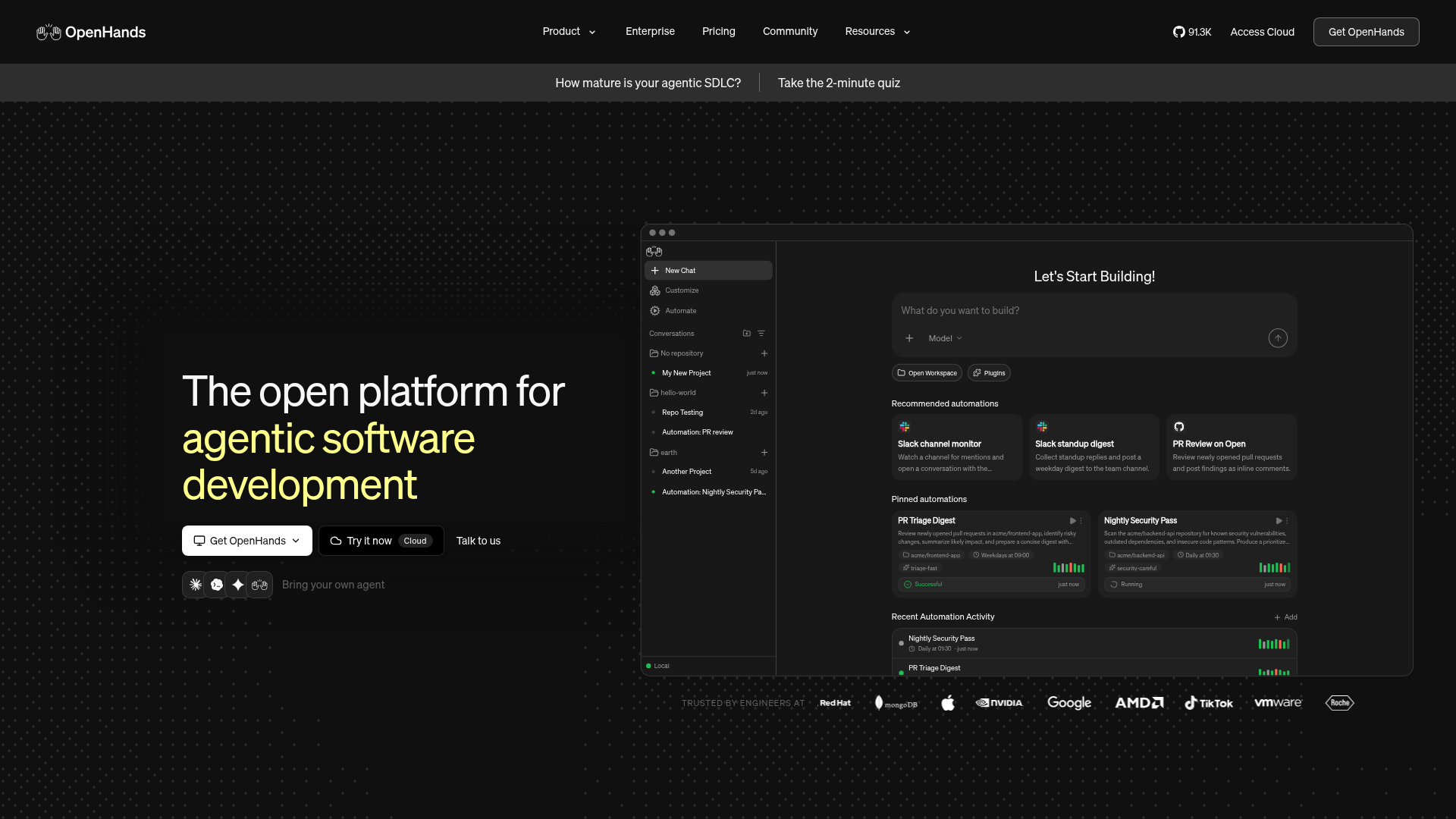
Captured: openhands.dev on 2026-10-21.
In one breath.
4 LINESStart on the free Agent Canvas tier, which the OpenHands pricing page lists as local and self-hosted with open-source community support.
Hand over credentials one at a time as the agent requests them; that inline prompt is the headline change in 1.28.1.
Budget for model costs separately, because every plan runs on your own LLM key.
Wire it to GitHub or Slack first, since the recommended automations on the homepage target PR review and channel monitoring.
The working parts.
5 CAPABILITIES- Inline secret requests
- During a conversation the agent can request a specific secret, such as an API key, at the moment it needs it.
- Model and agent choice
- Connect your own LLM or run third-party agents such as Claude and Codex inside the platform.
- Scheduled automations
- Recurring jobs like a weekday PR triage digest or a nightly security pass run on a cron-style schedule.
- PR review on open
- Newly opened pull requests get reviewed automatically, with findings posted as inline comments.
- Parallel agents
- Multiple agents can work at the same time, even on the free individual plan.
Where it earns its keep.
2 PLAYS- Failing-test triage
- Point Agent Canvas at a repo with a broken integration test and hold back every credential, handing each one over only when the agent pauses to ask.WHOBackend developerPAYOFFYou learn exactly which keys the fix touched, and nothing extra sits in the agent's context.
- Free or Teams decision rule
- Stay on Agent Canvas while one person drives runs; move to Teams once several engineers need shared automations and per-user RBAC, and only if monthly runs fit under the Teams session cap.WHOEngineering leadPAYOFFA paid plan arrives when shared identity becomes the bottleneck, and not before.
The price, as listed.
4 TIERS- Verdict on the price
- The free tier covers a real evaluation, and flat team pricing beats per-seat billing once the seats fill up, though model spend comes on top.
What users report.
2 QUOTEDNobody has posted a verdict on 1.28.1 yet; older Reddit threads about the project lean positive.
Came away really impressed: the agent seemed highly capable and the project looked well run and maintained.
PraiseWhile hunting for Copilot alternatives, OpenHands was one of the few that stood out, offering an experience similar to Copilot.
MixedWhat it will not do.
4 LIMITATIONSOutput quality rides on whichever model you connect, and the agent inherits that model's blind spots.
Good results take configuration, and OpenHands itself flags integration with legacy systems as complex.
Support below Enterprise is thin: community help on the free tier and best-effort email on Teams plans, with SLA response times reserved for Enterprise.
Public user feedback on the inline secrets feature in 1.28.1 has not surfaced yet.
The other options.
2 ALTERNATIVES- Cline
- Open-source coding agent that lives in VS Code and JetBrains.PICK IT WHENYou want interactive, developer-in-the-loop help inside the editor over long unattended runs.
- Devin
- Proprietary autonomous software-engineering agent.PICK IT WHENA polished managed service matters more to you than self-hosting or open source.
How to begin.
4 STEPSDownload Agent Canvas for your machine, or sign in to OpenHands Cloud at app.all-hands.dev.
Pick a model and add your own LLM key.
Open a workspace on the repository you want worked on.
Type the task in the prompt and answer credential prompts as they appear.
Straight answers.
2 ANSWERS- Can I keep everything on my own infrastructure?
- Every plan on the pricing page is self-hosted, and a hosted OpenHands Cloud option exists for those who prefer it. Enterprise adds deployment in controlled environments with isolated agent execution and action auditing.
- Do the built-in integrations work on the free plan?
- Built-in OAuth integrations come with the paid plans; the free Agent Canvas gets select MCP ones only. Expect more manual wiring when you test for free.
Where this lands.
SPECIMEN 0257 CLOSEDGrab the free Agent Canvas and aim it at your nastiest failing test; how few keys it actually requests will tell you whether a team plan is worth the call.
Field research: 2 pages scraped · 3 search passes · 6 community sources. Reviewed by the Koda desk on 2026-10-21.