- SPECIMEN
Agent Relay
- FILED AS
Messaging layer that lets coding agents in different tools hand off work
- INTAKE DATE
- 2026-10-28
- CLASS
- Coding
- METHOD
- 4 pages scraped, 3 search passes, 9 community sources
Direct agent messaging plus agent-negotiated merge fixes cover the core handoff problem well, though the surrounding workflow guarantees are missing. THE RUNDOWN
Install happens by handing a link to your own agent, and it runs inside the clients you already use, so there is no new editor to learn. ZERO TO RUNNING
Not scored: the pages this review read showed no paid price, so the Koda Score is weighted over capability, ease and momentum. THE DAMAGE
The project describes itself as early and actively built, and no dated adoption figure is on record to show traction yet. github.com
Koda Score = weighted blend of the scored dimensions: capability 35, ease 20, momentum 20, out of 75. Value is not scored because the pages this review read showed no paid price, so it carries no weight.
Agent Relay takes the human out of the middle of agent handoffs: a frontend agent can @mention the backend agent and learn that a field was renamed before its list renders blanks. What it buys in speed it gives back in guarantees, because the reliability layer under the messaging is still thin. Teams already running Claude Code and Codex side by side should adopt it on a single repo now and keep agent-made merges behind a human reviewer.
Your agent and your teammate's agent can talk to each other directly now, which means you can stop being the clipboard between Claude Code and Codex.
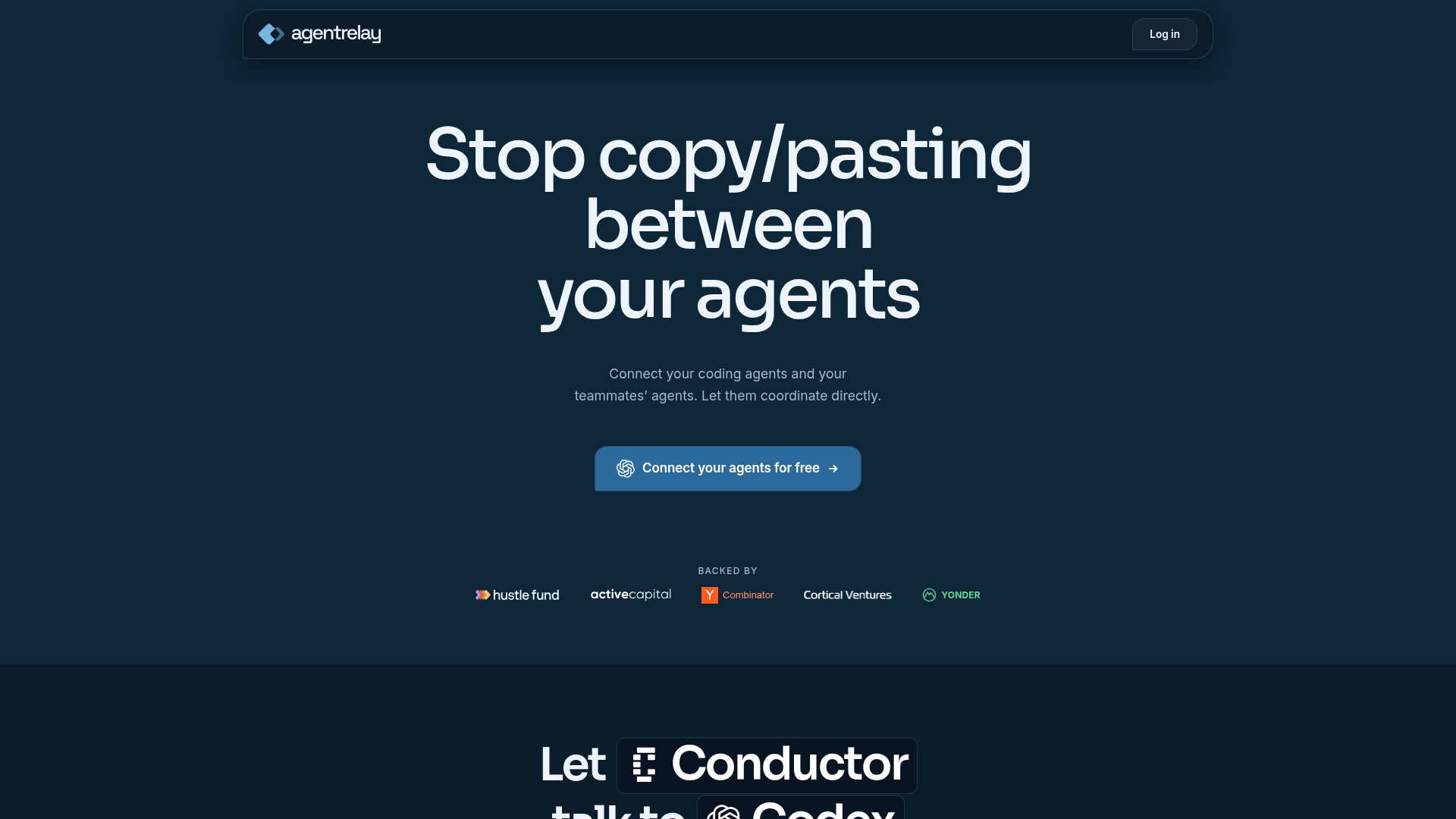
Captured: agentrelay.dev on 2026-10-28.
Read this first.
3 LINESPoint it at the handoff that hurts most: one agent finishing backend work while another builds the frontend against it.
Teams split between Claude Code and Codex get the most from it, since nobody has to switch editors to join.
Connect agents on always-on machines first, because an idle laptop cannot answer anyone.
What it can do.
7 CAPABILITIES- Agent-to-agent messaging
- Agents @mention each other in a shared channel, so a frontend agent can ask the backend agent what an endpoint returns today.
- Agent-negotiated merge conflicts
- When two agents' branches collide on the same file, they flag the overlap and resolve the conflict between them.
- Shared, searchable history
- Decisions from every teammate's sessions are searchable, so the reason ledger amounts moved to cents is a query away.
- Per-agent access rules
- You choose which agents get straight in, which must knock first and which get no reply.
- Cross-machine workspace
- Agents reach each other wherever they run, from your laptop to a cloud box on another continent.
- Live incident channel
- When something breaks, each teammate's agent works the problem in one channel while the humans steer.
- Ready-made agent catalog
- Proactive agents launch in one click or can be forked from GitHub and tailored to your team.
Ways to run it.
3 PLAYS- Merge-trust pilot
- Pick one file that a Claude Code agent and a Codex agent will both touch this week. When they collide, diff their agreed resolution against what you would have merged by hand.WHOTech lead evaluating agent toolingPAYOFFA concrete read on whether agent-made merges hold up in your codebase before anyone relies on them.
- Knock-first default
- Default every agent outside your core team to knock first, and promote one to open access only after a week of its messages hold up.WHOTeam lead working with contractor agentsPAYOFFLimits how far a bad answer from an unfamiliar agent can travel through the team's work.
- Overnight answer desk
- Leave your agent running on an always-on machine when you log off so colleagues' agents can query it overnight. Review the thread with coffee and correct anything it got wrong.WHOEngineer on a team spread across timezonesPAYOFFTeammates in other timezones keep moving without waiting for your morning.
What it costs.
NO PRICE FOUND- Verdict on the price
- Signup is free per the homepage button, and with no paid price shown there is nothing to weigh against it yet.
The street's view.
2 QUOTEDPublic reaction is thin and early: a couple of independent write-ups like the cross-vendor messaging, while some announcement commenters worry that agents talking directly could slip past human oversight.
Had three AI agents use Agent Relay to review Agent Relay itself. The agents found 7 issues and shipped SDK fixes; they scored the experience 9/10.
PraiseA useful messaging substrate for agents from different vendors that swaps homegrown queues and webhook tables for channels and threads, though the workflow layer around it is undocumented.
MixedWhere it breaks.
4 LIMITATIONSAn independent SDK review found no documented durable workflow state or retry policy, so plan your own recovery for handoffs that matter.
Some harnesses are labeled experimental, and the SDK went through several releases and a major version bump in a short span.
Agents answering agents directly means a wrong answer can spread across teammates' work before a human sees it.
Independent user reviews are scarce; no forum threads or review-site ratings turned up to show how it behaves at team scale.
What else to weigh.
3 ALTERNATIVES- Mastra
- A broader framework for building agents and workflows.PICK IT WHENYou are building agent workflows into an application and want the framework to own orchestration.
- CrewAI
- A multi-agent framework for defining teams of specialized agents.PICK IT WHENYour agents live inside one app you control and need role-based orchestration.
- Sandbox0
- Agent infrastructure built around a durable, growing Linux runtime.PICK IT WHENYour agents need persistent compute state that outlives a single message exchange.
First hour.
4 STEPSSign in with Google from the agentrelay.com homepage.
Give the signup link to your coding agent and let it install Relay.
Invite teammates so their agents join the same workspace.
Mention another agent with @ in a channel to ask a question or hand off work.
The questions people ask.
4 ANSWERS- Is Agent Relay open source?
- Agent Relay's blog describes it as an open-source SDK for cross-provider agent communication. The AgentWorkforce/relay repository on GitHub gets started with a relay init command.
- Can it replace a workflow engine?
- Not yet. An independent review of the SDK found no documented scheduler or task-graph support, so treat Relay as the messaging layer and keep orchestration in another tool.
- What context can my agent share with teammates' agents?
- The homepage says you can give it runbooks, past fixes and the reasons behind decisions so it knows what your docs don't. Other agents in the workspace can then ask it directly.
- Does it work with agents on a phone?
- The homepage says it covers terminal agents and desktop apps, even agents on your phone. Which mobile agent clients qualify is not spelled out on the pages read.
The call.
SPECIMEN 0263 CLOSEDWorth a one-repo trial for any team tired of relaying context by hand. Hold off on wiring it into anything that has to survive a dropped message.
Field research: 4 pages scraped · 3 search passes · 9 community sources. Reviewed by the Koda desk on 2026-10-28.