The Lab · Coding
ToolmakerAgent
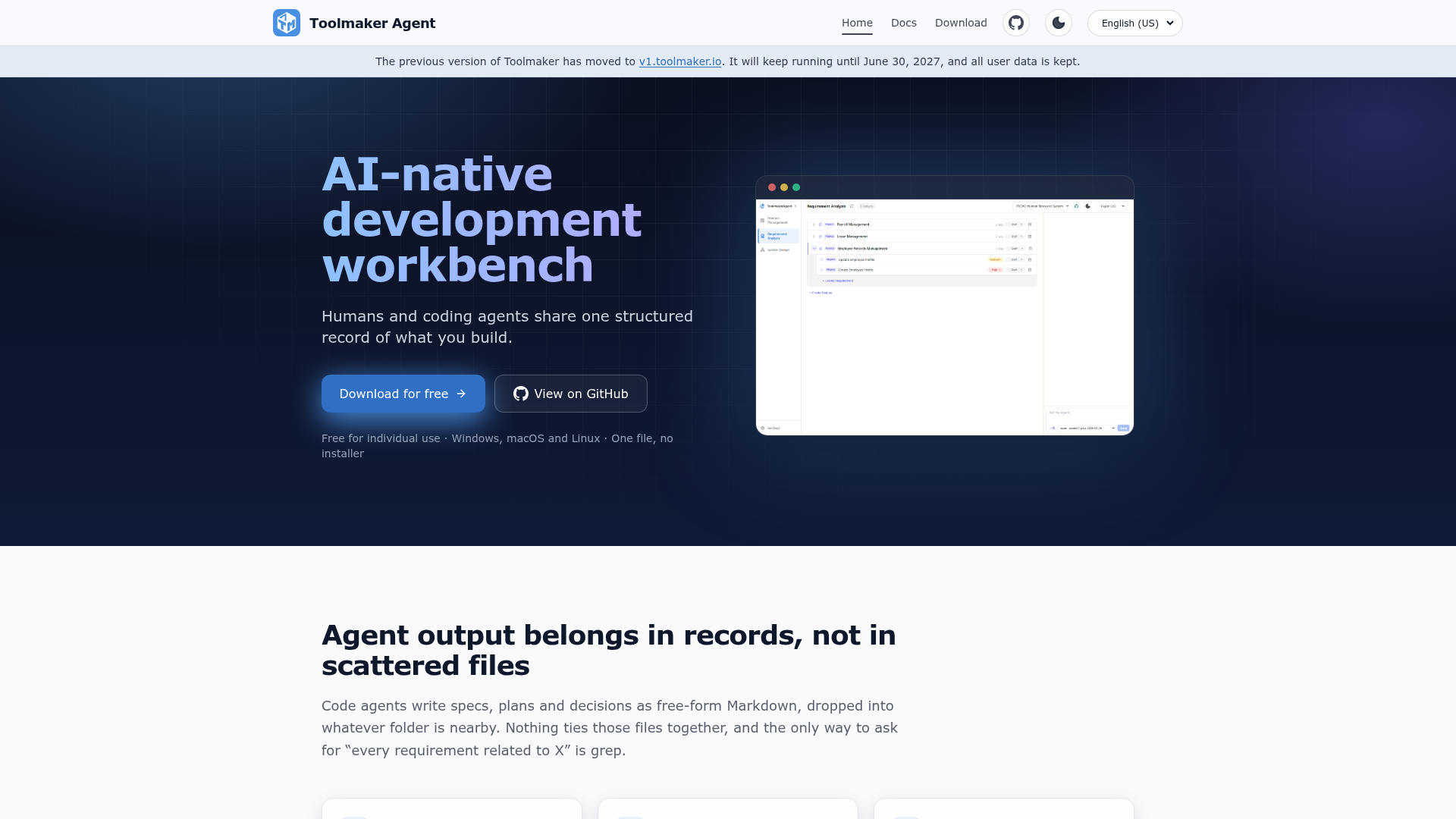
Local workbench that serves requirements, tests and UML to coding agents via MCP
ToolmakerAgent stores your spec as typed, versioned records and hands them to a coding agent through 48 MCP tools, ToolmakerAgent says, all from one executable on your own disk.
The verdict
Giving an agent a queryable spec with stable IDs beats pasting intent into a chat box, and ToolmakerAgent says the workbench is free for individual use, so trying it costs an afternoon. The catch is maturity: GitHub lists v0.1.2 as the newest release, and nobody outside the maker has published a hands-on report. Solo developers who already write acceptance tests before code should install it now; teams should wait for clearer multi-user terms.
- Good for
- Spec-first solo developers; Agent-heavy coders tired of stray Markdown specs; Privacy-bound projects that stay offline
- Skip it if
- Teams needing cloud sync; Buyers wanting a hosted SaaS
- Costs
- Free for individual use1
What it does
As ToolmakerAgent describes it.1
- Typed spec records
- A hierarchy from product down to requirement, each record carrying a stable OID, revisions and optimistic concurrency so edits never silently overwrite each other.
- Tests and defects beside requirements
- Test cases and defects live next to the requirement they belong to, keeping traceability inside the same database.
- MCP server for agents
- 48 tools over Streamable HTTP, built on the official Go SDK, let agents read and write the same records you do.
- System design in 4+1 views
- Seven Mermaid diagram types from use case to ER, exportable as PNG or SVG.
- Semantic search
- Finds records by meaning across every product from the search box, chat or MCP.
- Built-in chat agent
- Talks to hosted providers such as OpenAI or Anthropic, or to local models through Ollama or LM Studio.
- Plain manual forms
- A web UI where you click Create, type and save with no AI involved, on the same service layer the agents use.
Ways to put it to work
Spec-reading smoke test · for the developer evaluating agent tooling
Enter one feature with four requirements, connect your coding agent over MCP, and ask it to list those requirements by OID before it touches any code.
You get: Ten minutes tells you whether the agent actually pulls the spec or keeps guessing from the prompt.
Tests-first build loop · for the solo SaaS builder
Draft acceptance tests under each requirement, have the agent implement against them, and log every failure as a defect attached to the same requirement.
You get: A traceable trail from requirement to test to defect that survives after the chat session is gone.
Model placement rule · for the engineer handling confidential designs
Route the built-in chat to Ollama or LM Studio for any product whose documents must stay on the laptop, and allow a hosted model only for open projects.
You get: One clear policy for where design data may travel, enforced by which provider you configure.
What it costs
| Plan | Price | Includes |
|---|---|---|
| Free for individual useOur pick | $0 | Single self-contained executable, no installer, SQLite created on first launch, works offline |
Prices from toolmaker.io on 2 November 2026.1
Our take: Free for individual use hands over the full workbench at no cost, which is generous; the pages read showed no team tier, so budget for an open question there.
What people say
Too new for a street reaction: billionare.me notes the Show HN post drew 2 points and 0 comments, and no attributable user reviews exist yet.
Where it falls short
- Everything sits in local SQLite with no cloud storage or sync, so sharing with teammates means sharing the machine or the file.
- There is no graphical installer; you place and launch the executable manually on each machine.
- The vendor flags possible feature limits on the free tier without saying what they are.
- Pricing shown covers individual use only, and the pages read showed no terms for teams.
- No public reviews or bug reports exist yet to judge stability on real projects.
Your first hour
- Download the build for your OS and CPU from toolmaker.io/en/download.
- Run the file; it creates its SQLite database on first launch and serves the web UI.
- Create a product, add features and requirements, then attach test cases.
- Point your coding agent at the MCP server over Streamable HTTP and ask it to read the spec.
If it isn't the fit
Questions
- Does any of my design data leave my computer?
- Storage is a local SQLite file inside the app. If you connect the chat agent to Ollama or LM Studio, ToolmakerAgent says no data leaves your machine; a hosted provider will receive whatever you send it.
- Which processors and operating systems are supported?
- ToolmakerAgent offers six builds covering Windows, macOS and Linux, each in x64 and ARM64 versions.
- What happens to my data from the old Toolmaker?
- The previous version moved to v1.toolmaker.io and keeps running until June 30, 2027, with all user data kept, according to the homepage.
- Can I read the source before trusting it with my specs?
- Yes. The project is published on GitHub under phcp-tech/toolmaker-agent, so you can inspect the Go code before running the binary.
The call
Worth a local install for any spec-first developer running coding agents, since the downside is one deleted file. Hold off on standardizing a team around it until the project shows more releases and real users.
How we scored it
Four scores out of 10, weighted and added. The weights are the same for every tool.
Capability6.5 × 35% = 2.28
Typed requirement records, test and defect tracking, Mermaid UML views, semantic search and an MCP server cover a wide slice of the SDLC, though each piece is young and unproven at scale. What it does
Ease of use7.5 × 20% = 1.50
A single binary with SQLite created on first launch means no database or deploy work, but you still run it by hand and wire the MCP endpoint into your agent yourself. Your first hour
Value8.5 × 25% = 2.13
The whole workbench costs $0 for individual use, so the only spend is model tokens if you pick a hosted provider. What it costs
Momentum5.5 × 20% = 1.10
GitHub showed 92 stars on 2026-11-02, with 2 releases in the last 90 days and v0.1.2 shipped on 2026-10-28, which is steady shipping on a very small base.4
Read by Koda: phcp-tech/toolmaker-agent on GitHub, read 2026-11-02: 92 stars; 2 releases in the last 90 days; last release v0.1.2 on 2026-10-28. github.com
Koda score7.0
The parts add to 7.00, rounded half up to one decimal.
Sources
- 1ToolmakerAgent · toolmaker.io, read 2 November 2026: prices, capabilitiesReported
- 2UML-MCP · github.com, read 2 November 2026: what it isReported
- 3SoftJL · repocloud.io, read 2 November 2026: what it isReported
- 4github.com · read 2 November 2026: momentum evidenceReported
Also read, not quoted: kpvi.wo.com, cankao.nul-een.com, billionare.me, rukou.cn, showhn.buzzing.cc (2).
How this review was made
We read 4 pages of toolmaker.io, ran 3 searches and read 6 community posts. Prices were captured on 2 November 2026. Prices and product claims are reported as their source published them. The four scores are the Koda Lab's judgement; per-user prices and the total are our math.
How we scoreCorrectionsLAB REPORT 268