The Lab · Coding
AgentMon
Open-source monitor that shows what your AI coding agents do and what they spend
Codenotary's sample feed shows an agent firing 17 identical failing database calls in one minute; AgentMon Live is the open-source plugin built to catch that before your reviewer does.
The verdict
AgentMon Live hooks into Claude Code as a plugin and turns agent sessions into a feed of flagged events, each with a cost attached. That cost angle is the bet: Langfuse and Phoenix trace LLM apps broadly, while AgentMon aims squarely at coding agents burning money on loops and oversized models. Worth a one-machine trial for teams with a growing Claude Code bill, though no independent user has yet reported whether the alerts hold up in daily work.
- Good for
- Teams running Claude Code agents; Engineering leads watching agent spend
- Skip it if
- Teams building LLM apps beyond coding agents; Buyers who need peer-reviewed tooling now
- Costs
- Free open-source core; fleet tier $15/device/mo1
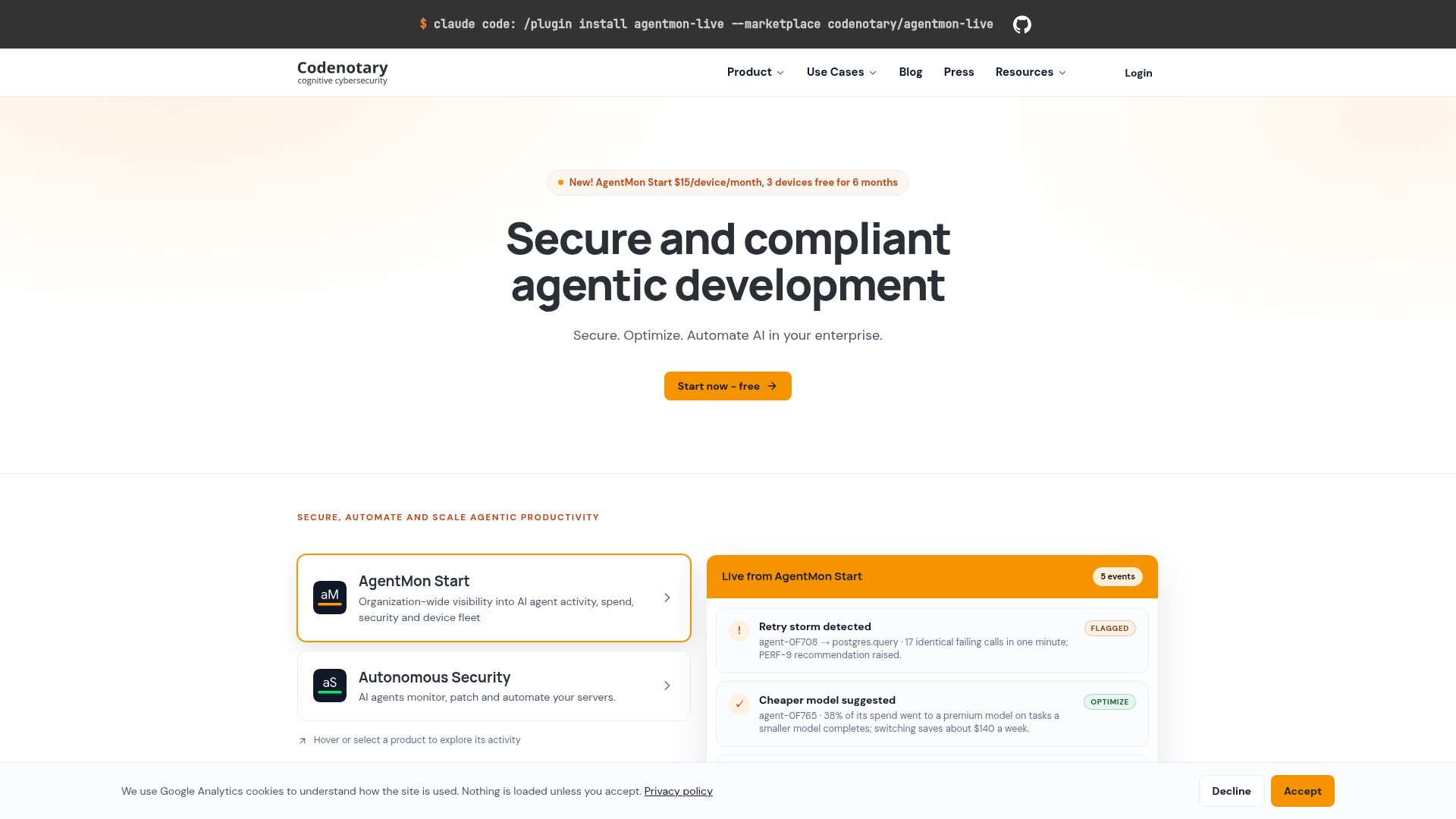
What it does
As AgentMon describes it.1
- Retry storm flags
- Flags an agent repeating the same failing call, such as a burst of identical database queries, and raises a performance recommendation.
- Model right-sizing
- Points out spend going to a premium model on tasks a smaller model completes and estimates the weekly saving from switching.
- Burn-rate alerts
- Notifies the team owner when agent spend jumps well above its recent hourly average.
- Prompt cache audit
- Tracks cache hit rate across sessions and links drops to a system prompt that keeps being edited.
- Cost per merged task
- Records whether an agent's change passed CI and review with no human edits and what each success cost.
- Fleet view
- AgentMon Start rolls agent activity and spend from every enrolled device into one organization view.
Ways to put it to work
Pre-review triage · for the platform engineer
Install the plugin on one developer machine for a week and scan the feed for retry storms before each code review. A session that hammered the same failing call earns its diff a closer read.
You get: Misbehaving agent sessions get caught before they eat reviewer time.
Model downgrade rule · for the engineering manager
Adopt a rule: when AgentMon flags a task class where premium-model spend went to work a smaller model handles, switch only that class and watch its cost per merged task for two weeks before switching more.
You get: Model spend gets trimmed on evidence from your own sessions.
What it costs
| Plan | Price | Includes |
|---|---|---|
| AgentMon Live | $0/mo | Open-source plugin, installed from the codenotary/agentmon-live GitHub marketplace |
| AgentMon StartOur pick | $15/device/mo | 3 devices free for 6 months; organization-wide visibility into AI agent activity |
Prices from codenotary.com on 15 November 2026.1
Our take: AgentMon Start is a fair price for a pilot because the free devices cover a small team's trial, but a large engineering org should model the per-device bill before rolling it out.
What people say
No public user reactions to AgentMon have surfaced; the Hacker News and Reddit r/fosswire posts announcing the open-source release carried no visible user commentary.
Where it falls short
- Install instructions on the homepage cover only Claude Code; support for other coding agents is described only as various AI frameworks.
- Codenotary's pricing page lists its compliance and security products and leaves AgentMon off, so plan details beyond the homepage banner are thin.
- Per-device billing grows linearly with the number of developer machines you enroll.
- The customer logos on the homepage belong to Codenotary as a whole, and none is tied to AgentMon specifically.
Your first hour
- In Claude Code, run /plugin install agentmon-live --marketplace codenotary/agentmon-live.
- Run an ordinary agent session so the plugin can record its tool calls and costs.
- For organization-wide visibility, sign up for AgentMon Start at apps.codenotary.com/agentmon-install.
- Enroll each developer device and review agent events in the shared view.
If it isn't the fit
Langfuse2 · Open-source, self-hostable LLM observability with tracing, prompts and evaluations
Pick it when you trace full LLM applications and want mature tooling you can host yourself.
Arize Phoenix3 · Open-source tracing and evaluation built on OpenTelemetry and OpenInference
Pick it when you want standards-based telemetry and formal evaluation runs across agent steps.
Questions
- Is the open-source version the same product as AgentMon Start?
- AgentMon Live is the open-source plugin published at github.com/codenotary/agentmon-live. AgentMon Start is the paid organization tier, which Codenotary says adds a shared view across enrolled devices.
- Are the dollar savings shown in the homepage feed real results?
- Codenotary labels that feed as illustrative, anonymized events, so figures such as a $140 weekly saving from a cheaper model are examples. Your own numbers depend on how your agents use models and prompts.
The call
Run the free plugin against a week of your own agent sessions, and buy fleet seats only if its alerts surface waste you can actually cut.
How we scored it
Four scores out of 10, weighted and added. The weights are the same for every tool.
Capability6.5 × 35% = 2.28
Its alert types target the costly failure modes of coding agents, a narrower scope than the tracing and evaluation depth of Langfuse or Phoenix. What it does
Ease of use7.5 × 20% = 1.50
One /plugin install command inside Claude Code is the whole documented setup for the open-source version. Your first hour
Value7.0 × 25% = 1.75
The core costs nothing and the fleet tier opens with a free window on a few devices, though per-device billing climbs with headcount. What it costs
Momentum4.5 × 20% = 0.90
The open-source release was posted to Hacker News and Reddit with no user discussion surfacing, and no dated star count or release record is on hand.4
Koda score6.4
The parts add to 6.43, rounded half up to one decimal.
Sources
- 1AgentMon · codenotary.com, read 15 November 2026: prices, capabilitiesReported
- 2Langfuse · digitalocean.com, read 15 November 2026: what it isReported
- 3Arize Phoenix · arize.com, read 15 November 2026: what it isReported
- 4news.ycombinator.com · read 15 November 2026: momentum evidenceReported
Also read, not quoted: linkedin.com, peerspot.com.
How this review was made
We read 2 pages of codenotary.com, ran 3 searches and read 6 community posts. Prices were captured on 15 November 2026. Prices and product claims are reported as their source published them. The four scores are the Koda Lab's judgement; the total is our math.
How we scoreCorrectionsLAB REPORT 281