The Lab · Coding
TF Code
ToothFairyAI's terminal coding agent with MCP, SDK access and workspace sign-in
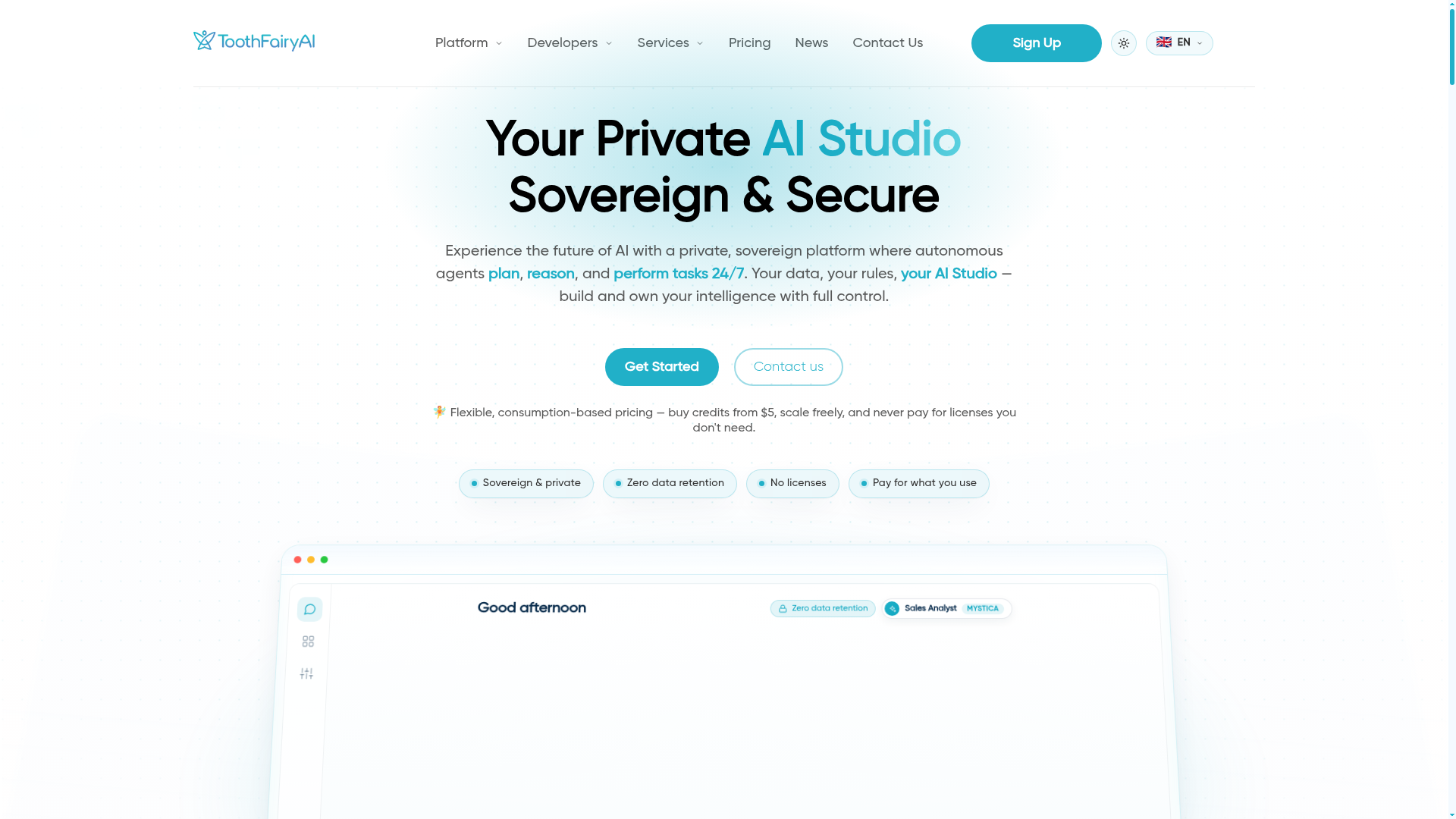
TF Code puts a coding agent in your terminal that signs in as your ToothFairyAI workspace, so every run carries the team's agents and MCP tools with it.
The verdict
TF Code's real bet is identity: each agent run authenticates against a ToothFairyAI workspace, which keeps shared automations tied to a known team context once several people trigger them. Engineering groups already running on ToothFairyAI get a coding agent their internal tools can call through an SDK or REST API, though with zero independent reviews on record, adoption starts with your own trial on a bounded task. Teams outside that platform have little reason to move off Claude Code or Aider yet.
- Good for
- Teams already on ToothFairyAI; Platform engineers building internal dev tools
- Skip it if
- Developers with no ToothFairyAI workspace; Buyers who need proven user track records
- Costs
- Pay-as-you-go credits from $5; Enterprise is custom1
What it does
As TF Code describes it.1
- Authenticated CLI
- Runs the coding agent from the terminal under your workspace login, so each run maps to a known team.
- MCP tool access
- Lets the agent call tools exposed through Model Context Protocol servers connected to the workspace.
- SDKs and REST API
- Exposes the agent programmatically so internal scripts and developer tools can start runs.
- Workspace knowledge
- Draws on the workspace's existing agents and its Knowledge Hub, which the Serverless plan sizes at 5,000 documents.
- Scheduling and triggers
- Platform job scheduling can fire agents on a timetable or an event without anyone at a keyboard.
- Versioning and rollback
- Entity versioning lets you revert an agent configuration that started behaving badly.
Ways to put it to work
The one-module trial · for the engineering lead evaluating TF Code
Point the CLI at a single module, ask for unit tests, then run the suite and count how many pass without edits before granting the agent any more of the repo.
You get: A cheap, concrete read on output quality before anyone builds on it.
Agent behind an internal tool · for the platform engineer
Call the agent from an existing internal developer tool through the SDK or REST API, so a script kicks off runs on demand.
You get: Coding automation lives inside tools the team already opens daily.
Shared-automation rule · for the team lead with several people on the same automations
Adopt a rule that any agent automation two or more people trigger must go through workspace-authenticated CLI or API calls.
You get: Every run traces back to one team context, which keeps shared automations accountable.
What it costs
| Plan | Price | Includes |
|---|---|---|
| ServerlessOur pick | From $5in credits | Billed by UoI credits bought upfront that never expire; unlimited users, no per-license fees; TF Code appears among the plan's listed modules |
| Enterprise | Custom | Everything in Serverless plus a custom UoI budget, dedicated or on-premise hosting and bring your own model |
Prices from toothfairyai.com on 17 November 2026.1
Our take: Serverless is a fair entry point because credits carry over and seats cost nothing, but meter a few coding runs before committing, since UoI consumption per task is not shown.
What people say
Third-party reaction to TF Code is essentially absent; the only public commentary found is a promotional LinkedIn post, so no community verdict exists yet.
Promotes TF Code as running from a single command and plugging into the workspace, where it can reach its agents, knowledge base and MCP tools.
Where it falls short
- No public user reports on TF Code's reliability or code quality exist, so its output is unproven outside vendor material.
- UoI credits carry no published per-task rate, which makes spend on a busy coding agent hard to forecast.
- Single sign-on, role-based access and on-premise hosting sit behind custom Enterprise pricing.
- The homepage pitches no-code business agents, and TF Code gets little dedicated detail on the main site or pricing page.
Your first hour
- Create an account at app.toothfairyai.com.
- Buy a starting block of credits on the Serverless plan.
- Authenticate the TF Code CLI against your workspace.
- Run a contained task in the terminal, such as generating tests for one module.
If it isn't the fit
Claude Code3 · Anthropic's terminal coding agent with MCP support, tied to Claude models.
Pick it when you want the most widely used terminal agent and have no ToothFairyAI workspace to connect.
Questions
- How are TF Code runs billed?
- Runs draw on the same Units of Intelligence credits as the rest of ToothFairyAI. The pages read show no per-run cost for coding work, so watch the analytics dashboard during a trial to see what a typical task consumes.
- Where is my code and data processed?
- ToothFairyAI's pricing page lists regional data residency in AU, EU and US regions along with zero data retention on the Serverless plan. Teams needing dedicated hosting must move to Enterprise.
- Which models does it run on, and can I bring my own?
- Serverless includes ToothFairyAI's Sorcerer and Mystica models plus leading open-source options. Bring your own model is listed only on the Enterprise plan.
- How does it compare with Claude Code?
- Both are terminal agents that speak MCP. ToothFairyAI publishes its own comparison page, and its pitch rests on workspace integration with existing agents and knowledge, while Claude Code is bound to Anthropic's models and ecosystem.
The call
Worth a small credit top-up and an afternoon if your company already lives in ToothFairyAI. Everyone else should wait for real user reports before moving a workflow onto it.
How we scored it
Four scores out of 10, weighted and added. The weights are the same for every tool.
Capability6.0 × 35% = 2.10
The listed surface covers a terminal agent, MCP tool calls and programmatic access bound to workspace knowledge, but none of it has been independently exercised in public. What it does
Ease of use6.0 × 20% = 1.20
A terminal start on one small task and a low credit floor make a first run cheap to attempt, though no setup duration is published. Your first hour
Value6.0 × 25% = 1.50
Credits that carry over and free seats are fair terms, yet with no per-task rate shown, the cost of a coding run is a guess until you meter one. What it costs
Momentum4.0 × 20% = 0.80
ToothFairyAI's news page announces TF Code, but no dated traction figure such as a release count, star total or raise is on record, and third-party discussion is close to nil.6
Koda score5.6
The parts add to 5.60, rounded half up to one decimal.
Sources
- 1TF Code · toothfairyai.com, read 17 November 2026: prices, capabilitiesReported
- 2linkedin.com · read 17 November 2026: the reviewer paraphrased under What people sayReported
- 3Claude Code · anthropic.com, read 17 November 2026: what it isReported
- 4Cursor · cursor.com, read 17 November 2026: what it isReported
- 5Aider · aider.chat, read 17 November 2026: what it isReported
- 6toothfairyai.com · read 17 November 2026: momentum evidenceReported
How this review was made
We read 2 pages of toothfairyai.com, ran 3 searches and read 1 community post. Prices were captured on 17 November 2026. Prices and product claims are reported as their source published them. The four scores are the Koda Lab's judgement; the total is our math.
How we scoreCorrectionsLAB REPORT 283