The Lab · Coding
Plannotator
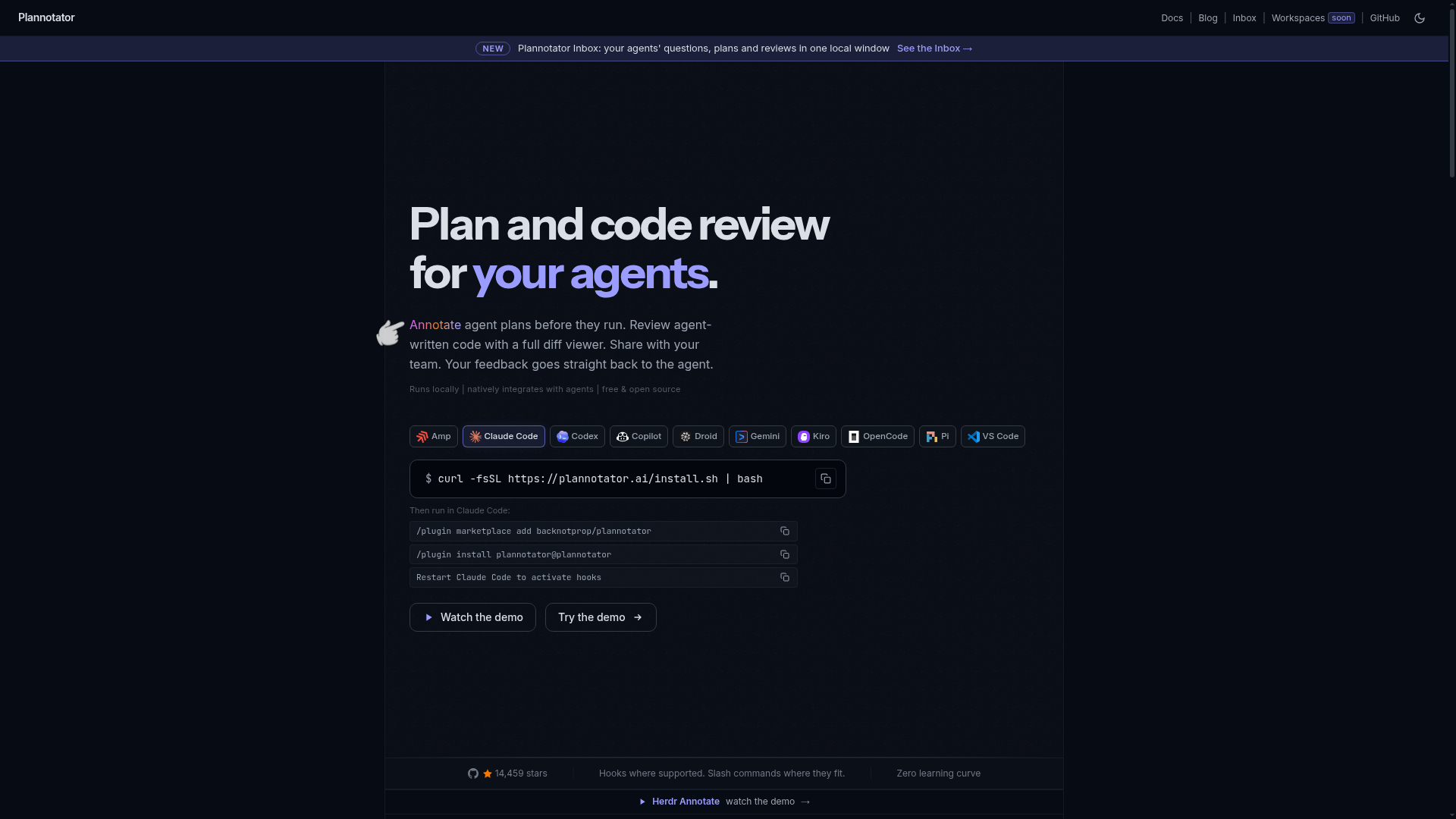
Local, open-source review surface for coding agent plans and diffs
Most agent mistakes are already sitting in the plan, and Plannotator lets you strike them out before a single file changes.
The verdict
Plannotator inserts a review gate between an agent's plan and its first edit, then hands your deletions and comments back to the agent as feedback it can act on. The GitHub repo shows v0.29.2 released on 2026-11-22, so adopting it means wiring hooks into your agent and living with a fast-moving pre-1.0 tool. Engineers who keep cleaning up after Claude Code or Pi should put it in front of their next feature.
- Good for
- Claude Code teams; Pi users iterating on plans
- Skip it if
- Orgs wanting a hosted policy platform; Users of unsupported agents
- Costs
- Free and open source1
What it does
As Plannotator describes it.1
- Plan annotation
- Select text in a plan to delete it, comment on it, or replace it, and the marks export as structured feedback the agent reads.
- Agent code review
- /plannotator-review opens a PR-style diff of uncommitted agent changes, with line-level annotations that can carry code suggestions.
- Plan version history
- Every plan revision is saved, and a diff view shows what changed between iterations.
- Draft auto-save
- Annotations survive server crashes and restarts mid-review.
- Annotate any spec
- Point /plannotator-annotate at any markdown spec or URL, or use /plannotator-last on the agent's latest message.
- HTML and live site review
- Comment on rendered HTML files or an app running on your machine, opened live through a local proxy.
- Inbox
- Gathers everything your agents are waiting on you for into one local window.
Ways to put it to work
Scope-creep test · for the claude Code user evaluating the tool
Pick a feature you have shipped before, have the agent plan it, and mark every step you would cut with a deletion annotation; then count how many cuts survive into the revised plan.
You get: A fast read on whether the agent actually honors structured feedback in your codebase.
Pre-commit gate · for the engineer pairing with an agent daily
Make /plannotator-review the last step before any commit of agent-written code, staging only the files that cleared line-level review.
You get: Agent changes reach history with the same scrutiny a teammate's PR would get.
Second-reviewer rule · for the tech lead
Adopt a simple rule: any plan touching auth or data migrations gets shared with a teammate by link before approval, and everything else is approved solo.
You get: Risky plans get two sets of eyes without slowing routine work.
What it costs
| Plan | Price | Includes |
|---|---|---|
| Free & Open SourceOur pick | $0/mo | Runs locally; full plan and code review included |
Prices from plannotator.ai on 23 November 2026.1
Our take: Fair by any measure: the Free & Open Source tier is the only one, and the site lists no premium features held back for a paid plan.
What people say
Independent reaction is sparse, with one directory showing no reviews yet, but the few firsthand voices are positive about using it inside the planning loop.
A user says they run it with Pi to iterate on planning steps and for reviews, and calls it the closest fit among related tools.
Calls Plannotator a really cool piece of software and wishes for something like it to give precise feedback on generated media such as images.
Where it falls short
- Works only with the agents it ships integrations for; anything outside that list gets no plan interception.
- Agents without hook support fall back to slash commands, so automatic plan review is uneven across tools.
- No hosted policy or governance layer for teams that need centralized enforcement.
- Pre-1.0 versioning and near-daily releases mean behavior can shift between updates.
- Install pipes a remote script into bash, which security-conscious teams will want to read first.
Your first hour
- Run curl -fsSL https://plannotator.ai/install.sh | bash in a terminal.
- In Claude Code, run /plugin marketplace add backnotprop/plannotator.
- Run /plugin install plannotator@plannotator.
- Restart Claude Code to activate hooks, then ask the agent for a plan to trigger the review window.
If it isn't the fit
Hunk4 · Terminal-focused diff review with an agent-aware workflow.
Pick it when you live in the terminal and have no use for browser-based plan annotation.
Open Code Review4 · Open-source code-review workflow for agent changes.
Pick it when diff review is all you need and plan or document annotation adds nothing.
Questions
- Which coding agents does Plannotator support?
- The homepage shows Amp, Claude Code, Codex, Copilot, Droid, Gemini, Kiro, OpenCode and Pi, plus a VS Code integration. Plan review hooks in automatically where an agent allows it.
- Does sharing a review send my code anywhere?
- Sharing is something you trigger yourself. Small shares travel inside URL fragments, while larger and HTML shares go through encrypted short links.
- Can it review changes outside my current agent session?
- Yes. The homepage says /plannotator-review accepts GitHub or GitLab PR URLs as well as local diffs, and LibHunt notes it also handles jj and p4 changes.
The call
Free and local, it is a cheap experiment to run; the bet is whether your agent follows structured feedback closely enough to make plan review a daily habit.
How we scored it
Four scores out of 10, weighted and added. The weights are the same for every tool.
Capability7.6 × 35% = 2.66
Plan annotation, a PR-style diff viewer and HTML commenting share one review surface across most major coding agents, though it offers no policy or governance layer. What it does
Ease of use7.3 × 20% = 1.46
Getting started takes one install script, two plugin commands and a restart with no account to create, though hook depth differs from agent to agent. Your first hour
Value9.0 × 25% = 2.25
The whole tool ships under a single $0 open-source tier, so the only spend is your own review time. What it costs
Momentum8.3 × 20% = 1.66
GitHub shows 14,459 stars and at least 85 releases in the last 90 days, read 2026-11-23, while independent user discussion stays thin.5
Read by Koda: backnotprop/plannotator on GitHub, read 2026-11-23: 14,459 stars; at least 85 releases in the last 90 days; last release v0.29.2 on 2026-11-22. github.com
Koda score8.0
The parts add to 8.03, rounded half up to one decimal.
Sources
- 1Plannotator · plannotator.ai, read 23 November 2026: prices, capabilitiesReported
- 2libhunt.com · read 23 November 2026: the reviewer paraphrased under What people sayReported
- 3x.com · read 23 November 2026: the reviewer paraphrased under What people sayReported
- 4Hunk · vibecodinghub.org, read 23 November 2026: what it isReported
- 5github.com · read 23 November 2026: momentum evidenceReported
Also read, not quoted: chatgate.ai, m.youtube.com, skillsllm.com, Hacker News, Reddit r/PiCodingAgent, Reddit r/opencodeCLI.
How this review was made
We read 4 pages of plannotator.ai, ran 3 searches and read 10 community posts. Prices were captured on 23 November 2026. Prices and product claims are reported as their source published them. The four scores are the Koda Lab's judgement; the total is our math.
How we scoreCorrectionsLAB REPORT 289